Ethereum vs Solana: Settlement Layer or Transaction Factory? Does AI Shift the Balance
Summary
Executive framing: two economic metaphors
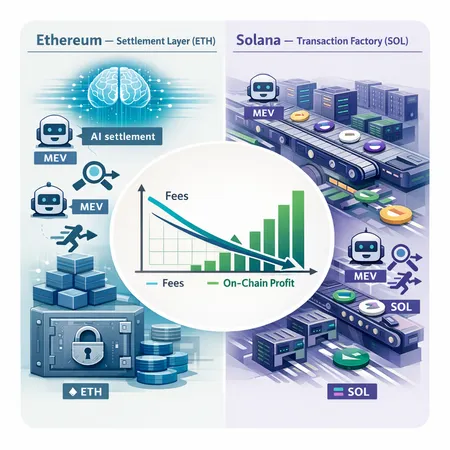
For most of the last three years the industry adopted two shorthand metaphors. Ethereum is the settlement layer — the place where economic value is finalized and long-lived positions are recorded. Solana is the transaction factory — optimized to push high-throughput, low-latency transactions at minimal cost. Those narratives shape developer decisions, investor narratives, and how value accrues to ETH and SOL.
Narratives are powerful because they explain where fees and protocol rents are expected to pool. A settlement layer captures relatively high fees per operation and a share of persistent economic activity; a transaction factory competes on cost and volume. But narratives evolve. New on-chain data around fees and whale profits, and strategic pivots like Ethereum’s AI settlement push, are narrowing and reframing the competitive landscape.
Where the fee gap narrowed: data and context
Historically, Ethereum’s average per-transaction fees — particularly during high demand for DeFi and NFT minting — far exceeded Solana’s. That dynamic underpinned the settlement-layer story: higher absolute fees, greater captured economic rents, and richer MEV opportunities. Yet recent comparative analyses show the picture is more nuanced. A recent insight piece that directly compared fee economics of ETH and SOL highlights how fee structures and throughput trade-offs create different effective costs across use cases (not just per-transaction metrics) comparing fee regimes.
On-chain behaviour also matters. For example, recent on-chain reporting shows large Ethereum holders (whales) returning to profit after prior drawdowns, which often precedes renewed risk-taking and fee-generating activity on-chain. That return to profitability has implications for activity that generates fees and MEV on Ethereum reports on whales returning to profit.
Put simply: absolute fee levels may still favour Solana for cheap volume and Ethereum for high-value settlement, but the gap in effective economic capture is not as wide as simple TPS or median-fee comparisons suggest. Developers and architects should compare end-to-end costs for their specific workload (confirmation risk, reorg risk, finality time) rather than raw fee figures alone.
Ethereum’s AI settlement initiative: what it proposes and why it matters
Ethereum has signalled ambitions to become a settlement layer not only for financial activity but for AI-native economic flows: model outputs, data access, reputation records, and exchanges of compute credits. The network-level argument is familiar — Ethereum’s security and composability make it a natural ledger for higher-assurance settlement — but the scale and characteristics of AI workloads introduce fresh constraints and opportunities.
Reports on this effort describe protocols and tooling that would let AI agents and marketplaces use Ethereum primitives for attestation, micropayments, and dispute resolution around model outputs and dataset provenance Ethereum settling AI activity. The proposal is not that raw model inference runs on L1 — that would be infeasible — but that the economic settlement around those interactions (who paid whom, which output was delivered, who stakes on quality) happens on-chain.
Why does this matter? If AI workloads generate recurring micropayments, high-frequency attestations, and periodic settlement events, they represent a new and potentially sticky demand for settlement — exactly the kind of activity that can sustain higher fee capture, long-lived value accrual, and MEV extraction opportunities for a secure layer like Ethereum.
Fees, MEV, and the mechanics of AI settlement
There are two axes to consider: transaction frequency (volume) and economic density (fees per logical event). AI systems can produce high-frequency micropayments (e.g., per inference) and high-value settlements (e.g., licensing, dispute resolution). Each behaves differently for fees and MEV.
If AI demand translates mostly into micropayments, its compatibility with batch-aggregation and L2 settlement matters. L2s and rollups could absorb per-inference noise while settling aggregated receipts onto Ethereum, preserving economic capture without overwhelming L1. That architecture limits direct per-inference fee accrual on L1 but increases the value of being the canonical finalizer of aggregated state.
If AI workloads require frequent attestation and arbitration (for model correctness, provenance, or reputation), those high-trust settlement events will be valuable on L1 and can support higher per-event fees. Those events also create MEV-like windows: validators or sequencers could reorder attestations, front-run model access, or extract value from arbitration ordering.
Ethereum’s push to be the settlement layer implies an evolution of MEV dynamics: more diversified sources of extractable value (beyond token trades and liquidation events) could arise, including oracle ordering, access-rights sequencing, and dispute resolution timing. That suggests sophisticated MEV capture and mitigation strategies will become even more important.
So does AI shift the balance towards Ethereum?
Short answer: potentially, but not automatically. The outcome depends on three variables:
- The shape of AI demand. Is it dominated by tiny, high-frequency micropayments or by episodic, high-trust settlements? The former benefits high-throughput cheap chains like Solana (or specialized L2s); the latter benefits secure finalizers like Ethereum.
- The layered architecture chosen by builders. If AI marketplaces use optimistic or zk-rollups to aggregate micro-interactions and then use Ethereum for settlement, Ethereum captures the value of finality without bearing the per-transaction latency/cost. That’s a win for Ethereum’s settlement narrative without forcing every inference on L1.
- The infrastructure and tooling around MEV and fee markets. As AI introduces new value flows, the team that masters fair sequencing, MEV capture, and privacy-preserving settlement (e.g., via cryptographic commitments) will extract more economic rent.
Solana doesn’t vanish from the equation. For workloads where latency, throughput, and low per-op cost dominate (real-time inference pipelines, high-frequency NFT mints tied to AI output, memecoin-style demand spikes), Solana remains compelling. For settlement-critical, composable, multi-party AI commerce where legal/regulatory auditability and composability matter, Ethereum’s security and broad developer ecosystem remain hard to beat. For many projects the answer will be hybrid: inference and high-throughput messaging on Solana or L2s, settlements and disputes on Ethereum.
Developer and investor implications: practical questions to weigh
Developers and architects should evaluate platform choice with a checklist tuned to both technical and economic factors:
- Workload profile: transaction size, frequency, confirmation requirements, and tolerance for reorgs.
- Composability needs: will you integrate with oracles, lending, identity, or AMMs? Ethereum’s deep DeFi stack and developer tools often win here; see how DeFi integrations materially reduce integration cost.
- Finality and auditability: does your product need globally canonical history for disputes or compliance? That favours Ethereum’s settlement properties.
- Fee sensitivity vs revenue model: can you monetize value capture (e.g., licensing fees) to offset higher settlement fees? If so, paying for settlement on Ethereum may be sustainable.
- MEV exposure and mitigation: consider sequencer design, MEV-aware fee markets, or private transaction relays.
For token investors the calculus is about durable value capture: ETH benefits from being the ledger of finality and settlement across many L2 ecosystems; SOL benefits if application-level volume and native revenue models remain concentrated on Solana. The recent fee and on-chain profit datapoints suggest both networks can expand economic capture in different niches, and diversification across infrastructure tokens can be rational depending on risk appetite.
Practical architectures: hybrid approaches that make sense now
A pragmatic architecture for many AI-native projects will be hybrid: run inference and rapid state updates off-chain or on a high-throughput chain, aggregate and cryptographically commit state to a rollup, and settle disputes or licensing on Ethereum. That model captures low latency while preserving finality and auditability on-chain. It also spreads fee capture across layers — an outcome that can sustain both ETH and SOL value propositions simultaneously.
Mentioning ecosystem tools matters in real decisions. Platforms like Bitlet.app are part of the broader tooling stack that helps teams think through payment rails and custody when designing monetization and settlement flows.
Conclusion — an evolving tug-of-war, not a winner-take-all
Ethereum’s bid to become an AI settlement layer changes the strategic map by potentially adding new, high-trust economic activity that benefits a secure finalizer. But Solana’s place as a transaction factory remains compelling for throughput-sensitive AI primitives. The real battlefield will be hybrid architectures, MEV mitigation, and whether developers can design economic flows that monetize settlement in durable ways.
For architects and token investors, the question is not purely ETH or SOL, but how to compose layers and pick primitives that optimize both application UX and long-term value capture. That means modeling fees end-to-end, stress-testing MEV scenarios, and thinking systemically about who pays and who captures value when AI and blockchain interact.