Why XRP Overtaking BNB Matters for the Payments Narrative
Summary
Executive snapshot
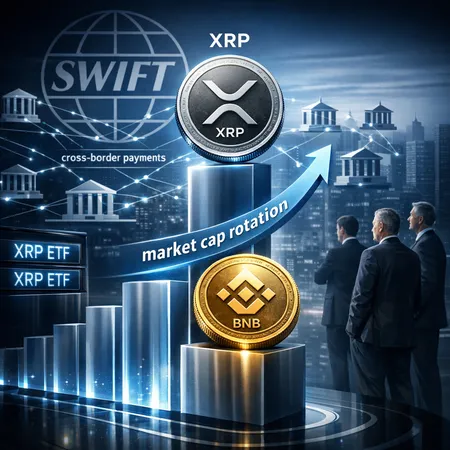
On March 24, 2026 XRP briefly overtook BNB to become the fourth-largest cryptocurrency by market capitalization — a milestone that has payments strategists and crypto-literate investors asking a simple question: is this a re-ranking of speculation, or a structural shift toward payments utility?
This article walks through the timing and mechanics of that market-cap rotation, why a SWIFT mention of Ripple-linked banks matters for enterprise rails, how XRP ETFs and large holders reshape liquidity, and the realistic implications for on‑ramps and cross‑border payments.
What happened: timing and mechanics of XRP overtaking BNB
The market-cap reshuffle on March 24, 2026 was driven by a combination of price appreciation in XRP, relative price weakness in BNB, and tokenomic differences between the two protocols. The market-cap move was reported contemporaneously by media outlets, highlighting the milestone as both symbolic and consequential for narrative formation (Invezz report).
Mechanically, market-cap = price × circulating supply. XRP’s smaller free-floating supply and renewed buying pressure from retail and institutions can lift its ranking faster than tokens with larger or differentially distributed supplies. BNB’s valuation dynamics are more tied to Binance ecosystem activity and token burns; an episode of muted exchange-related demand or sell-side pressure can create the window for another asset to leapfrog its ranking.
Why this matters beyond vanity metrics: a higher market-cap tends to change narrative framing, media coverage, and — crucially — institutional attention. When an asset moves up the ranks, it becomes more visible in index products, ETF creation conversations, and corporate treasury discussions that rely on standing lists of top assets.
SWIFT’s framework mention: institutional overlap that changes the conversation
A separate but related development: SWIFT’s new retail payments framework named banks that have known links to Ripple. Coverage of this came as part of broader reporting on the framework and its participants (Coinpaper coverage).
Why that matters:
- Institutional validation: SWIFT is the backbone of cross-border banking messaging. When its framework surfaces banks that are already engaged with Ripple-related products, it creates a point of overlap between traditional rails and distributed-rail experiments.
- Reduced black-or-white framing: Historically, the payments debate framed Ripple/XRP as either fringe crypto or outright replacement for correspondent banking. Seeing the same banks appear in a SWIFT framework suggests a future where rails interoperate or compete in complementary ways.
- Procurement and vendor choices: Large banks and corporates are conservative. If a SWIFT framework includes banks that use Ripple tech, procurement officers can more easily justify pilot programs and integration work because there’s a recognized peer set.
This is not the same as SWIFT endorsing XRP as a currency, but it does highlight institutional channels and counterparties that already operate in both worlds — which in turn supports greater real-world experimentation with on‑ramps and settlement corridors.
The role of XRP ETFs and big institutional holders
ETF wrappers transform investor behavior. An XRP ETF aggregates demand, simplifies custody and compliance requirements for institutions, and creates predictable on‑exchange flows. Recent reporting shows large institutional players owning sizable positions in XRP ETF products, a structural development worth unpacking (Fool report on big holder).
Why ETF flows matter for payments:
- Liquidity provision: ETFs can improve secondary-market liquidity by concentrating buy-side demand into a managed product, which deepens order books and reduces slippage for larger trades — helpful for corporates moving large sums.
- Price discovery and confidence: Institutional allocation to ETFs signals due diligence and lifts market confidence. For treasury teams comparing rails, an asset that shows stable institutional custody is easier to pilot.
- Supply effects: ETFs often operate by acquiring underlying assets or creating/destroying shares against baskets. That process can temporarily lock up circulating supply, creating tighter on‑chain liquidity for settlement use-cases.
But an ETF-centric demand model also introduces a new form of pass-through dependence: if ETF flows reverse sharply, on-chain liquidity can evaporate just as quickly. The presence of large holders, whether sovereign wealth or investment banks, changes narrative risk and concentration risk at the same time.
What this could mean for on‑ramps and enterprise payments
Taken together — market-cap rotation, SWIFT overlap, and ETF-led institutional demand — the signal for payments strategists is pragmatic: the plumbing for enterprise adoption is improving, but it is uneven.
Practical implications:
- Better fiat on‑ramps: Enhanced liquidity and institutional custody lower barriers for fiat-to-crypto conversions at scale. Payment providers and exchanges can offer tighter spreads and higher limits, which matter for corporate payors and remittance corridors.
- Settlement latency and FX management: XRP’s design for fast settlement remains an attractive attribute for cross-border rails where time-to-settle and FX exposure are the key costs. When combined with institutional liquidity from ETFs and bank partnerships, the total cost of payments could become competitive with traditional correspondent banking in targeted corridors.
- Pilots and corridors: Expect pilots to concentrate in corridors where bank partners already operate and where FX volatility is manageable. Commercial teams at fintechs and banks will prioritize predictable counterparty liquidity over speculative reach.
Platforms that manage on‑ramps and peer-to-peer exchange — including providers such as Bitlet.app — stand to benefit as institutional demand translates into product-level features like higher throughput, dedicated custody, and compliance tooling.
Risks and counterarguments: supply walls, regulatory exposure, and narrative gaps
A sober assessment requires listing clear risks:
Concentrated supply and “supply walls” — Large institutional holders and ETF treasuries can create strong support levels, but they can also represent concentrated sell pressure. If a few entities hold a meaningful share of circulating XRP, they can influence price and liquidity, which complicates using XRP as a neutral settlement unit.
Regulatory tail risk — XRP’s history in regulatory debates means any new enforcement action or adverse ruling could materially affect its suitability for enterprise payments. Enterprises favor predictability; a perception of regulatory uncertainty raises legal and compliance costs.
Market-cap optics vs. utility — Rank changes can be headline-grabbing but do not equal operational adoption. Real payments adoption requires integrations, service-level agreements, and counterparty risk management — all non-trivial and often slow.
Competing rails and token choices — Banks and corporates may prefer token-agnostic solutions that use dollar liquidity pools, tokenized settlements on permissioned ledgers, or even central bank digital currencies (CBDCs) instead of a single public token. The market-cap move helps narratives but does not eliminate competitive alternatives.
These counterpoints underscore that while the current momentum is meaningful, it is not determinative. Payments strategists should treat the shift as a signal to pilot thoughtfully, not as a mandate to fully convert rails.
How to evaluate next moves as a payments strategist or investor
If you are assessing whether XRP is transitioning from speculation toward payments utility, consider a layered approach:
- Track on‑chain and off‑chain liquidity: watch ETF creations/redemptions, major wallet flows, and how market depth behaves during large trades.
- Monitor counterparties named in institutional frameworks: SWIFT’s list and bank disclosures provide clues to where enterprise pilots are likely to appear.
- Stress-test settlement scenarios: simulate FX volatility, counterparty default, and compliance outages to see how XRP-based flows behave under operational strain.
- Keep portfolio and product flexibility: design integrations that can pivot between token rails and token-agnostic settlement options, reducing single-point dependency.
Also compare shifts in broader crypto market leadership — for many investors, macro context around Bitcoin dominance or a resurgence in DeFi activity will influence whether XRP’s moment is sustained or momentary.
Conclusion
XRP overtaking BNB is more than a ranking headline; it’s a convergence of price mechanics, institutional attention, and interoperability signals that matter for the payments narrative. SWIFT’s framework naming banks linked to Ripple and the visibility of large XRP ETF holders are practical developments that narrow certain adoption gaps.
Still, adoption is not automatic. Concentrated holdings, regulatory uncertainty, and competing rails temper the optimism. For payments strategists and crypto-literate investors, the proper response is neither blind enthusiasm nor reflexive dismissal — it’s disciplined piloting, active liquidity monitoring, and architecture that can evolve as the corridor economics prove out.
Sources
- Invezz — XRP overtakes BNB report: https://invezz.com/news/2026/03/24/xrp-overtakes-bnb-eyes-the-1-50-psychological-level/?utm_source=snapi
- Coinpaper — SWIFT names Ripple-linked banks in framework: https://coinpaper.com/15652/swift-names-ripple-linked-banks-in-new-payment-framework-xrp-army-takes-notice?utm_source=snapi
- The Motley Fool — Coverage on large institutional XRP ETF holder: https://www.fool.com/investing/2026/03/24/this-power-player-owns-154-million-in-xrp-etfs-sho/