XRP Momentum: Staking Surge, DeFi Integration, and the Payments Pivot
Summary
Executive snapshot
XRP is no longer just a court-case or memetic price story. Over the past few months we've seen three distinct currents collide: on-chain capital locking through staking on Flare (led in scale by Firelight), a pickup in derivatives activity and open interest, and a narrative push from Ripple's leadership toward stablecoins and payments as institutional hooks. Add a high-profile philanthropic use of XRP and suddenly the asset is being discussed in product, risk and PR terms — not just price charts.
This piece unpacks each vector and then synthesizes what it means for holders and payments/DeFi strategists trying to balance adoption upside against clear market risks.
Staking on Flare: Firelight, 50M XRP, and protocol economics
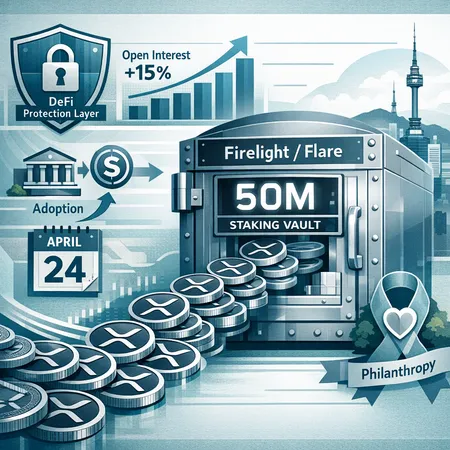
The headline is simple but consequential: Firelight has pushed more than 50 million XRP into staking on Flare, a milestone that signals both demand for yield and a meaningful on-chain lock-up of supply. Reporters covering the milestone note that Firelight's stake is not just a retail phenomenon but a large-scale institutional-style allocation to secure protocol rewards and participate in Flare's emerging ecosystem (Firelight pushes XRP into DeFi cover).
Why this matters:
- Circulating liquidity tightens. A 50M-XRP stake held for months reduces tradable float and can amplify price moves when matched with fresh demand. From an economics standpoint, the effective supply available for spot markets falls while holders earn yield — a classical supply-side bullish signal if demand persists.
- Incentive alignment for Flare apps. Large stakes support Flare's security and enable users to access services that rely on staked collateral, including the emerging DeFi protection layer models promising insurance-like coverage for cross-chain exposure.
- Concentration risks. Big single-party stakes can centralize voting and reward capture; if Firelight or similar actors re-stake or unstake large positions rapidly, it can trigger liquidity shocks.
For DeFi strategists this change is meaningful: staked capital on Flare can be repurposed into layered products that sit at the intersection of payments and decentralized finance. If you're tracking cross-chain flows, remember that staking isn't neutral — it's capital intentionally taken off the market to earn protocol yield or to underwrite services.
Derivatives revival: open interest, April seasonality, and leverage dynamics
Market structure has shifted alongside on-chain developments. Open interest in XRP derivatives rose roughly 15% heading into April, pointing to renewed speculative and hedging demand that often precedes higher volatility (XRP open interest jumps 15%). Traders cite seasonality and macro liquidity windows; April historically sees heavier positioning around portfolio reallocations and product launches.
That matters for two reasons:
- Leverage can amplify on-chain effects. When derivatives players are long and price runs, forced liquidations can pull more XRP into spot markets at unfavorable prices — or conversely, short squeezes can magnify rallies.
- Professional flow interacts with staking. Institutional desks may prefer hedging via derivatives rather than touching staked XRP, creating a bifurcation: staked supply stays locked while notional exposure trades freely, which can exaggerate price moves relative to the free float.
For strategists, the upshot is that higher open interest combined with a tightened circulating supply is a recipe for outsized intraday and multi-day moves. That can be good for active traders and risky for long-term holders who underestimate tail volatility.
The payments and stablecoin narrative: Ripple’s enterprise pitch
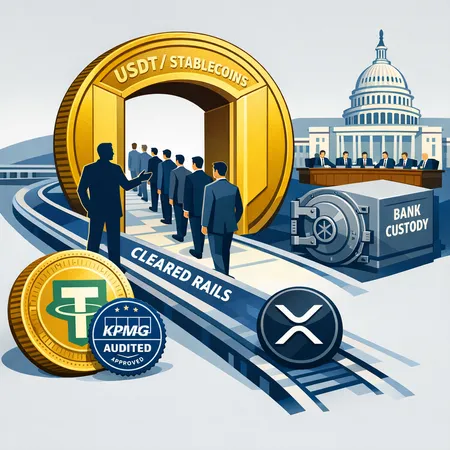
Ripple's leadership has been explicit that stablecoins and payments represent a major on-ramp for enterprise adoption — what Ripple's CEO called crypto's "ChatGPT moment" for payments as large banks experiment with tokenized cashflows (Ripple CEO: stablecoins are the ChatGPT moment).
How this complements staking and DeFi:
- Payments use-cases create durable, utility-driven demand. Unlike short-term speculative flows, payment rails and tokenized liquidity pools create recurring transactional velocity, which can underpin stablecoin issuance and settlement services.
- Staking as a rails enabler. Locked capital on Flare could be used as backing or to provide insurance-like protections for payment channels and on/off-ramps, integrating with the so-called DeFi protection layer ambitions.
- Institutional comfort. Banks and custodians evaluating tokenized payments may favor architectures that show capital commitments (staking) and risk-mitigation primitives — making the ecosystem's maturation attractive beyond pure traders.
Still, payments adoption is a long, institutional sales cycle. The narrative helps shift investor conversations from litigation-era headlines to product, but real-world integration (banks, rails, KYC/AML) takes time and regulatory clarity.
Philanthropy and PR: the Seoul National Hospital donation
A quieter but symbolically powerful event was a substantial XRP-powered donation to Seoul National Hospital, widely reported as a six-figure philanthropic gesture using XRP rails (XRP donation to Seoul National Hospital).
Why this matters beyond warm fuzzies:
- Real-world utility signal. Philanthropy demonstrates payment rails that are fast and cheap in a highly visible way, helping non-crypto-native audiences see practical value.
- PR lever for adoption. These stories give ecosystem builders a foothold when pitching to corporates and regulators: it’s not only trading narratives, it’s tangible utility.
- Network effects. High-profile use cases encourage partnerships and integrations, which can feed back into increased on-chain activity and demand for staking-backed services.
Taken together with staking and the payments narrative, philanthropic use cases look less like one-off PR stunts and more like strategic signaling that XRP advocates can deploy to broaden conversations about adoption.
Risks that could stall a sustained recovery
Momentum is real, but the path is narrow and has several clear failure modes:
- Regulatory uncertainty. Rules governing tokenized payments, stablecoins, and staking vary across jurisdictions. Adverse rulings or restrictive frameworks could choke institutional interest in tokenized rails.
- Liquidity mismatches. Large stakes reduce float but derivatives and retail liquidity remain active; sudden deleveraging can create flash crashes. Concentrated staking positions worsen this risk.
- Smart-contract and bridge risk. Flare and any DeFi protection layer rely on code and cross-chain plumbing. Exploits or bridge failures could quickly erase confidence and capital.
- Centralization of power. When large entities capture most staking rewards or governance weight, the ecosystem's decentralization claims weaken — and counterparties may balk at relying on such networks.
- Narrative dissonance. If payments adoption stalls while derivatives-driven volatility returns, narratives will diverge and capital could rotate out of XRP into other rails or stablecoins that appear more institutionally mature.
For holders and strategists, this means hedging is not optional. Track on-chain stake changes, monitor open interest and liquidation levels, and watch regulatory headlines — especially around stablecoin prudential rules.
Tactical checklist for holders and payments/DeFi strategists
- Monitor staked supply metrics on Flare and large delegator movements; sudden unstaking intentions are an early warning.
- Watch derivatives open interest and funding rates; elevated leverage ahead of macro windows increases tail-risk.
- Follow enterprise pilot announcements and bank stablecoin programs; those are real demand signals that change long-term adoption calculus. For broader context on DeFi trends, see DeFi.
- Consider layered exposure: core XRP allocations for long-term adoption, a tactical component for derivatives-driven volatility, and involvement in Flare-based products only after assessing smart-contract audits and custody arrangements.
Platforms that offer split exposure or dollar-cost-average purchasing and staking workflows (including custodial and non-custodial solutions like Bitlet.app) can simplify execution but validate counterparty and audit credentials first.
Conclusion: converging signals, conditional upside
XRP's current momentum feels different because it blends product signals (staking, payments pilots, DeFi protection layer experiments) with market signals (rising open interest, PR through philanthropy). That combination raises the potential for durable adoption-led appreciation — but only if regulatory clarity, protocol security, and liquidity dynamics align.
For traders and strategists, the rule is straightforward: respect both on-chain fundamentals and market structure. Staking reduces float and can be bullish; derivatives amplify moves and introduce risk. The payments and stablecoin narrative offers a credible path to institutional demand, but it's a multiyear journey. Keep watching stake concentrations, open interest, and enterprise pilot traction as the primary barometers of whether this momentum becomes a sustained re-rating.
Sources
- https://crypto.news/firelight-pushes-xrp-into-defi-cover-as-staked-total-tops-50m/
- https://crypto.news/xrp-traders-watch-april-as-open-interest-jumps-15/
- https://coinpaper.com/15801/xrp-steps-up-for-a-good-cause-after-historic-145-000-donation-to-seoul-national-hospital?utm_source=snapi
- https://coinpaper.com/15800/ripple-ceo-calls-it-the-chat-gpt-moment-for-crypto-as-big-banks-rush-into-stablecoins?utm_source=snapi