Ripple’s RLUSD Pilot in MAS BLOOM: Ripple Prime, DTCC Tokenization, and Trade-Finance Impacts
Summary
Executive snapshot
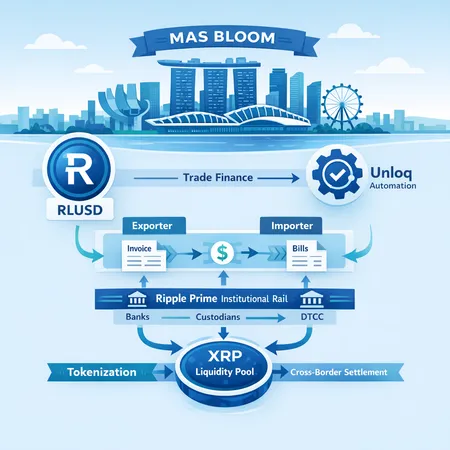
Ripple’s RLUSD stablecoin is now part of a practical sandbox: a MAS BLOOM pilot testing automated trade-finance settlements in Singapore. The pilot combines conditional-payment logic (built and executed via Unloq’s platform) with on-chain settlement mechanics to shorten settlement time and reduce manual reconciliation. At the same time, Ripple Prime — Ripple’s institutional infrastructure for custody, settlement, and liquidity — is being positioned to plug into legacy institutional rails and tokenization initiatives, notably those reflected in DTCC’s accelerated tokenization timeline. For treasury and trade-finance teams, the experiment is a concrete case study: can stablecoins and the XRP Ledger deliver reliable, auditable, and operationally superior alternatives to existing correspondent-banking flows?
What the MAS BLOOM RLUSD pilot actually does
The Singapore pilot focuses on automating trade-finance releases: when contractual conditions are met, payment instructions are released automatically and settled using RLUSD. This is not a proof-of-concept scribble on a whiteboard — Ripple chose Unloq’s automation to orchestrate conditional releases, which reduces human intervention in document checks and payment triggers. The Block’s reporting on the deployment explains that Ripple will use Unloq’s platform to automate payment releases for the Singapore test run, an important step toward operationalizing smart-condition settlement logic in regulated environments. (See: Unloq + Ripple deployment).
A separate coverage of the MAS BLOOM testing emphasises the trade-finance use case: RLUSD runs inside MAS’s sandbox to speed global payments while providing a supervised environment for regulators to observe actual transactional behavior. Invezz’s article on the pilot underscores how RLUSD is being trialed specifically to accelerate trade-finance settlements and test integration patterns with real-world corporate flows (see: RLUSD in MAS BLOOM).
Why this matters operationally: automated conditional releases reduce touchpoints that typically cause delays (manual document checks, time-zone handoffs, reconciliation mismatches). For treasurers, that translates to lower working capital tied up in documentary credits and shorter days-payable-outstanding in cross-border scenarios. The pilot also surfaces latency profiles and reconciliation models — the technical metrics CFOs and operations teams will care about when measuring ROI.
Ripple Prime: institutional rails and custody alignment
Ripple Prime is the institutional-facing stack Ripple has built for custody, settlement, and liquidity orchestration. It’s not merely a custody product; Prime is designed to interface with both traditional financial plumbing and the growing body of tokenized infrastructure. Coinpaper’s coverage outlines a broader picture: with the DTCC moving to tokenize assets rapidly, Ripple Prime has already been integrated into relevant institutional corridors (for example, being plugged into NSCC workflows through partnerships), which signals an intention to be a back-office-friendly bridge between tokenized instruments and legacy systems (see: DTCC tokenization and Ripple Prime).
Operationally, Ripple Prime offers institutions a compliance-first interface: custody controls, settlement guarantees, and connectivity to AML/CTF tooling. For trade finance, those features mean banks and corporates can experiment with tokenized payment instruments and stablecoins without rearchitecting core compliance stacks from scratch. This reduces one of the biggest frictions to institutional pilots: fitting novel rails into existing risk and regulatory models.
RLUSD, XRP liquidity, and why on-ledger liquidity still matters
One of the strategic questions for treasury teams is liquidity sourcing: if RLUSD is the settlement medium, how will corridors source and buffer liquidity to avoid failed payments or expensive pre-funding? Ripple’s architecture suggests multiple models: pure stablecoin rails (RLUSD wallets and rails), hybrid models using XRP as an on-ledger bridge asset for instant liquidity conversion, or a mix depending on counterparty preferences.
Market coverage has also noted RLUSD’s rising market footprint during tests — CoinGape reported RLUSD’s market-cap estimates during early rollouts as a signal of adoption momentum (see: RLUSD market context). That doesn’t guarantee broad adoption, but larger on-chain liquidity pools reduce the execution risk of converting on-chain assets. For treasury technologists, designing playbooks around on-chain liquidity — order books, AMM routing, or prime-brokered pools via Ripple Prime — will be central to delivering resilient payment flows.
How RLUSD + Ripple Prime aligns with DTCC’s tokenization timeline
DTCC’s push to tokenize a wide swathe of securities and post-trade processes on a rapid schedule reframes institutional expectations: tokenization isn’t a niche project anymore; it’s a priority for core market infrastructure. Coinpaper’s reporting on DTCC’s timeframe and the fact that Ripple Prime is already embedded in some institutional networks suggests that Ripple is positioning to be part of the rails that will service tokenized securities and associated payments.
From a trade-finance standpoint, tokenization and stablecoin settlement are complementary: tokenized trade receivables, supplier financing instruments, or digitized bills of lading can be settled instantly if both the asset and the payment medium exist and are interoperable. Ripple Prime’s role is to connect custody, settlement, and liquidity in a way that makes those interactions operationally robust for banks and custodians that are subject to strict post-trade controls.
Practical implications for corporate treasury and trade-finance teams
Measurable efficiency gains: expect shorter settlement windows, fewer reconciliation exceptions, and lower pre-funding needs if automation works as intended. The MAS BLOOM pilot is explicitly testing those variables.
Integration complexity: despite Ripple Prime’s institutional focus, back-office integration still requires mapping of legal agreements, reconciliation flows, and compliance checks. Teams should run parallel processes and measure delta improvements in cash-conversion-cycle metrics.
Liquidity strategy: treasurers must decide whether to rely on on-ledger stablecoins (RLUSD pools), hybrid XRP bridge liquidity, or classical pre-funded Nostro arrangements. Each choice has trade-offs in cost, counterparty risk, and operational complexity.
Counterparty acceptance: bank and corporate counterparties must accept tokenized instruments; regulatory standing and legal enforceability of on-chain contracts and tokenized documents (e.g., eBLs) will influence adoption timelines.
For teams running pilots, use short, measurable KPIs: settlement time reductions, exception rates, cost-per-transaction, and working-capital impact. Incorporate legal and compliance sign-offs early; technology wins are moot without enforceable contractual frameworks.
Risks, unknowns, and mitigation
Regulatory clarity: even within MAS BLOOM, regulatory observations do not equate to final legal frameworks. Treasury teams should model regulatory change risk and work with counsel.
Counterparty and corridor liquidity: initial corridors may be liquid enough, but scaling across multiple fiat pairs will require market-making and potential centralization of liquidity provision. Ripple Prime and market makers can help, but treasury must stress-test scenarios.
Settlement finality and operational resilience: on-chain settlement reduces some operational risks but introduces others (smart-contract bugs, custody compromises). Implement robust multi-sig and reconciliation tooling.
Legal enforceability of tokenized trade documents: until courts and regulators provide clear precedence, corporates may be reluctant to move core liabilities fully on-chain.
Strategic verdict: where Ripple fits in the tokenized trade-finance future
RLUSD in MAS BLOOM and the institutional posture of Ripple Prime move Ripple from experimentation toward practical infrastructure. The combination addresses two key frictions: programmable conditional payments (via Unloq automation) and institutional settlement/custody expectations (via Ripple Prime). That pairing is meaningful for treasurers who need both automation and enterprise-grade controls.
However, success depends on network effects: more counterparties, deeper on-chain liquidity, and legal clarity. DTCC’s tokenization roadmap accelerates the need for interoperable institutional rails; Ripple Prime’s early integrations position it to be a participant, not merely a peripheral experiment. For pragmatic treasury teams, the right stance is deliberate pilotism: run narrow, measurable programs; quantify working-capital and operational improvements; and build legal templates for tokenized instruments.
Recommended next steps for treasury and trade-finance technologists
- Design a focused pilot: choose one corridor and one instrument (e.g., supplier financing denominated in USD settled via RLUSD). Measure settlement time, exception rate, and working-capital improvement.
- Build liquidity playbooks: decide on primary liquidity sourcing (RLUSD pools, XRP bridge, or pre-funding), and model costs for each scenario.
- Map compliance and legal gaps: engage legal, compliance, and operations to create enforceable frameworks for tokenized documents and on-chain settlements.
- Partner with institutional rails: consider providers like Ripple Prime for custody and settlement to reduce integration and compliance overheads.
- Report to stakeholders with hard metrics: show CFOs and operations leads concrete delta improvements to justify scale.
For teams seeking vendor-neutral context, platforms like Bitlet.app are tracking how tokenized rails and stablecoins impact liquidity and settlement economics; match vendor claims against measured KPIs.
Conclusion
The MAS BLOOM RLUSD pilot, powered by Unloq’s automation and observed through the lens of Ripple Prime’s institutional integrations, is a concrete test of whether tokenized money plus programmable conditions can improve trade-finance outcomes. The promise is real: shorter settlement, fewer exceptions, and cleaner reconciliation. But operational adoption will hinge on liquidity depth, regulatory clarity, legal enforceability of tokenized documents, and the willingness of institutional players to rewire legacy processes.
Ripple’s approach — coupling an institutional product (Ripple Prime) with an on-chain stablecoin (RLUSD) and automated settlement logic — makes it a credible contender in the tokenized trade-finance stack. For treasury teams, the right move is careful, metric-driven pilots that quantify savings, surface integration challenges, and prepare legal frameworks for wider rollout.
Sources
- Ripple joins Singapore pilot, deploying Unloq’s platform to automate payment releases (The Block)
- Ripple tests RLUSD in MAS BLOOM trade-finance pilot (Invezz)
- RLUSD market context and testing coverage (CoinGape)
- DTCC tokenization timeline and Ripple Prime alignment (Coinpaper)
For additional background on tokenization and institutional rails, see DeFi and XRP.