Where to Find Upside in Altcoins 2026: L1 Fundamentals vs AI-Native Narratives
Summary
Executive summary
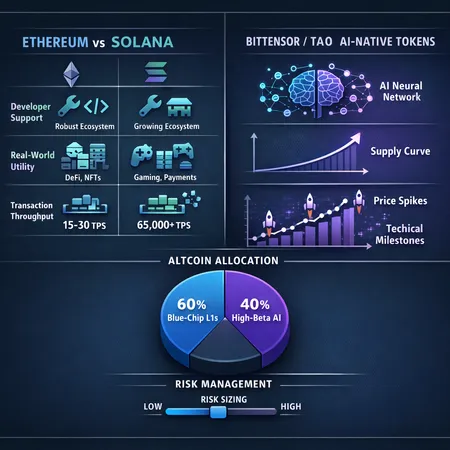
2026 feels like a two‑track race for altcoin upside. On one side you have large layer‑1 networks — Ethereum (ETH) and Solana (SOL) — competing on developer support, composability and real‑world utility. On the other, a new generation of AI crypto tokens (Bittensor/TAO among them) are rallying around technical milestones and supply narratives that can mirror Bitcoin‑style scarcity.
This article lays out a head‑to‑head of Ethereum vs Solana, dissects why AI‑native plays like Bittensor (TAO) have spiked, and gives a practical framework for retail and semi‑sophisticated investors to size altcoin exposure. I’ll also touch on risk management and provide sample allocations to match different risk tolerances. For hands‑on traders, Bitlet.app can be a convenient way to execute on these allocations, but the focus here is strategic, not promotional.
Ethereum vs Solana: developer support, utility and growth corridors
Developer ecosystem and tooling
Ethereum remains the industry’s composability hub. Its developer tooling, mature smart contract standards, and vast library of audited contracts continue to attract teams building complex DeFi, tokenization, and L2‑centric products. For many builders, Ethereum is still the default because of liquidity depth and cross‑protocol integrations.
Solana competes on a different vector: throughput and low transaction costs. Its Rust ecosystem and focus on high‑performance on‑chain primitives make it a better fit for certain real‑time financial apps, gaming and NFT experiences that need cheap, fast transactions. Developer growth on Solana has been more volatile — fewer blue‑chip DeFi primitives than Ethereum, but attractive for apps that value UX at scale.
Real‑world utility and on‑chain activity
Utility is where the two chains diverge in meaningful ways. Ethereum’s strength is breadth — decentralized exchanges, asset tokenization, real‑world asset bridges and a thriving L2 landscape that extends utility while reducing costs. Solana’s strength is scale and low friction: streaming microtransactions, in‑game economies, and certain high‑TPS payment rails.
When evaluating upside, ask: is the narrative driven by developer‑led organic growth (protocol upgrades, better tooling) or by single‑use spikes (token launches, social momentum)? Ethereum’s roadmap and L2 adoption point to steady, structurally backed growth corridors. Solana’s corridors are potentially higher growth but more binary — depend on big dApps reaching traction and network stability improving.
Likely growth corridors to watch
- Ethereum: incremental L2 adoption, tokenized real‑world assets, institutional custody flows and composable DeFi primitives. These represent slow, persistent compounding growth.
- Solana: gaming/NFT economies, high‑frequency payment rails, on‑chain order‑matching for new markets. These corridors can scale quickly if UX and infrastructure issues are solved.
The Fool comparison of ETH vs SOL provides a useful lens on where each chain’s upside might sit in 2026 and beyond; their piece helps quantify developer momentum and likely value capture across ecosystems (Fool — Ethereum vs Solana).
AI‑native tokens and the Bittensor (TAO) story: why technical milestones matter
What makes AI crypto different?
AI‑native protocols combine on‑chain incentives with models or compute networks. They don’t just sell utility; they sell progress — better models, network scale, or a meaningful decentralization milestone. Price action often follows verifiable technical achievements: model benchmark wins, network throughput milestones, or token supply events.
Bittensor’s recent rally is a case in point. The token TAO spiked after a major technical accomplishment and a supply policy that rewards node operators in a manner reminiscent of Bitcoin’s predictable issuance narrative. Coverage of TAO highlights how much of the move was driven by these milestones and investor narratives around scarcity and utility (Fool — This AI crypto is up 111%).
Technical milestones vs. fundamentals
With AI cryptos you should treat technical milestones as catalysts, not guarantees. A successful milestone can create a new floor for expectations — improved model scores, increased throughput, or a widely adopted API. But absent sustained developer adoption or clear revenue capture, the token can retrace quickly once the novelty fades.
The supply narrative matters too. TAO’s issuance schedule created a scarcity story that enticed allocators who think in Bitcoin‑like terms. Scarcity plus utility can be powerful; scarcity without on‑chain demand is fragile.
Risk characteristics
- Concentration risk: small developer teams and single‑product reliance. If the core model or network fails, token value can vaporize.
- Liquidity risk: many AI tokens trade thinly outside major exchanges, amplifying volatility.
- Execution risk: delivering model quality and real‑world integrations is hard and expensive.
AI crypto is higher beta. That’s attractive — but it needs to be sized accordingly.
Building a practical altcoin allocation for 2026
Allocation philosophy: backbone + optionality
Think of your portfolio as two layers: a backbone of blue‑chip L1 exposure and a smaller optionality sleeve for theme and event‑driven bets.
- Backbone (50–80% of altcoin sleeve): ETH and other large L1s. This is your low‑to‑medium volatility exposure to the long‑term growth of smart contract adoption.
- Optionality sleeve (20–50% of altcoin sleeve): AI‑native tokens, experimental L1s, memecoins or concentrated DeFi bets. These positions should be smaller, actively monitored, and tied to clear milestones.
How large should the entire altcoin allocation be relative to your total crypto allocation? That depends on risk tolerance, but a reasonable starting point for many retail investors in 2026 is: 60–80% in blue chips (ETH/SOL/large stablecoins/Bitcoin), 20–40% in altcoins including AI themes. Adjust down if you need liquidity or can’t stomach drawdowns.
Sizing rules for AI‑native tokens (practical guidance)
- Conviction sizing: 1–3% of portfolio for low‑conviction, event‑driven plays; 3–7% for higher conviction after research and due diligence.
- Maximum exposure cap: no more than 10–12% aggregate to highly speculative AI tokens.
- Dollar‑cost entries: stage buys around milestones rather than all‑in before an event.
- Stop and re‑evaluate: if the project misses two consecutive major milestones, exit or drastically reduce position.
These rules help the optionality sleeve participate in upside while limiting ruin risk.
Risk management and scenario planning
- Define scenarios: base (milestones met, slow adoption), bull (rapid adoption and token‑use), and crash (milestones fail, liquidity dries up). Assign probabilities and stress test allocations.
- Liquidity buffers: keep 5–10% of portfolio in cash or stablecoins to buy dips after liquidity events.
- Rebalancing cadence: rebalance back to target exposures quarterly, but be flexible around binary events.
- Use conviction ladders: smaller early entries with tranche size increasing only if milestones complete.
Sample portfolios (templates you can adapt)
Conservative crypto investor
- 70% ETH + BTC and other blue‑chips (mostly ETH for L1 exposure)
- 20% Solana and other promising L1s
- 10% optionality sleeve (small positions in AI crypto like TAO and other thematic plays)
Balanced altcoin allocator
- 50% ETH and BTC
- 20% SOL and other L1s
- 20% thematic/Ops (AI tokens, selective DeFi)
- 10% stablecoins for buying opportunities
High‑beta allocator (experienced, high risk tolerance)
- 40% ETH/BTC
- 20% SOL and mid‑cap L1s
- 30% high‑conviction thematic (AI crypto, infrastructure tokens)
- 10% stablecoins
Adjust these templates for your time horizon and financial situation. If you’re using margin or leverage, reduce speculative allocations proportionally.
Monitoring, stop conditions and exit signals
For L1s like ETH and SOL, monitor developer metrics, TVL trends, and major protocol upgrades. For AI tokens, track technical milestones, node economics, and adoption KPIs. Exit or reduce size if: major milestones are missed, core developer team departs, or token economics are rewritten in a way that undermines scarcity.
A practical rule: reduce your optionality sleeve by 25–50% after a large, unexplained 2x price run unless backed by verifiable fundamental progress. That preserves gains and reduces the risk of a subsequent veteran‑led unwind.
Final thoughts: balancing durability and upside
In 2026, upside in altcoins will come from both slow grinding fundamentals and sharp, event‑driven narratives. Ethereum offers durability and composability, while Solana offers a different, higher‑throughput growth vector. AI crypto tokens like Bittensor (TAO) can spike on technical milestones and supply narratives, but they require tighter sizing and active risk management.
A pragmatic investor blends a durable backbone of large L1 exposure with a deliberately small optionality sleeve for AI‑native bets. Use clear sizing rules, milestone checkpoints, and liquidity buffers to participate in upside while managing downside. Keep researching, follow on‑chain signals, and treat every thematic bet as an experiment in portfolio construction.
Sources