Solana and the Agentic Internet: 15M AI-Agent Payments and the Microtransaction Test
Summary
Introduction: What 15M agent payments actually signals
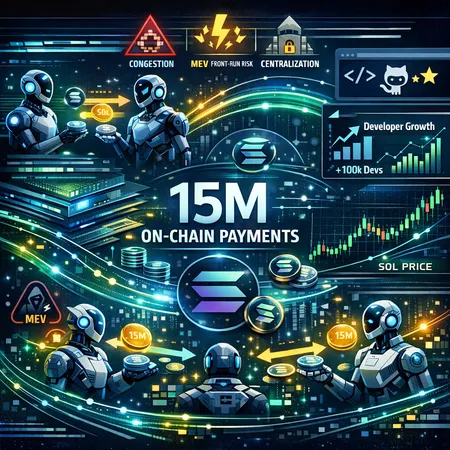
When the Solana Foundation published metrics pointing to roughly 15 million on-chain AI-agent payments, the headline was simple: software agents are starting to transact at scale. That’s not just a number — it’s an early stress test of microtransaction economics and of the rails that must carry millions of tiny value transfers per day without collapsing under fees or latency.
The phrase agentic internet describes a world where autonomous agents — think programmatic purchasers, data brokers and negotiation bots — operate on behalf of humans or other services and settle value with each other. For many infrastructure investors and Web3 developers this raises two immediate questions: can blockchains handle this volume affordably, and what does it mean for SOL and the developer ecosystem? Below we unpack both the technical fit and the economic logic, and then look at the risks that could derail the thesis.
What are AI agents in an on-chain context?
AI agents are autonomous or semi-autonomous software programs that observe, decide, and act to accomplish goals. On the web today they exist as browser extensions, server daemons, or cloud services. On-chain agents add two distinct properties: cryptographic identity and on-chain settlement. That means agents can sign transactions, hold or manage assets, and pay or be paid in native crypto — enabling trust-minimized value exchange between agents.
There are several agent archetypes to keep in mind:
- Purchasing agents: automatically buy scarce items, subscriptions or API calls when conditions are met.
- Data agents: purchase data feeds or compute results from marketplaces.
- Execution agents: coordinate multi-step workflows, paying micro-fees for each subtask.
Agents generate a higher share of small-value, high-frequency transactions than human wallets. This is why the distinction between off-chain micro-aggregation and native on-chain micropayments matters — and why selecting the right settlement layer is critical.
Why Solana is being positioned as the rails for agentic commerce
Solana’s technical profile (parallelized runtime, blockless-ish architecture, and sub-second finality) was designed to push transactions per second well beyond earlier chains. But the real enabler for agentic micro-payments is the combination of sustained throughput and low nominal fees.
Throughput, latency and composability
Solana’s architecture — from Sealevel parallel execution to its Pipelined validation flow — lets nodes process many transactions concurrently, which reduces per-tx latency and enables high raw throughput. For agents that frequently ping markets or need immediate settlement, sub-second finality reduces the time-value friction of payment confirmation.
Composability matters too: agent workflows often require calling multiple programs in a single logical operation (market order, oracle query, escrow settlement). Solana’s single-transaction composability reduces round-trips and gas overhead compared to multi-chain or multi-tx patterns on some other layers.
Fee model and microtransaction economics
Low absolute fees are the most obvious enabling factor. If a chain charges several cents per transaction, millions of micro-payments become economically infeasible. Solana’s fee regime—measured in fractions of a cent for many operations historically—lets agents route tiny payments on-chain without prohibitive cost.
That said, fees are not constant. At scale, blockspace scarcity drives up congestion and fees, and validator fee capture dynamics change. The recent reports of 15M on-chain AI-agent payments (documented by industry coverage) show the concept is viable, but we should be cautious about extrapolating constant low-fee assumptions into the future. For context see reporting from Blockonomi and CryptoNews on Solana’s AI-agent activity and the 15M figure: Blockonomi overview of Solana’s agentic internet and CryptoNews coverage of the Solana Foundation’s metrics.
Economic models powering agent-to-agent commerce
The raw ability to move value cheaply doesn't create markets by itself. Different economic models will determine how agent-driven microtransactions are priced, routed and secured.
Micropayment rails (pay-per-action): Agents pay discrete amounts per service (e.g., 0.0001 SOL per API response). This is the simplest model and resembles old web micropayment experiments, but on-chain settlement gives it verifiable accounting.
Streaming and payment channels: Continuous payments for ongoing services (music, compute) can use token streaming primitives or layer-2 channels to reduce on-chain writes. Agents benefit because they can stop a stream instantly if conditions change.
Escrow + outcome-based settlement: Agents deposit funds into an escrow program; funds are released when an arbiter (on-chain oracle or adjudicator agent) signals completion. This reduces dispute friction between unknown agents.
Staking-backed guarantees and reputation economies: Agents can stake tokens as collateral or pay reputation costs to reduce counterparty risk. Validators and relayers may require economic skin-in-the-game for high-frequency agents.
Market-making and routing economics: Some agents will act as brokers or market makers, aggregating micro-demands and issuing batched orders. That creates a two-sided economy: end-user agents pay tiny fees, while aggregator agents capture liquidity rents.
These models are not mutually exclusive; they can be layered. For instance, a data marketplace might accept streaming payments for continuous telemetry while using staking to underwrite delivery guarantees.
Risks and technical constraints
Moving from prototype to mass adoption exposes multiple failure modes. Here are the ones developers and investors should watch closely.
Congestion and fee spikes
If agents become a dominant source of transactions, peak periods could overwhelm validators and push fees up. Low baseline fees are attractive until they’re not — when blockspace is scarce fees will reprice, and small-value payments become uneconomical.
Mitigations include off-chain aggregation, payment channels, priority fee mechanisms, or explicit protocol-level QoS for critical messages. But each mitigation introduces complexity and coordination costs.
MEV and new extraction channels
Agentic flows open new MEV vectors. Agents submitting many small conditional transactions create ordering opportunities for frontrunners and sandwichers. Unlike human wallet flows, agent patterns can be highly predictable, making them lucrative targets for MEV bots unless the protocol reduces extractable value or agents use MEV-resistant submission strategies.
Centralization pressure
High-throughput, low-latency networks often centralize for performance reasons — fewer validator nodes with better hardware can sustain the load. Solana has faced centralization critiques before; an influx of agentic traffic could reinforce hardware/infra arms races that make participation harder for smaller validators, affecting decentralization and censorship-resistance.
Security and authentication of agents
Agents act autonomously and can be compromised at scale. A vulnerability in an agent framework could lead to mass-drain attacks or cascading liquidity problems. Robust identity, secure key management, and governance frameworks for agent registries will be essential.
What this means for SOL price and developer signals
There are several levers by which rising agentic activity could affect SOL’s market dynamics.
Fee demand and validator economics: Higher on-chain payments increase fee revenue, which flows to validators and, indirectly, to staked token economics. If fee growth is sustained, SOL becomes more valuable as staking yields and protocol utility rise.
Growth in developer activity: If agentic apps attract teams and users, developer tooling, SDK downloads, and on-chain program deployments should tick up. These are leading indicators investors watch — more devs generally means more long-term value capture.
Speculation and narrative: Markets price narratives. If Solana becomes synonymous with the agentic internet in developer discourse, speculative flows into SOL could amplify price action — at least until on-chain fundamentals (fees and usage) justify valuations.
Countervailing risks: Congestion, MEV extraction, or a visible centralization trend could erode confidence and pressure SOL. Investors should monitor not just raw transaction counts but the quality of transactions (micro-payments vs. spam), validator distribution, and fee volatility.
Observable signals to track: active developers per month, program deployments, transactions per second (sustained), average fee per tx, distribution of fees to validators, and the ratio of agent-sourced txs to retail txs.
Practical advice for Web3 developers and infrastructure investors
Developers: design agents to batch and aggregate when possible, consider on-chain streaming only when necessary, and build MEV-aware submission strategies. Use secure key stores and plan for agent revocation mechanisms.
Builders of middleware (relayers, aggregators, wallets): focus on privacy-preserving submission, fee smoothing, and reputation systems that reduce attack surface for MEV and fraud. Platforms like Bitlet.app that support payment rails will be part of a broader middleware stack developers rely on.
Investors and operators: look beyond headline transaction numbers. Validate that increased throughput correlates with meaningful economic activity (paid services, subscriptions, data purchases), and watch validator economics for signs of unsustainable centralization.
Takeaway: plausible tail, but execution matters
Solana’s properties make it a natural candidate for early agentic internet experiments: high throughput, low latency and a low-fee environment enable millions of micro-payments in principle. The Solana Foundation’s 15M on-chain AI-agent payments are an important proof point that the idea moves from theory to practice. But if agentic activity scales aggressively, the ecosystem will face real constraints: congestion, new MEV dynamics, and centralization pressures that could change the value proposition.
For developers, the prudent path is to optimize agent economics and security from day one. For investors, the story is conditional: SOL’s upside from an agentic internet depends on sustainable fee capture, broad developer adoption, and the chain’s ability to manage MEV and decentralization trade-offs.
Sources
- Blockonomi — Solana targets the agentic internet as AI agents drive millions in on-chain payments: https://blockonomi.com/solana-targets-the-agentic-internet-as-ai-agents-drive-millions-in-on-chain-payments/
- CryptoNews — Solana price prediction: Solana Foundation AI agents and 15M on-chain payments: https://cryptonews.com/news/solana-price-prediction-solana-foundation-ai-agents/