Why Bitcoin’s 50-Day Tight Range Looks Like Structural Consolidation — A Data-Driven Scenario Matrix
Summary
Executive snapshot
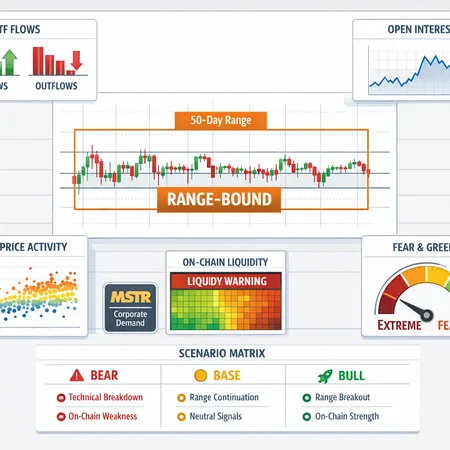
Bitcoin has been trapped in a tight, almost 50-day range — a price pattern that, on face value, could be read as either exhaustion before a breakdown or a structural pause before a resumption of trend. CoinDesk recently argued that this extended range-bound action looks like consolidation rather than a textbook bear flag, and that distinction matters for position sizing and risk management. See their take here: CoinDesk analysis.
In practice the right read depends on reconciling three sets of evidence: technical price behavior, on-chain liquidity and flows (ETF flows, STH activity, corporate demand proxies such as MSTR), and the sentiment/liquidity backdrop highlighted by Glassnode. Below I walk through those signals and then lay out a scenario matrix with actionable triggers.
Why the 50-day range leans toward consolidation
A few structural features favor a consolidation interpretation:
Duration and compressed volatility. Ranges that persist for many weeks often reflect supply/demand clearing and distribution of risk across time rather than an immediate capitulation. The CoinDesk piece frames the current behavior as consolidation rather than an accelerant to the downside.
Lack of expanding selling volume. A classic bear-flag breakdown is usually accompanied by expanding downside volume and a spike in liquidations/open interest on the short side. Recent market snapshots show open interest has fallen, not spiked, which is inconsistent with a forced margin-call-style capitulation (source: Cryptopolitan).
Corporate/ETF demand is still present intermittently. While not a constant bid large enough to force price higher, corporate proxies and institutional flows — MSTR on the corporate side and ETF flows on the institutional side — continue to provide pockets of buy-side interest that can absorb selling and extend consolidation periods.
These points suggest the market is spending time digesting existing positions rather than actively breaking down.
The mixed on-chain picture: flows, STHs, open interest, and liquidity
On-chain data give us texture. They don't all point the same way; they ask for a conditional interpretation.
ETF flows and institutional demand. ETF flows remain an important microstructure input. Periodic inflows can stabilize price even if they aren’t large enough to fuel a near-term breakout; conversely, outflows would remove a structural buyer. Watch ETF flows as near-immediate confirmation (or refutation) of renewed demand.
Short-term holder (STH) activity. Short-term holder inflows to exchanges — a proxy for panic selling or immediate liquidity provision — have dropped to notably low levels (Blockonomi reported Binance STH inflows dipping to about 25k BTC at one point). That decline in exchange STH activity suggests panic selling has faded, reducing the immediate downside fuel for a cascade (source: Blockonomi).
Open interest and derivatives positioning. Open interest has recently contracted alongside the range, signaling position reduction rather than building leverage. As Cryptopolitan notes, falling open interest and a collapse in implied volatility is consistent with traders stepping back, not piling into short squeezes or leveraged directional bets.
On-chain liquidity warnings (Glassnode). Here’s the caveat: Glassnode’s analysis — summarized by NewsBTC — flags that the recovery to date lacks a healthy demand profile and that liquidity conditions remain fragile. That means the market can still move violently if a liquidity vacuum appears or if a large seller hits the market (source: NewsBTC / Glassnode).
Reconciling these: STH panic selling is low and open interest is down — both argue for an absence of forced liquidation risk right now. But underlying liquidity (order-book depth, cross-exchange liquidity) remains shallow enough that large flows or negative news could still trigger outsized moves. In short: the market is calm because participants are waiting, not because liquidity is robust.
Sentiment backdrop: extreme fear as a double-edged sword
The Fear & Greed index and related sentiment gauges show extreme fear conditions (reported in market coverage such as Cryptopolitan). Extreme fear typically suppresses speculative long positions and reduces immediate upside pressure, but historically it can also set the stage for outsized rebounds once on-chain liquidity lines up.
Two practical implications:
- Price chop is likely to persist while fear limits fresh buy-side conviction.
- Conversely, a single credible liquidity event or consistent ETF/corporate inflow cadence can flip the narrative quickly because there are fewer marginal buyers priced in.
For traders on platforms like Bitlet.app, that means sizing positions for potentially rapid moves and using clear stop rules tied to on-chain/technical triggers rather than sentiment alone.
Scenario matrix: bear, base, bull — triggers to watch
Below is a pragmatic matrix with technical and on-chain triggers you can monitor. Treat these as conditions that validate each scenario rather than deterministic predictions.
Bear (resumed decline)
Key thesis: a liquidity shock or sell cascade finds thin bids and forces a breakdown out of the tight range.
Technical triggers
- Daily close decisively below the lower bound of the 50-day range with expanding downside volume.
- Breakdown accompanied by a multi-day series of lower lows and failure to reclaim the range within 3 trading sessions.
On-chain triggers
- Spike in STH inflows to exchanges (renewed retail/panic selling), reversing the recent low inflow trend (Blockonomi data reference).
- ETF outflows or stalled ETF flows over multiple days; institutional demand vanishes.
- Rising short-side open interest (leveraged shorts building) combined with falling spot liquidity — a dangerous mix.
- Glassnode liquidity metrics deteriorate further (increased spreads, falling bid depth).
What validates the scenario: expanding open interest on shorts, rising exchange STH inflows, and an ETF flow reversal in the same 24–72 hour window.
Base (prolonged consolidation / range extension)
Key thesis: the market continues to digest with slow accumulation by longer-term players and periodic institutional bids, but lacks the decisive demand to break higher.
Technical triggers
- Price continues to oscillate within the 50-day range, testing both edges but failing to break decisively.
- Volatility remains compressed; intraday ranges narrow but without directional conviction.
On-chain triggers
- ETF flows are neutral to mildly positive (small inflows offset by outflows), keeping a bid but not fueling rampant buying.
- Open interest remains muted — traders are de-risking rather than levered directional bets.
- STH inflows to exchanges remain low, confirming the absence of panic-selling.
What validates the scenario: persistent low open interest, neutral-small ETF flows, and stable low STH exchange activity over multiple weeks.
Bull (durable recovery)
Key thesis: a return of durable demand — institutional + retail accumulation — pushes BTC out of the range on high conviction and liquidity improvement.
Technical triggers
- Multi-day breakout above the upper range bound with above-average volume and a confirmed retest that holds (classic breakout + retest confirmation).
- Rising higher lows on shorter timeframes (4H/1D) and moving-average cross confirming directional bias.
On-chain triggers
- Consistent, sustained ETF inflows and/or visible corporate accumulation (e.g., renewed MSTR buys, or similar corporate demand proxies) over several consecutive days.
- Rising open interest and derivative volume in the same direction as spot flows, indicating leverage backing the move rather than a squeeze.
- STH price metrics shifting from selling to accumulation — short-term holders begin reducing their on-chain sell pressure.
- Improvements in on-chain liquidity metrics (tighter spreads, deeper bids across major venues) and Glassnode indicators moving off the “danger” threshold.
What validates the scenario: consecutive days of net ETF inflows, rising open interest in the direction of the breakout, and visible reductions in STH exchange inflows.
Tactical checklists for intermediate traders
When the market is this balanced, clear rules beat hunches. Here are short, actionable checklists keyed to the scenarios above:
Bear checklist:
- Reduce size or hedge if STH inflows spike and price breaks range lower with volume.
- Use stop orders below the confirmed breakdown level; avoid tight stops that can be taken out by intraday whipsaws.
- Consider short-duration hedges (options/synthetic) rather than high-leverage perpetuals in shallow liquidity.
Base checklist:
- Stay nimble: prefer smaller position sizes and set range edges as actionable long/short levels.
- Monitor ETF flows daily and watch for any consistent change in direction.
- Use time-based scaling: add size on confirmed accumulation candles, trim on failed breakout attempts.
Bull checklist:
- Add to trends once breakout + retest is confirmed and open interest increases alongside ETF inflows.
- Move stop-loss to breakeven after the first confirmed retest holds.
- Consider corporate demand signals (e.g., MSTR filings/announcements) as additional confirmation; corporate accumulation tends to be sticky.
Practical monitoring dashboard (minimum telemetry)
If you maintain a monitoring screen, include at least these items daily:
- Price relative to the range (upper / lower bound) on 1D and 4H.
- ETF flows (net inflows/outflows) — immediate confirmation metric.
- Exchange STH inflows/outflows (Binance and major venues) — panic-sell proxy.
- Open interest and funding rates across major derivatives venues.
- A Glassnode-derived liquidity gauge (spreads, order-book depth) and the Fear & Greed index for sentiment context.
This telemetry lets you map real-time events to the scenario matrix above.
Final read: cautious optimism with clear stop rules
The 50-day tight trading range more likely reflects a structural consolidation than an automatic bear-flag collapse, but that does not imply a clean path upward. The market is waiting: STH panic has faded and open interest has contracted, which reduces immediate forced selling risk, while ETF/corporate demand remains the marginal difference-maker. Glassnode’s liquidity warning is the counterbalance: shallow bids can make any large move sudden and exaggerated.
For intermediate traders the operational takeaway is straightforward: trade the triggers, not the narrative. Use the technical boundaries of the range together with the on-chain confirmations (ETF flows, STH activity, open interest) to validate a scenario before committing size. And always size for the possibility of sudden liquidity-driven moves.
For more context on how institutional flows and on-chain liquidity interact with price action, see how Bitcoin narratives evolve alongside DeFi liquidity cycles on platforms like DeFi. Bitlet.app traders may find these rules useful when constructing multi-legged hedge strategies or carrying scaled allocations through a prolonged consolidation.
Sources
- CoinDesk — Bitcoin has traded in a tight range for nearly 50 days, but this is not a bear flag
- NewsBTC — Bitcoin recovery lacks one key ingredient: Glassnode
- Cryptopolitan — Why is Bitcoin crashing again today? (market snapshot on open interest, fear & greed)
- Blockonomi — Bitcoin STH inflows drop to record low as panic selling fades on Binance