Cardano, Midnight, and Monument Bank: How Tokenized Deposits Could Rewire Private Banking Rails
Summary
Why Monument Bank’s move matters now
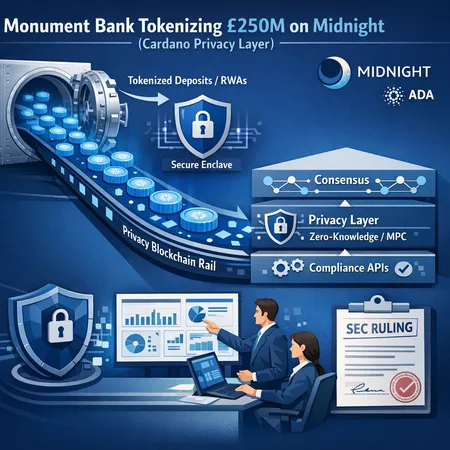
Monument Bank’s plan to tokenize up to £250M of retail deposits on Midnight is more than a headline; it’s a proof point for one of the industry’s heavier bets: that regulated institutions can use privacy-first blockchains to issue on-chain representations of traditionally off-chain liabilities. The announcement, framed by Cardano founder Charles Hoskinson as potentially “one of Cardano’s biggest commercial wins,” signals a convergence of commercial banking and privacy-enabled distributed ledgers rather than a sideways experiment (Bitcoinist, Cointribune).
For institutional RWA teams and compliance officers, the questions are practical: how does Midnight actually provide privacy while remaining auditable? What does the recent SEC guidance mean for the legal footing of on-chain deposit tokens? And how might tokenized deposits change market plumbing for RWAs over the next 12–36 months?
What Midnight is and how its architecture targets private banking rails
Midnight is positioned as a privacy-first execution environment built to run on Cardano’s settlement layer. Its core design objective is to offer programmable confidentiality for smart contracts and assets while preserving the ability for regulated participants to satisfy audit, KYC/KYB and AML processes.
Key architectural principles
Confidential state and transactions: Midnight isolates transaction payloads and contract state from public view by default, exposing only the metadata required for settlement on Cardano’s base layer. This reduces public exposure of account balances, counterparties and contract logic.
Selective disclosure / view keys: To be compatible with regulated workflows, Midnight supports mechanisms for selective disclosure—auditors, custodians and regulators can be granted scoped access to view transaction data without making it public. That capability is critical for tokenized deposits where a bank must prove solvency and compliance without publishing customer-level information.
Programmable privacy controls: Rather than a binary public/private choice, Midnight’s model emphasizes policy-driven privacy (who can see what, under which conditions). This enables permissioned flows—useful for custody, reconciliation, and dispute resolution.
Interoperability with Cardano settlement (ADA): Midnight settles proofs or anchor transactions on Cardano’s base layer, keeping finality and settlement on a network recognized by market infrastructure and custodians.
Note: Midnight’s implementation details—specific cryptographic primitives or rollup designs—continue to evolve. But the architectural trade-off is visible: preserve confidentiality at the execution layer while maintaining auditable settlement on Cardano.
Tokenized deposits: mechanics, benefits and risks
Tokenized deposits refer to minted tokens that represent bank liabilities (customer deposits) or claims on a bank’s balance sheet. In Monument Bank’s proposal, retail deposits become on-chain tokens issued on Midnight, redeemable off-chain under the bank’s terms.
How it would work in practice
- A retail depositor’s fiat deposit is recorded in Monument Bank’s ledger and a corresponding token representing that deposit is minted on Midnight. The token is transferable under bank policy and can be used in on-chain markets or held.
- Redemption requests are processed by Monument’s custodial/legal entity: tokens are burned and fiat is returned, governed by contractual terms and settlement windows.
- Custody and KYC are enforced at issuance and redemption points; secondary market transfers may be restricted or require whitelisting depending on policy.
Benefits for RWAs and market participants
- Liquidity and composability: Tokenized deposits can act as high-quality liquid assets inside DeFi primitives—short-term funding, repo, and automated settlement workflows—without forcing riskless public disclosure of depositor identities.
- Fractionalization and programmability: Banks can structure deposit tranches, integrate interest-bearing rules, or offer conditional liquidity products that integrate with on-chain markets.
- Operational efficiency: Straight-through settlement, faster reconciliation and programmable settlement conditions can reduce operational costs compared with correspondent banking rails.
Risks and open questions
- Redemption & bank-run dynamics: Converting demand deposits into transferable tokens introduces run risk if secondary-market liquidity dries up. Legal and contract design must mitigate mismatch between on-chain transferability and off-chain redemption mechanics.
- Custody and counterparty risk: Who holds reserves? How are they audited? Trust in the bank’s reserves underpins the token’s credibility.
- Regulatory and cross-border frictions: Tokenizing deposits raises licensing, capital, and deposit insurance questions across jurisdictions.
Regulatory context: recent SEC guidance and its implications
A recent development that matters here is easing regulatory uncertainty tied to staking and airdrops. The SEC’s latest posture—summarized in recent coverage—suggests more nuanced treatment of staking rewards and discrete token distributions, which reduces one dimension of classification risk for tokenized products and reward schemes (The Motley Fool).
What this does—and does not—mean:
- It lowers the odds that rewards or airdrop-style mechanics tied to on-chain deposits will be automatically treated as securities in the U.S., if those distributions follow certain programmatic templates and lack central profit-seeking narratives.
- It does not remove licensing, money transmitter or deposit-taking requirements for banks issuing on-chain liabilities. Banks still operate in regulated regimes and must align on custody, capital and consumer protections.
For compliance officers, the practical takeaway is that the legal fog around token economic primitives is thinning. But regulatory diligence must now shift toward ensuring operational controls (KYC/KYB, sanctions screening, proof-of-reserve) and careful documentation of the legal relationship between token holders and the issuing bank.
Designing privacy with compliance: patterns that reconcile confidentiality and auditability
Adoption of privacy-enabled token rails in regulated settings will hinge on technical patterns that make privacy compatible with compliance.
Recommended design patterns:
- Permissioned view-keys and escrowed audit channels: Provide role-based cryptographic access to transaction content for auditors and regulators without leaking public data.
- Proofs-of-reserve and liabilities accounting: Use cryptographic proofs plus third-party attestations to demonstrate backing of on-chain tokens, coupled with on-ledger commitments that are auditable at high level.
- Reconciliation oracles: Privacy-preserving oracles can attest to aggregate states (e.g., total token supply vs. reserves) without exposing individual balances.
- Time-locked or conditional redemption mechanics: To reduce run risk, redemption windows and settlement clauses can be programmable and transparent in the token’s terms.
These patterns are consistent with Midnight’s stated goals and with the type of institutional controls Monument Bank will likely require to operate at scale.
What Monument Bank’s move could mean for ADA holders and privacy-blockchain adoption
A large-scale institutional issuer using Midnight as a rails provider has several downstream implications:
- Increased on-chain settlement activity: More tokenized deposits mean more settlement transactions anchored on Cardano, increasing utility for ADA as a settlement token and potentially lifting fee demand.
- Network effect for privacy primitives: If regulated institutions accept selective-disclosure privacy as compliant and practical, Midnight-like approaches could drive adoption among other banks and asset managers seeking confidentiality.
- Collateral uses and DeFi linkages: Tokenized deposits can feed into institutional DeFi primitives—repo, tokenized lending pools and short-term funding markets—where composability multiplies utility. That said, institutional participation will likely favor permissioned or whitelisted DeFi integrations at first.
For ADA holders the narrative becomes one of infrastructure demand rather than pure speculation: real-world institutions need predictable settlement, custody integrations and legal interoperability. Projects like Midnight that offer auditable privacy could be a differentiator in attracting that demand.
A pragmatic checklist for RWA teams and compliance officers
Before committing live capital or recommending tokenized deposit initiatives, teams should validate the following:
- Legal framework: Are issuance, redemption and custody contracts vetted for the jurisdictions involved? Is deposit insurance or equivalent protection addressed?
- Proof-of-reserve and audit model: Is there an on-chain + off-chain attestation model that satisfies auditors and regulators?
- Privacy controls: Does the platform support scoped disclosure (view-keys, auditor access) and deterministic audit trails when required?
- Custody integration: Which custodians support the chain and Midnight’s execution environment? How will keys and multisig be managed?
- AML/sanctions screening: How are KYC/KYB and sanctions checks enforced at issuance and redemption points—and how are suspicious flows investigated in a privacy-preserving way?
- Operational contingency: Redemption stress tests, governance fallback, and legal dispute resolution pathways must be defined and tested.
Final perspective: guarded optimism with operational rigor
Monument Bank’s planned tokenization on Midnight is a significant test case for privacy-first RWAs. If implemented with strong custody, rigorous proofs-of-reserve, and permissioned privacy for auditors, it could demonstrate a practical template for banks to issue on-chain liabilities without sacrificing regulatory compliance. Recent SEC clarifications reduce one axis of uncertainty, but institutional adoption will be won or lost on operational capabilities, legal clarity, and the robustness of privacy-plus-audit tooling.
For ADA holders, the upside is tangible: settlement demand, new product flows, and a clearer institutional narrative for Cardano’s stack. For compliance officers and RWA teams, the imperative is equally clear—treat privacy-enabled token rails as a hybrid engineering, legal, and operational challenge. Projects like Midnight and partnerships like Monument Bank’s will likely set the playbook for the next phase of tokenized banking.
As this ecosystem evolves, platforms across the stack (including consumer-facing services such as Bitlet.app) will need to adapt custody, reconciliation and compliance workflows to support regulated tokenized deposits while honoring customer privacy.
Sources
- Monument Bank’s plan to tokenize deposits on Midnight: https://www.cointribune.com/en/crypto-cardano-signs-a-major-deal-with-a-british-bank/?utm_source=snapi
- Charles Hoskinson framing the deal: https://bitcoinist.com/cardano-founder-midnight-deal-billions-tvl/
- SEC rule-change context favoring staking/airdrops: https://www.fool.com/investing/2026/03/26/cardano-just-caught-a-major-break-from-the-sec-is/
For more technical background on Cardano’s ecosystem and privacy infrastructure, see Cardano and related coverage of institutional primitives on DeFi.