Tokenizing Bitcoin Mining: Apex’s OMN on Coinbase Base and the Rise of Hashrate-Backed Notes
Summary
Why Apex’s OMN Tokenization Matters
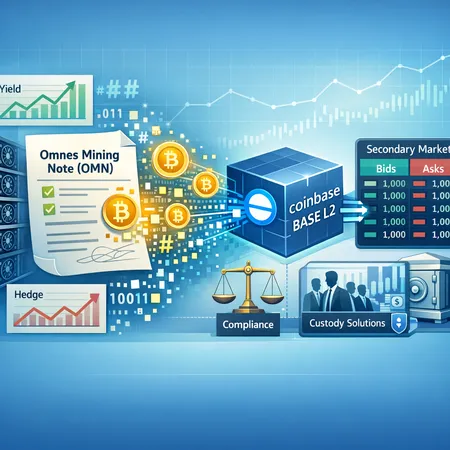
Apex’s move to tokenize the Omnes Mining Note (OMN) on Coinbase’s Base is more than another spot-RWA headline: it’s an attempt to convert physical mining capacity into a tradeable, programmable instrument that institutional desks and product architects can price, hedge and distribute. According to a Coindesk report, Apex will mint a representation of the Omnes Mining Note on Base, bringing hashrate exposure onto an L2 optimized for cheap, fast settlement. For institutions thinking about alternatives to owning rigs, tokenization promises fractional access, secondary liquidity and the ability to plug mining economics into DeFi flows.
Cointelegraph’s recent analysis of miner metrics provides the market backdrop: miners are under pressure, valuation metrics are at cycle lows, and many operators are searching for non-dilutive financing or ways to monetize future production. That weakness helps explain why structured products that convert hashrate into tradable cashflows are suddenly attractive to both issuers and buyers.
What is a Hashrate-Backed Structured Note?
A hashrate-backed note is a financial instrument that ties the buyer’s economic claim to the output of mining hardware rather than to the hardware itself. Conceptually it resembles other asset-backed notes, but the underlying is power + compute: terahashes per second (TH/s) of deployed miners and the expected BTC they will mine over a defined period.
At issuance the note is typically defined by:
- A hashrate tranche (e.g., X TH/s deployed across specified sites)
- A time horizon and expected uptime (contractual or measured)
- A payout formula converting mined BTC into distributions (fixed coupon, floating, or hybrid)
- Credit and operational covenants that specify maintenance, replacement and force majeure rules
For many traders, Bitcoin remains the primary market bellwether—so a hashrate note’s value is a blend of BTC spot expectations and the production risk of the mining operation.
Typical Payout Structures
- Floating revenue share: token holders receive a pro rata share of BTC mined (after fees) and optionally converted to a stable asset.
- Fixed coupon: issuer guarantees a target yield (paid by selling future BTC or via reserve funding); buyers accept issuer and operational risk.
- Capped/participating notes: offer downside protection up to a threshold and upside participation beyond, useful for risk-managed exposure.
Technical Design: How a Hashrate-Backed Note Actually Works
Designing a robust hashrate-backed token requires aligning off-chain mining operations with on-chain claims. The core components are:
Legal wrapper / SPV: miners or arrangers create a special-purpose vehicle that owns the miners or holds the revenue rights. The SPV issues the note and defines legal entitlements.
Operational telemetry and attestations: continuous data feeds (telemetry) report hashrate, availability, and mined BTC. Independent verifiers and on-site auditors provide proof-of-performance.
Custody of mined BTC and settlement engine: mined BTC is routed to a custody solution (custodial wallet, multi-sig, qualified custodian) where distributions are computed. Smart contracts on Base control token issuance and redemption, but cashflows typically settle via an off-chain custodian with on-chain proofs.
Token economics: the OMN token represents a claim on the SPV’s cashflows. Its smart contract enforces transferability, fee schedules, and payout triggers but generally does not (and cannot easily) control physical assets directly.
Oracles and oracles’ governance: difficulty, block rewards, and BTC price feed into the yield calculus and need robust oracle design to avoid manipulation.
These pieces form a hybrid architecture where legal & operational control remains off-chain while ownership and transferability are handled on-chain.
Settlement and Cashflow Mechanics
A practical settlement flow looks like this:
- Miner mines BTC and deposits it to the SPV’s custody address.
- Custodian reports receipts and makes distributions per the note’s rules (e.g., weekly BTC paydown or periodic stablecoin conversions).
- Smart contract on Coinbase Base mints or burns OMN tokens to reflect outstanding claims; transfers execute instantly on L2 rails.
Because Base is an L2, token transfers are low-cost and fast, enabling secondary trading and real-time position management that would be cumbersome on mainnet.
Mining-Economics Backdrop: Why Now?
Several dynamics have converged to make tokenized mining notes commercially relevant:
- Miner balance-sheet pressure: prolonged weak miner metrics—illustrated in recent reporting—have pushed operators to find liquidity other than selling rigs or diluting equity.
- Capital intensity of mining: acquiring and running rigs requires CapEx, site contracts and power agreements; tokenization reduces upfront capital needs for investors.
- Macro and BTC price uncertainty: institutions may prefer yield-like exposures linked to machine productivity rather than direct BTC spot exposure.
Cointelegraph’s piece on miners’ deep-value metrics shows how these pressures create supply (miners willing to monetize future production) and demand (investors seeking yield or differentiated BTC exposure). Tokenization becomes a middle path: miners turn future production into tradable claims; investors gain programmable access.
Custody, Liquidity and Secondary Market Prospects on Coinbase Base
Layer-2 rails like Coinbase Base materially change the secondary-market story. Base offers lower gas costs, higher throughput and integration with major custodians and exchanges—key for institutional adoption.
Liquidity prospects depend on three levers:
- Market makers and dealers: institutional desks must be willing to quote two-way prices in OMN. The instrument’s design (standardized tenure, clear waterfall) determines how easily dealers can hedge.
- On-chain liquidity primitives: ERC-20 representation on Base allows AMMs and lending markets to onboard OMN tokens, enabling composability with DeFi primitives.
- Custody interoperability: if major custodians support the token and SPV custody, prime brokers can clear, settle and repo positions against OMN.
Operationally, custody involves two layers: custody of the physical BTC (or proceeds) and custody of the OMN token. Institutional buyers will insist on qualified custodians, segregated accounts, SOC 2-like attestations and regular proof-of-reserve statements.
Compliance and Institutional Considerations
Tokenized RWAs on L2s blur securities, commodities and property law lines. Institutions evaluating OMN-like offers should focus on:
- Legal classification: is the OMN a security under local law? The legal wrapper’s structure (note, debt, equity, membership interest) determines regulatory treatment.
- AML / KYC and investor qualification: RWA issuances typically require KYC gating and accredited/institutional-only issuance windows.
- Custodial standards: institutions expect qualified custody, clear audit trails, and the ability to segregate assets for insolvency protection.
- Accounting and tax treatment: revenue recognition, depreciation of the underlying rigs (if held in SPV), and token accounting must align with GAAP/IFRS—auditors will want clear documentation.
- Settlement finality & legal enforceability: the L2 transfer is distinct from legal ownership of the claim. Institutions will require that on-chain token transfers map to enforceable claims against the SPV.
Regulators are paying attention. Issuers should be ready for securities-style disclosures, market conduct rules and cross-border complexity. The minting on Base reduces friction, but it does not remove legal obligations.
Risks: Operational, Market and Smart-Contract
- Operational risk: mining uptime, hardware failures, supply-chain and local power disruptions can lower production versus projections.
- Difficulty and network risk: increasing network difficulty reduces BTC yields per TH/s independent of miner effort.
- Price risk: token holders still face BTC volatility unless payouts are converted to stablecoins or hedged.
- Counterparty risk: the SPV, issuer or custodian could fail, misreport or mismanage funds.
- Smart contract risk: bugs in the token or settlement contracts could lead to loss or lockup of tokens.
- Liquidity risk: secondary markets may be thin, forcing large holders to accept wide spreads.
Good product design mitigates—insurance wraps, third-party attestations, on-chain proofs and transparent governance all help—but they rarely eliminate these risks entirely.
Use Cases and Product Scenarios for Institutions
Yield-seeking allocator: an allocator seeking yield without direct miner exposure buys OMN tokens with a floating revenue share, gaining periodic BTC income that can be converted to stablecoin.
Miners’ hedging vehicle: a miner issues OMN to monetise future production and sells a tranche to hedge capex repayment, retaining residual upside.
Structured-credit desks: desks can tranche OMN flows—senior tranches get priority fixed coupons, junior tranches capture upside—creating familiar credit-style products for fixed-income investors.
Programmatic DeFi strategies: OMN tokens integrated into AMMs on Base allow yield farms to offer enhanced returns by combining mining revenue with liquidity incentives. Platforms like Bitlet.app and on-chain liquidity providers could route mining yield into broader DeFi credit strategies.
Treasury diversification: corporates or funds seeking non-correlated operational yields can allocate a portion of portfolios to hashrate notes as an alternative yield stream.
Each scenario requires bespoke diligence: modelled BTC production, counterparty strength, legal enforceability and market liquidity.
Pricing and Hedging: How Market Makers See OMN
Valuing a hashrate-backed note requires a model of expected BTC production (TH/s × uptime × expected difficulty-adjusted yield), expected fees and conversion timing. Hedging typically uses spot BTC futures and sometimes miner-cost hedges (power or hardware insurance products). Dealers will stress-test models across difficulty and price shocks before quoting.
A transparent waterfall, frequent reporting and robust oracles reduce model risk and tighten spreads.
Conclusion: Practical Steps for Product Teams and Allocators
Tokenizing mining capacity on a Layer‑2 like Coinbase Base is a pragmatic path to unlock illiquid mining economics for a broader investor base. But tokenization is not a silver bullet—success depends on legal wrapper clarity, rigorous custody and audit practices, clear operational telemetry, and realistic liquidity plans.
For product designers: standardize tenors and payout formulas, build in third-party attestations, and partner with qualified custodians.
For institutional buyers: insist on enforceable legal rights to cashflows, independent proof-of-performance, and audited financials for the SPV.
For miners: structured token issuance can be a non-dilutive alternative to equity and a way to smooth cashflows—if you can tolerate the reporting, governance and price discovery that comes with public token markets.
Tokenization of real-world assets like mining capacity is a meaningful step toward programmable finance. When thoughtfully designed and conservatively marketed, hashrate-backed notes can become a useful tool in the institutional toolkit for yield, hedge and diversification—especially as L2 rails like Coinbase Base reduce frictions and make secondary trading practical.