Tactical Analysis: The Fast-Moving Spot Hyperliquid (HYPE) ETF Race and What Grayscale's S‑1 Means
Summary
Quick take: why this race matters now
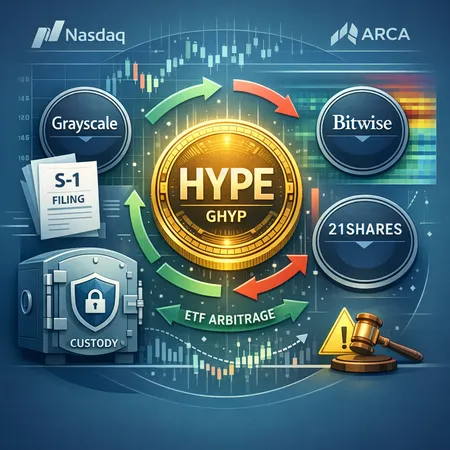
Grayscale’s recent S‑1 filing for a spot Hyperliquid ETF — proposing the ticker GHYP — turned an emerging product category into a full-scale institutional sprint. The filing, reported widely, places Grayscale side-by-side with earlier movers Bitwise and 21Shares and signals asset managers expect meaningful institutional interest in HYPE exposure once a regulated ETF wrapper exists. For market participants this matters because ETFs change demand mechanics: they create predictable creation/redemption flows, enable authorized participants (APs) to arbitrage price gaps, and bring a new class of capital that can be operationally simpler for institutions than direct token custody.
For active readers this analysis focuses on four tactical questions: who the main suitors are, why managers are rushing now, how ETFs would affect HYPE liquidity and price, and what custody/listing and regulatory hurdles to watch.
Who the main ETF suitors are and why their filings differ
Three names dominate the filings and coverage: Grayscale, Bitwise, and 21Shares. Each brings slightly different strengths:
- Grayscale — a household name in crypto asset management — filed an S‑1 that proposes listing on Nasdaq under the ticker GHYP. The filing signals mature operational plans (including custody and an exchange venue) and leans on Grayscale’s institutional distribution channels (coverage: ZyCrypto).
- Bitwise — an early ETF innovator in crypto — tends to emphasize index construction and tax/operational efficiency. Their playbook is optimized for institutional clients who want clean indexing exposure.
- 21Shares — with deep exchange-traded product experience in Europe, focuses on rapid product launch and market-making relationships to ensure liquidity on day one.
Coverage across outlets highlights that Grayscale’s S‑1 takes a concrete step beyond intent; it provides proposed ticker and listing guidance, which can shorten time-to-market if the SEC greenlights the approach (see reporting in Blockonomi and Crypto.news).
Why asset managers are racing to launch spot HYPE ETFs now
Several converging forces create urgency:
- Institutional demand: Many allocators prefer regulated ETF wrappers over direct wallet exposure because ETFs fit existing custody, compliance, and reporting workflows. Managers want to capture that demand and the recurring AUM that follows.
- First-mover advantage: The first ETF to establish liquidity and narrow spreads can become the dominant on‑exchange vehicle, attracting APs and retail flows that compound over time.
- Arbitrage engine: ETFs enable APs to perform creation/redemption arbitrage, which in liquid underlying markets is a reliable source of daily demand or supply. Managers anticipate these flows will support tighter ETF-to-NAV spreads and, by extension, deeper liquidity in the HYPE token.
- Market sentiment and momentum: The filings themselves create narrative momentum. HYPE’s token price has reacted to S‑1 news, and managers hope to convert interest into durable inflows rather than one-off pumps.
Put simply: managers want product shelf space and the operational relationships (exchanges, custodians, APs) that lock in distribution before competitors do.
Expected market impact if approvals occur: liquidity, price, and arbitrage mechanics
If the SEC approves spot HYPE ETFs, expect a multi-phased market response:
Immediate liquidity expansion: ETFs aggregate demand from institutional conduits and retail channels. Authorized Participants will source HYPE on spot markets to create ETF shares, which increases buying pressure and narrows bid-ask spreads on HYPE. That effect usually appears fastest in the most liquid trading venues for the underlying token.
Price re-rating potential: Early inflows can create structural upward pressure on HYPE, particularly while supply for creations is scarce or concentrated. However, price discovery will be tempered by arbitrage: APs will sell ETF shares versus buying underlying (or vice versa) to capture basis opportunities, which tends to keep ETF price linked to HYPE NAV.
Volatility and correlation shifts: ETF flows can reduce idiosyncratic volatility by broadening the investor base, but they can also introduce new cyclical dynamics — for instance, rapid redemptions during risk-off episodes could transmit selling pressure back to the spot HYPE market.
Liquidity concentration and venue effects: Expect market-making to concentrate on venues where APs and custodians have robust rails. OTC desks and institutional-focused venues may become dominant sourcing points during large creations.
Tactically, institutional investors that want exposure ahead of approval must weigh whether to (a) accumulate spot HYPE and risk being long before ETF arbitrage normalizes spreads, or (b) wait for an ETF product to reduce custody/operational complexity but potentially pay premiums at launch.
Custody and listing details to watch: Nasdaq vs Arca, Coinbase custody, and operational implications
Two operational decisions matter for timing, market structure, and perceived legitimacy: the exchange chosen for listing and the custodian used.
Exchange venue (Nasdaq vs Arca): Grayscale’s S‑1 indicates a proposed Nasdaq listing for GHYP. Nasdaq carries its own listing rules, market-making ecosystem, and brand perception. By contrast, many crypto-related ETFs have listed on NYSE Arca historically; Arca has been the home for large U.S. spot crypto ETF activity. The difference is not merely cosmetic — the chosen exchange dictates market-maker networks, share distribution practices, and potentially the speed of secondary-market adoption. A Nasdaq listing could attract a different set of institutional market makers and retail brokers, affecting early liquidity patterns (Blockonomi notes the proposed Nasdaq plan in their coverage).
Custody: Custody is central to SEC comfort. Filings have mentioned institutional-grade custodians; press reporting highlights Coinbase custody capabilities as a commonly referenced solution for crypto spot ETFs. Custodian selection affects perceived security, insurance coverage, and the mechanics of AP settlement. If a custodian like Coinbase is used, that simplifies integration for many U.S. APs familiar with Coinbase rails — but the SEC will scrutinize policies around access controls, cold-storage segregation, and proof-of-reserves procedures (see source reporting in Blockonomi and ZyCrypto).
Operational takeaways:
- Watch the finalized custodian name and its segregation model (hot vs cold, insured policies).
- Monitor whether the filing describes AP settlement windows and in-kind vs cash creations — this affects execution risk for large institutional trades.
- The exchange choice will shape where ETF liquidity aggregates; brokers’ routing patterns often favor one venue, which impacts spreads and the ease of ETF access for retail investors.
Regulatory hurdles and hard stops that could delay approvals
Approving a new spot ETF that holds a token like HYPE is not automatic. Primary regulatory issues to monitor:
- Market manipulation and surveillance: The SEC will evaluate market surveillance arrangements between the listing exchange and markets where HYPE trades. Questions include whether surveillance-sharing agreements exist and whether spot markets have protections against spoofing, wash trading, or concentrated liquidity.
- Custody and operational risk: The SEC will probe custody safeguards, disaster recovery, proof-of-reserves, and the custodian’s independence. Any ambiguity here can add review time.
- Liquidity and trading venues: If a significant portion of HYPE liquidity resides on venues outside U.S. regulatory oversight, the SEC may demand stronger mitigation or delay approvals until surveillance gaps are closed.
- Legal/regulatory precedent: The SEC’s approach to spot crypto ETFs has been evolving; despite recent approvals for major assets, novel token structures or governance models (e.g., if Hyperliquid has on-chain mechanisms that complicate control assumptions) can invite deeper review.
Because of these points, approvals can be subject to comment periods, conditional requirements, or litigated delay. Managers often preemptively negotiate surveillance-sharing agreements and tighten custody details to reduce friction, but the SEC can still require changes or ask for clarifications.
Tactical positioning recommendations for institutional and retail investors
If you’re mapping ETF-driven demand and planning positioning, consider the following pragmatic steps:
Differentiate time horizons: If you’re long-term and prefer operational simplicity, waiting for an ETF can reduce custody/regulatory overhead. If you seek asymmetric upside and can tolerate operational risk, selective spot accumulation might capture early re-rating.
Monitor filings and operational details closely: The custodian named, the exchange venue (Nasdaq vs Arca), and whether AP creation will be in-kind or cash will materially affect the mechanics of how ETF flows translate into spot demand.
Plan for arbitrage windows: Early listings often produce intraday NAV dislocations. If you’re trading the basis between ETF and spot, ensure access to AP channels or work with brokers that can execute creations/redemptions efficiently.
Size cautiously relative to liquidity: HYPE spot market depth will determine how much ETF inflows can be absorbed without severe slippage. Use staged accumulation and align expectations for slippage during large creation events.
Watch market structure and custody announcements: A well-known custodian and clear surveillance agreements shorten approval risk. Filings that reference Coinbase-level custody rails and Nasdaq listing plans (as reported) are positive signals but not guarantees.
Scenario sketch: short-term, medium-term, long-term outcomes
- Short-term (weeks to months): Filing announcements and S‑1 details will likely lift volatility and draw speculative volume. Expect tight but episodic liquidity spikes around news.
- Medium-term (post-approval months): AP-driven creation activity should increase buying pressure on HYPE and reduce spreads. ETFs that establish tight NAV tracking and broad broker access will dominate flows.
- Long-term (1+ year): ETF-wrapped demand could normalize HYPE as a mainstream institutional allocation, lowering idiosyncratic volatility and expanding market depth — provided regulatory stability and robust custody/surveillance measures remain in place.
Final perspective
Grayscale’s S‑1 raises the stakes by moving from intent to a concrete product proposal — including a proposed ticker (GHYP) and listing plan — and puts pressure on other managers to finalize operations. That competitive dynamic benefits end investors through faster product availability and potentially better execution terms, but it also compresses the margin for operational errors. Whether you’re institutional or retail, the smart play is to follow custody, exchange, and surveillance details closely and to size positions with an eye toward arbitrage and liquidity dynamics rather than pure speculation.
Bitlet.app users and other market participants should view these filings as a call to scrutinize execution pathways: where will ETF liquidity be sourced, which custodians will underpin settlements, and how will APs manage creation/redemption flows? The answers will determine how much of the ETF demand ends up as durable spot liquidity versus transient quote-level volatility.
Sources
- Grayscale files to launch spot Hyperliquid ETF — ZyCrypto
- Hyperliquid hype attracts third ETF filing; proposed Nasdaq listing and custody details — Blockonomi
- Grayscale joins race to launch Hyperliquid ETF — Crypto.news
For context on macro crypto market behavior and ETF-driven flows, historical parallels with spot ETFs on Bitcoin and dynamics in DeFi markets can be informative.