Bhutan’s 519.7 BTC Drawdown: Sovereign Bitcoin Sales, Market Supply and Custody Risk
Summary
Executive snapshot
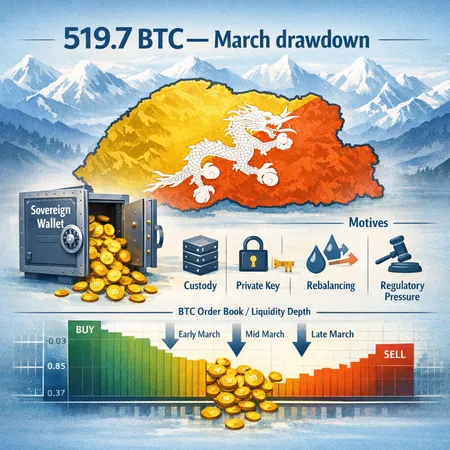
In March, Bhutan moved about 519.7 BTC out of a state-controlled sovereign wallet and into the market. The transfer — reported across outlets such as Cointelegraph and crypto.news — has reignited debate about what recurring sovereign Bitcoin sales mean for market supply, concentrated custody, and fiscal risk for smaller nations that hold digital reserves. For macro crypto investors and policy analysts, the episode is a useful case study in execution risk and treasury design.
Timeline: the March drawdown in brief
The on-chain movement first surfaced in reporting that cited the state's sovereign wallet drawdown of roughly 519 BTC during March. Cointelegraph documented the transfer and noted the drawdown timing and size reported here. Follow-up coverage refined the figure to 519.7 BTC and quantified the value of the transfer in fiat terms at prevailing prices in March crypto.news. Independent trackers and neutral data sites echoed the number for cross-checking (see cryip.co). Analysts at BeinCrypto also highlighted an acceleration in reported sovereign sales and contextualized the transaction within Bhutan’s broader drawdown activity beincrypto.
The key points in the timeline are simple: the sovereign wallet reduced its balance by ~519.7 BTC in March, that movement was visible on-chain, and market commentary immediately began to explore motive and impact. For onlookers the two most important questions were: why now, and how was the supply absorbed?
Likely motives behind the move
State-level sales rarely have a single cause. For Bhutan the plausible motives include:
- Liquidity needs: Small sovereign budgets are sensitive. Large, unexpected expenditures or FX requirements can force asset liquidation.
- Portfolio rebalancing: Bitcoin may have been a percentage of a reserve allocation that policymakers chose to trim to rebalance toward fiat or other assets.
- Regulatory or political pressure: Domestic politics, adviser changes, or external regulatory signals can prompt quick adjustments.
BeinCrypto’s analysis emphasized the acceleration of reported sales, which is consistent with either tactical rebalancing or an active policy to de-risk exposure. Meanwhile, reporting that quantified the USD value suggested the move could meaningfully affect a small government’s fiscal runway if done in a short window crypto.news.
None of the public reports definitively attribute the sale to one single driver; most reasonable analyses treat the motives as a mix of liquidity and portfolio management under short-term political pressures.
How market absorption works for sovereign flows
Market absorption is not just a function of the number of BTC moved; it hinges on how those coins hit the market.
- Execution channel matters: OTC desks and OTC swaps can handle large blocks with limited public slippage, while exchange sell orders can immediately widen spreads and move the spot price. For a transfer of ~520 BTC, a disciplined OTC program or staged exchange execution over several days/weeks dramatically reduces market impact.
- Market liquidity backdrop: Bitcoin’s daily spot volume and OTC capacity vary by regime. Even when on-chain volumes appear large, reputable brokers and prime dealers can often absorb sovereign-sized flows if the sales are staggered.
- Information leakage and signaling: Publicized sovereign sales can trigger front-running or add to a negative narrative. Transparency is good for governance, but poor communication about execution strategy can increase market impact.
For macro investors, the practical takeaway is that a 519.7 BTC sale is material for narratives but manageable for liquidity-providing intermediaries if handled via OTC or algorithmic execution. That said, repeated or concentrated sales from a sovereign wallet — especially from a small country with limited reserves — can compound market stress and create sticky negative price pressure.
Centralized custody: risks highlighted by sovereign wallets
A sovereign wallet is, by definition, a political and technical focal point. The Bhutan case exposes several custody risks:
- Concentration risk: A single sovereign wallet means private keys (or key control) are a national point of failure. Loss, theft, or coercion can translate into immediate fiscal loss.
- Operational opacity: Without clear governance over who can authorize moves and under what conditions, markets can misread transfers as sell intent even when transfers are internal.
- Single-signature vs multisig/MPC: Single-signature control is simpler but far riskier. Modern treasury practice favors multi-party control using multisig or MPC (multi-party computation). Institutional custodians add another layer but also introduce counterparty risk.
These custody considerations are why many policy analysts now argue that small sovereign holders should avoid direct single-key custody. Hybrid architectures that combine institutional custody for settlement and MPC/multisig for policy authorization are increasingly recommended.
Fiscal policy risk for small sovereign holders
Small holders face outsized fiscal and reputational risk when they hold volatile digital assets:
- Balance-sheet volatility: A sudden drawdown or forced sale at an inopportune time can amplify budget shortfalls.
- Timing and exchange-rate exposure: Selling BTC to meet local-currency obligations can create FX mismatch or force unfavorable execution versus hedging alternatives.
- Policy contagion: Visible sales can prompt other small holders to exit or inspire restrictive policy responses from creditors or multilateral institutions.
In short, recurring state-level sales without a clear policy framework increase macroeconomic fragility for small nations.
Best-practice custody and treasury models for sovereign crypto reserves
There’s no one-size-fits-all model, but several design principles should guide sovereign treasury policy.
- Governance first: Establish a legal and institutional framework that defines who can authorize moves, reporting cadence, and audit obligations. Publicly disclosing a high-level treasury policy reduces market speculation.
- Layered custody: Combine on-chain controls (multisig or MPC) with institutional custodial relationships to split operational control from settlement capacity. This reduces the risk of unilateral moves and allows for emergency procedures.
- Execution playbook: Pre-define rules for market execution: use OTC for large blocks, stagger sales, leverage algorithmic execution to minimize slippage, and mandate pre-trade consultations with market makers.
- Hedging and portfolio rules: Cap BTC exposure as a share of reserves, require periodic rebalancing, and use derivatives selectively (with clear counterparty limits) to hedge extreme price moves.
- Transparency and reserves reporting: Regular reporting — at least quarterly — improves market confidence and reduces rumors that can exacerbate price moves.
- Contingency planning: Prepare disaster recovery for key compromise, including key custodial escrow, legal pathways for frozen funds, and international cooperation clauses.
Platforms and service providers that support institutional workflows — including custody, OTC settlement, and treasury dashboards — can be part of a sovereign’s stack. For example, solutions across the ecosystem (including offerings integrated into platforms such as Bitlet.app) reflect this trend toward combining custody controls with execution and reporting.
Practical checklist for sovereign treasury teams
- Adopt multisig or MPC for on-chain control.
- Set formal limits for single-day/monthly BTC sales as a percent of reserves.
- Use vetted OTC counterparties and stagger execution windows.
- Maintain an independent audit trail and publish a high-level treasury policy.
- Build FX and fiscal buffers to avoid forced fire-sales.
What this means for macro investors and policy analysts
Sovereign sales of the magnitude of Bhutan’s March drawdown are noteworthy but not destabilizing to Bitcoin’s overall market if executed prudently. The larger policy concern is recurrence and poor execution: repeated, uncoordinated sales by multiple small sovereigns could strain market absorption in shorter windows and amplify volatility.
For investors, the signal is twofold: monitor on-chain sovereign wallet movements as a source of incremental supply, and engage with intermediaries who understand OTC absorption and algorithmic execution. For policymakers, the lesson is that custody design and a robust treasury playbook matter as much as the decision to hold crypto in the first place.
Conclusion
Bhutan’s 519.7 BTC drawdown is a reminder that holding sovereign Bitcoin introduces a new suite of treasury challenges. Market absorption is feasible for isolated, well-executed sales, but recurring sell-offs and centralized custody amplify fiscal and operational risk for small states. A layered custody approach, a disciplined execution playbook, and clear governance reduce risk — and they create more predictable outcomes for markets and taxpayers alike.
Sources
- Cointelegraph — Bhutan moves 519 Bitcoin sovereign wallet drawdown (https://cointelegraph.com/news/bhutan-moves-519-bitcoin-sovereign-wallet-drawdown-march?utm_source=rss_feed&utm_medium=rss&utm_campaign=rss_partner_inbound)
- Crypto.News — Bhutan moves more Bitcoin as state wallet outflows rise in March (https://crypto.news/bhutan-moves-more-bitcoin-as-state-wallet-outflows-rise-in-march/)
- BeinCrypto — Bhutan Bitcoin sales: QCP Capital accelerate analysis (https://beincrypto.com/bhutan-bitcoin-sales-qcp-capital-accelerate/)
- Cryip.co — Royal Government of Bhutan moves 519.7 BTC (https://cryip.co/royal-government-of-bhutan-moves-519-btc?utm_source=snapi)
For broader context on market structure and liquidity tools, many analysts watch activity around Bitcoin as well as execution patterns on DeFi and institutional trading venues.