ZeroLend Shutdown: A Cautionary Tale on DeFi Sustainability for Small Multi-Chain Lenders
Summary
Why ZeroLend’s shutdown matters
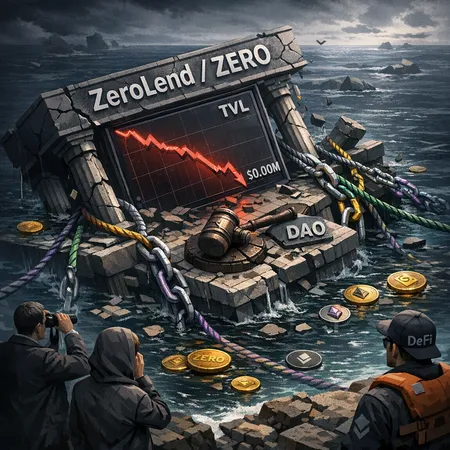
ZeroLend’s rapid wind-down is not just another headline — it’s a concentrated case study in DeFi sustainability failure. According to reporting, ZeroLend’s total value locked (TVL) crashed by roughly 98% before the team announced a wind-down, and the ZERO token plunged after the pullback and eventual shutdown announcement (The Block, Cryptonomist). For anyone building or backing small lending protocols, the lessons are immediate: fast-growing TVL can be illusory; multi-chain expansion introduces fragile operational layers; and token incentives can both create and destroy sustainability.
For the readers of this analysis — DeFi strategists, DAO members, and sophisticated retail users — the ZeroLend story is a checklist. It helps answer the question: what should I require, model, or refuse before putting capital into a nascent lending protocol?
A quick reconstruction: what happened with ZeroLend (the observable facts)
- TVL collapsed precipitously (reported ~98% fall) as assets drained from the protocol across chains.
- ZERO token price fell in concert with the TVL decline and investor confidence loss.
- Team announced a wind-down, citing unsustainability rather than an exploit or hack.
These facts are important because they tell a story of endogenous failure — the protocol’s mechanics and market dynamics failed to sustain operations — not a single catastrophic hack. The contemporary coverage from The Block and Cryptonomist corroborates that the wind-down followed a rapid unwinding of TVL and token value rather than only an external breach.
What the ZeroLend collapse reveals about product-market fit
Product-market fit for a lender is not just “people borrowed and supplied.” It’s sustainable, repeatable usage where rate models, asset selection and liquidity depth align with real demand.
- Mispriced risk: If lending rates are artificially high to attract deposits but do not reflect real credit/liquidation risk, borrowing demand can be speculative and ephemeral.
- Incentive-driven TVL: Heavy token emissions can inflate TVL without creating sticky usage. When incentives fade or emissions are diluted, deposits leave quickly.
- Fragile client mix: Relying on a small number of big depositors or on yield-chasing ephemeral funds creates concentration risk that collapses under modest outflows.
ZeroLend’s experience suggests the protocol was more incentive-led than product-led: TVL growth that depended on token rewards rather than durable borrowing demand is a red flag.
Capital efficiency and the illusion of scale
Capital efficiency measures how effectively a protocol converts TVL into productive lending (i.e., generating sustainable interest vs. subsidizing yields). Poor capital efficiency shows up as:
- Low utilization rates: large deposits sitting idle because of limited credit demand or conservative risk parameters.
- High subsidy-to-yield ratio: most of user returns come from token emissions rather than net interest income.
- Fragile leverage: strategies that rely on continuous inflows to rebalance collateral or fund rewards.
When TVL is mostly reward-driven, the protocol needs constant fresh capital to service rewards and maintain interest spreads. That creates a Ponzi-like fragility: if inflows stop, the economics collapse and users exit — exactly what appears to have occurred with ZeroLend.
Multi-chain operational complexity: more distribution, more failure modes
Going multi-chain is attractive: it opens new liquidity pools and markets. But it also multiplies operational risk.
- Liquidity fragmentation: TVL split across chains reduces single-chain depth and makes liquidation cascades more likely on thin rails.
- Cross-chain oracle sync: price feeds can lag or diverge across networks, introducing mismatched collateral valuations and liquidation mismatches.
- Bridge and gas risk: bridges and relayers introduce additional attack surfaces and latency; higher gas on one chain can cascade into liquidation stress elsewhere.
- Monitoring complexity: teams must observe and react across multiple networks, which increases the chance of human or tooling error.
ZeroLend’s multi-chain posture likely amplified off-ramps: capital could flee across chains quickly, and the protocol’s defenses were stretched across different environments.
Governance and incentive failures — the invisible leaks
Sound governance is a defensive control. ZeroLend’s shutdown indicates governance and incentive design did not provide either resilience or trust.
- Token distribution and concentration: heavy team/treasury allocations or concentrated token holders create exit risk — if a few parties sell, price collapses.
- Short runway for buybacks/stabilizers: without committed treasury measures to defend markets or buy back tokens, bear markets erode confidence fast.
- Governance paralysis or opacity: slow or opaque decision-making during a crisis prevents timely mitigations (e.g., pausing risky markets, adjusting emissions).
- Misaligned incentives: if token emissions reward short-term capital rather than long-term liquidity, LPs are incentivized to exit once yield is inferior.
These failures are not hypothetical. When holders see token value evaporate and governance cannot act quickly or credibly, panic accelerates outflows and TVL collapse.
How projects and LPs should stress-test DeFi lending businesses
Below is a practical checklist that both protocol teams and prospective LPs can use to evaluate risk. Treat it as a living framework: rerun tests quarterly and before any major capital move.
Protocol stress tests (for teams/DAOs):
- TVL shock scenarios: model 25%, 50%, 75% outflows within 48–72 hours. Can your reward spend, interest margins, and treasury cover this without insolvency?
- Tokenomics dilution paths: simulate emissions + vesting selling pressure over 12–36 months and its effect on market depth and price.
- Capital efficiency metrics: target utilization bands (e.g., 60–90%). If utilization <40% with high emissions, your model is subsidy-dependent.
- Cross-chain failure modes: simulate oracle lag, bridge downtime, and isolated chain liquidity drains; test liquidation bots in those scenarios.
- Governance stress: test emergency upgrade, pause, and treasury defense execution times; ensure multisig/quorum rules allow timely, secure action.
- Admin/guardian keys: run drills on key compromise and recovery; clearly document and publish the contingency plan.
LP/Investor due diligence (questions to ask and tests to run):
- What percentage of TVL is from native token staking vs. pure assets? High token-staked TVL is a red flag.
- Who holds the token supply? Insist on transparent cap table and vesting schedules.
- What is the true net interest margin (protocol interest minus subsidies)? If the margin is negative, ask why it’s sustainable.
- Request stress simulations: can the protocol provide model outputs for the TVL shock scenarios above?
- Ask about cross-chain risk controls: how are oracles reconciled, and what are bridge fallback plans?
- Governance responsiveness: what are the decision timelines for emergency measures and who can execute them?
These tests don’t require privileged access — many answers can be gleaned from on-chain analysis, published models, and straightforward questions to the team and governors.
Exit strategies and risk mitigation for LPs
Even with strong diligence, problems can occur. Here are practical exits and hedges:
- Tiered withdrawals: keep a rotation of assets across protocols; avoid >20% of liquid lending exposure in any single small protocol.
- On-chain limit sell orders: rather than panic-withdraw all at once, set withdrawal thresholds tied to token price or TVL movements.
- Hedging via options/shorts: for large exposures to protocol-native tokens (e.g., ZERO), consider cost-effective hedges where markets exist.
- Insurance and capital buffers: allocate a portion of capital to insurance protocols or maintain a liquidity buffer to avoid fire sales.
- Governance action: if you’re a DAO voter, use proposal mechanisms to insist on stronger runway, lower emissions, or timed buybacks early.
Practical metrics and red flags to monitor continuously
- Rapid TVL swings (>30% in 24–72 hours) without major market-wide catalysts.
- Token sell pressure coinciding with declining utilization — suggests deposits are reward-driven.
- Rising bad debt across markets or increasing reliance on treasury to subsidize interest.
- Increasing cross-chain liquidation events or oracle divergence warnings.
- Low on-chain activity from governance despite token price drops — voter apathy in crises is lethal.
Final lessons for builders and backers
ZeroLend’s wind-down crystallizes a set of durable lessons: growth without product-market fit is temporary, multi-chain reach multiplies risk, and token incentives must be paired with economic runway and accountable governance. For protocol teams, the priorities are clear: improve capital efficiency, keep cross-chain expansion measured and instrumented, and design tokenomics that incentivize long-term liquidity rather than ephemeral TVL. For LPs and DAO members, demand stress-test outputs, insist on transparency about token distribution and treasury defenses, and maintain exit playbooks.
Practically speaking, when you evaluate a lending project today, run the TVL-shock and token-dilution scenarios first. Ask how the team will respond if reward-driven deposits stop overnight. If they can’t answer credibly with on-chain data and rehearsed governance steps, act conservatively.
Small protocols can still succeed — but only when fast growth is matched by conservative assumptions and robust operational controls. Platforms like Bitlet.app and on-chain analytics make it easier to monitor exposures and perform scenario testing, but the human element — skeptical questioning, active governance participation, and disciplined LP behavior — remains decisive.
Sources
- The Block report on ZeroLend wind-down
- Cryptonomist coverage confirming ZeroLend shutdown and sustainability issues
For broader context on lending dynamics and cross-chain risks, readers may also find it useful to track analytics and governance discussions on leading DeFi and Blockchain coverage pages.