Institutionalizing Staked SOL: What HSDT’s Loans-on-Staked-SOL Mean for Treasurers
Summary
Why loans on staked SOL matter now
Helius (ticker: HSDT) has announced a Solana‑backed lending program that lets borrowers obtain loans against staked SOL without needing to unstake first. That functionality is important because it creates liquidity from what has traditionally been an illiquid yield‑bearing position. For many institutional treasuries the core problem has been simple: staking SOL generates attractive protocol rewards, but the tokens are locked or punished by unstaking lags. Being able to borrow against those staked positions preserves yield while freeing cash for operations or new investments.
This development sits at the intersection of staking liquidity, institutional lending and liquid‑staking markets. It should be read alongside broader trends in the crypto market — growing institutional custody, bespoke lending facilities, and rising interest in re‑staking and synthetic exposure — as products from exchanges, banks and protocols try to satisfy treasurers’ demand for both yield and liquidity. For context on Solana's broader ecosystem, many product teams still compare the tradeoffs here with liquid staking derivatives on other chains like Lido, and with DeFi primitives that try to synthetically recreate staking exposure (DeFi).
How the product actually works: mechanics and collateral dynamics
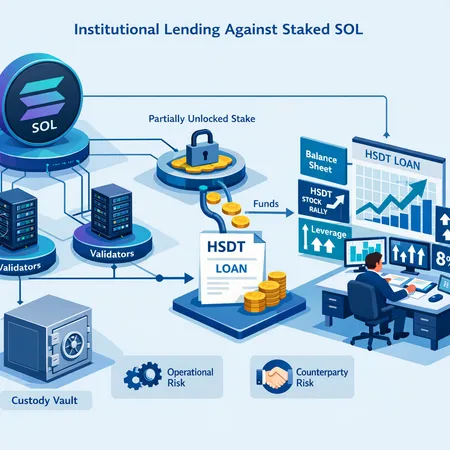
At a high level, the offering lets an institution pledge staked SOL as collateral and receive a loan in USD or stablecoins without triggering the unstake process. Practically, that requires the lender to accept either tokenized representations of stake or contractual custody arrangements that guarantee continued staking at the validator layer while the loan remains active.
There are two common architectures behind these products: (1) custodian + contractual pledge, where a qualified custodian holds and continues to delegate the stake on behalf of the borrower; and (2) tokenized staked‑SOL receipts that function like liquid staking tokens and can be rehypothecated. The HSDT announcement emphasizes a Solana‑backed lending program that targets institutional counterparties and keeps the stake active — the market treated the news as material, as covered by Coinpedia and Coingape. See coverage of the product and market reaction here: HSDT’s Solana‑backed lending program and the institutional framing in Coingape’s report on the stock rally.
Staking economics: how borrowing against staked SOL changes the calculus
Allowing loans on staked SOL alters the effective return profile of staking in several ways:
Net yield versus net cost: Treasurers will compare staking yield plus spread from the loan (if they lend out capital) against the borrowing rate they pay. If the cost of capital is below the staking yield, borrowing against staked SOL is accretive to returns; if not, it’s a leveraged play that reduces net yield.
Opportunity cost and flexibility: Previously, exiting a stake incurred opportunity cost (unstaking time, forgone rewards during the unstake window). Loans convert that illiquidity into immediate liquidity without redeeming the staked position, changing tradeoffs around portfolio rebalancing and hedging.
Counterparty and liquidation risk: Because UTx and other mechanics on Solana can make rapid liquidations costly, lenders will price in the risk that collateral falls below maintenance thresholds. That increases the effective margin calls or haircut policies applied to staked SOL compared with plain SOL.
Overall, this construct effectively allows institutions to “have yield and spend it” — at the expense of taking on interest cost and counterparty complexity.
Pressure on liquid staking and re‑staking markets
A product that preserves staking while unlocking liquidity reduces the immediate need for tokenized liquid staking derivatives (LSDs) for certain institutional users. That could produce three parallel effects:
- Reduced demand for retail‑oriented LSDs as large treasuries adopt custody‑backed loan facilities.
- Increased competition between LSD providers and custodial lenders; LSD platforms may need to compress fees or offer enhanced credit facilities to remain attractive.
- New re‑staking opportunities as institutional users look to redeploy borrowed capital into other yield strategies — which could include re‑staking, providing liquidity in DeFi, or even buying additional SOL.
If the lending model relies on tokenized receipts, it still feeds into the LSD ecosystem by creating more liquid units that can be traded or rehypothecated. If it relies on custodial pledge, it concentrates more voting power and staking balances under a smaller set of custodians and lending desks, which has its own decentralization implications.
Validator incentives and network health
Allowing loans on staked SOL without unstaking should be neutral to validators if the delegation stays intact and operators continue to receive rewards. But there are second‑order effects worth noting:
- Concentration: Institutional arrangements often favor a handful of qualified custodians and large validators, which could increase stake concentration and centralization risk on Solana.
- Slashing exposure: The economic exposure to slashing remains. Lenders and borrowers will negotiate who bears slashing losses; if that risk is pushed to borrowers, it changes the loss‑absorption profile of treasuries.
- Validator economics: If institutions increase delegated stake via borrowed proceeds, validators may capture more fees, but they may also face greater scrutiny and SLAs from enterprise clients.
Good stewardship and transparent SLAs will be essential to keep validator incentives aligned with network security.
Market reaction: HSDT stock and what the rally signals
Following the announcement, HSDT’s stock rallied — a quick market read of product/earnings potential. Coverage from Coinpedia noted the product launch and its immediate market impact, while Coingape highlighted the institutional angle, noting HSDT’s stock rallied ~15% in response. Those moves indicate capital markets view the product as potentially material to revenue and to enterprise adoption on Solana.
For treasurers and corporate product teams, the stock reaction is instructive: it shows that investors reward firms that lower the friction between staking rewards and liquid capital. But a share‑price move is not the same as product durability; adoption, counterparty defaults, and regulatory clarity will determine whether that revenue stream is predictable.
Operational, custodial and regulatory risks
Institutions considering these products must underwrite several operational vectors:
- Custody segregation and settlement: Is the staked collateral segregated from the lender’s balance sheet, or is it rehypothecated? How is client accounting handled? Treasurers should demand clear custody contracts and auditability.
- Liquidation mechanics: How quickly can collateral be liquidated if SOL price drops? Solana’s on‑chain liquidity conditions differ from Ethereum’s, and lenders must design robust liquidation rails.
- Slashing and downtime: Contracts must state who bears slashing penalties or rewards for missed blocks. Insurance or indemnities may be necessary.
- Regulatory and accounting treatment: Borrowing against staked assets may be treated differently by auditors and regulators than unsecured loans. Capital treatment, leverage ratios and tax treatment of staking rewards can all be affected.
Bitlet.app’s custodian and product teams frequently emphasize operational clarity when assessing similar custody‑and‑lend products; institutional buyers will do the same here.
What this means for SOL price and staking yields
There are plausible scenarios with differing price and yield outcomes:
- Positive feedback loop: If loans enable institutions to stay staked and also buy more SOL with borrowed funds, demand could push SOL price higher and reduce effective yield as staking rewards are distributed across a larger market cap. Higher prices can reduce nominal staking yield as APY is often expressed relative to USD value.
- Redistribution of yields: If borrowed funds are deployed into yield‑chasing strategies, it could compress yields elsewhere and shift volatility to other parts of the crypto market (e.g., increased memecoin or NFT speculation funded by borrowed stablecoins).
- Liquidity shocks: A fast deleveraging event (e.g., rapid SOL price drop triggering mass liquidations) could amplify downside pressure if lenders sell staked collateral in stressed market conditions.
Net effect depends on scale. A handful of large institutional programs will be manageable; broad adoption without clear liquidation rules increases systemic risk.
Practical checklist for treasurers and product teams
If you’re evaluating loans against staked SOL, consider this checklist:
- Legal & accounting: Obtain counsel on collateral treatment and reward recognition. Confirm whether staking rewards are considered income or yield for accounting.
- Custody & segregation: Insist on segregated custody or fully documented rehypothecation clauses. Ask for proof of validator delegation and reward flows.
- Stress tests: Model margin calls at 25%, 40% and 60% price declines and confirm operational timelines for liquidation.
- SLAs & insurance: Negotiate SLAs with validators and custodians; secure insurance for slashing, custody theft and operational downtime where possible.
- Capital vs yield: Run IRR models to compare borrow cost versus staking yield plus redeployment returns.
These are not theoretical concerns — they’re the day‑to‑day issues that determine whether a product is usable by a treasury.
Conclusion: an incremental but meaningful institutional step
HSDT’s loans‑on‑staked‑SOL program is an incremental step toward institutionalizing staking liquidity on Solana. It answers a real need — unlocking on‑balance‑sheet liquidity without sacrificing staking rewards — and the market’s positive reaction shows demand. But the long‑term impact will be decided by operational design, custody rules, and whether these facilities scale without amplifying liquidation and concentration risks.
For treasurers and product teams, this is a signal to start building operational expertise around staked assets: run stress scenarios, demand custody clarity, and treat re‑staking and rehypothecation as first‑class risks. If managed well, these lending programs can become a useful tool in the institutional toolbox; mismanaged, they can create systemic fragility in the SOL staking market.