Why RLUSD on Binance’s XRPL Matters: Liquidity Signals, Exchange Flows, and Ripple’s $1T Ambition
Summary
Executive snapshot
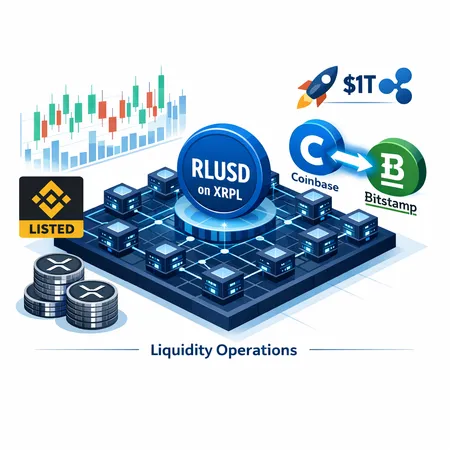
Binance’s finalized support for RLUSD on the XRP Ledger (XRPL) is more than a new ticker on an exchange: it creates a native stablecoin rail in an ecosystem with a built‑in decentralized exchange, fast finality, and low fees. At the same time, on‑chain observers flagged a 127.4M XRP transfer tied to Coinbase and Bitstamp that looks like operational liquidity movement rather than a simple dump. Taken together, these developments are useful signals for investors and token analysts tracking Ripple’s product expansion and balance‑sheet level liquidity operations.
What RLUSD on XRPL technically means
RLUSD is an issued token on XRPL — an IOU-style stablecoin that lives as a trustline-backed balance in wallets and is tradable directly on XRPL’s native order books. Practically this means:
- Native DEX connectivity: RLUSD can be swapped on XRPL’s built‑in decentralized exchange without bridging to Ethereum or other chains, enabling immediate rails for XRP pairs and on‑chain market making.
- Trustline model: Users and services opt into a trustline to hold RLUSD, which preserves issuer-credit semantics different from fully on‑chain collateralized stablecoins.
- Fast settlement and low fees: XRPL’s confirmation times and cost profile make RLUSD useful for frequent, low‑cost rails — from remittances to intra‑exchange settlement.
These technical properties increase the utility of RLUSD for traders and market makers, while keeping it under the governance and compliance posture dictated by the issuer. Binance’s finalized support confirms the token meets exchange acceptance criteria in practice (U.Today coverage).
Why a Binance stablecoin listing amplifies utility and liquidity
A major exchange listing is not just about user access; it reshapes the liquidity topology around a token. For RLUSD on Binance, expect three immediate effects:
- Order‑book depth and tighter spreads. When Binance enables a stablecoin pairing on XRPL, market makers and arbitrageurs are incentivized to provide quotes, compressing spreads between RLUSD and other fiat/crypto rails. That makes RLUSD a more practical unit of account and settlement medium.
- On/off‑ramp scale. Binance’s custody and fiat corridors let users convert between RLUSD and fiat at scale, increasing the stablecoin’s demand elasticity and making it a functional alternative to other USD‑pegged tokens in the ecosystem.
- Cross‑exchange arbitrage paths. RLUSD listed on Binance and tradable on XRPL’s DEX creates multi‑venue arbitrage loops (exchange order books ↔ XRPL on‑chain liquidity pools/DEX), which in turn enhance inter‑exchange liquidity for XRP and RLUSD.
In short, Binance listing turns RLUSD from a protocol experiment into a usable liquidity instrument — a step that benefits traders, institutional LPs, and developers building on XRPL. It also integrates RLUSD into broader crypto rails such as DeFi applications that seek lower‑cost settlement layers.
Interpreting the 127.4M XRP transfer: Coinbase → Bitstamp and liquidity operations
Recent on‑chain work highlighted a 127.4M XRP transfer that chain‑analysis links to Coinbase and Bitstamp wallets and to addresses monitored for liquidity activity (U.Today report). What should analysts infer?
- Exchange rebalancing and routing: Large inter‑exchange transfers are commonly used to rebalance inventories for order‑book resiliency and OTC settlement. A movement from a custody-centric exchange to another often precedes increased market‑making or client withdrawals on the receiving venue.
- Liquidity provisioning, not liquidation: The on‑chain pattern — size, counterparties, and timing — can be consistent with liquidity operations: depositing inventory on an exchange where market‑making will be more active or where new pairings (like RLUSD/XRP) need support.
- Potential Ripple involvement: While on‑chain data alone can’t prove corporate intent, the involvement of addresses associated with liquidity operations raises the possibility that these flows are coordinated to support deeper markets for XRP and related rails such as RLUSD.
Analysts should combine on‑chain metadata (wallet labels, clustering heuristics) with off‑chain disclosures and order‑book behavior to decide whether such flows signal near‑term selling pressure or deliberate liquidity provisioning.
Liquidity operations: how they relate to Ripple’s broader strategy
Large exchange transfers and stablecoin listings fit a coherent playbook if viewed as components of liquidity engineering: ensuring that markets are deep, spreads are narrow, and settlement rails are low‑friction so Ripple’s product stack can scale. For example:
- RLUSD gives market participants a XRPL‑native settlement medium that reduces dependency on external stablecoins.
- Exchange inventories and targeted transfers can seed liquidity for new RLUSD pairs, making those markets more attractive to traders.
- Liquidity operations help smooth volatility and support the narrative that XRPL is ready for higher‑frequency financial products.
This is not unusual in capital markets: firms seed new markets, coordinate with market makers, and use exchanges’ custody to bootstrap activity. For token analysts, the important signals are not just the raw transfer amounts but the subsequent effect on spreads, depth, and on‑chain turnover.
Garlinghouse’s $1T valuation aspiration — product ambitions seen through the lens of RLUSD and liquidity
Ripple CEO Brad Garlinghouse has publicly articulated a long‑term ambition for a $1 trillion valuation for the company (Cryptopolitan coverage). How does RLUSD and recent liquidity choreography connect to that bold target?
- Revenue and utility play: To approach a $1T valuation Ripple would need broad transactional volumes, products that capture sustainable fee flows, and enterprise adoption. Stablecoin rails like RLUSD — if widely used for remittances, on‑exchange settlement, and institutional flows — create recurring utility that can underpin revenue models.
- Ecosystem effects: A healthy RLUSD market on XRPL encourages third‑party services (custody, bridges, DeFi-like primitives) to build on XRPL, expanding total value captured by the platform. That network effect is a necessary ingredient for massive valuation targets.
- Regulatory and execution risk: Ambition must be matched with regulatory clarity and consistent product execution; lofty targets are conditional on market share, trust in the issuer, and predictable liquidity.
In short, the technical shipping of RLUSD onto major exchanges and observable liquidity operations are tactical moves consistent with an intent to scale product adoption — a prerequisite for any large valuation thesis.
Signals investors and token analysts should watch next
If you track Ripple’s expansion or XRP as an asset, prioritize these measurable signals:
- RLUSD liquidity on Binance: order‑book depth, daily traded volume, and spreads against XRP and major fiat pairs.
- Exchange inflows/outflows for XRP: persistent outflows to custodial addresses or concentrated inflows can presage liquidity shifts.
- On‑chain market‑maker activity: identify clustered addresses that place frequent small trades or rebalance between XRPL DEX and exchange order books.
- Trustline growth for RLUSD: increasing wallet counts with RLUSD balances suggests growing acceptance beyond market‑maker inventories.
- Price behavior after large transfers: if big transfers are followed by stable spreads and higher depth, then flows were likely provisioning liquidity; if followed by price pressure and widening spreads, selling may be dominant.
Tools from chain analytics providers, exchange order‑book snapshots, and on‑chain explorers focused on XRPL will help triangulate intent. Platforms like Bitlet.app and other market data services can surface P2P and installment demand that interacts with stablecoin rails.
Conclusion — reading liquidity as strategy
RLUSD’s arrival on Binance’s XRPL is a tactical milestone that improves the practicality of a XRPL‑native stablecoin. The 127.4M XRP movement linked to Coinbase and Bitstamp reads as an operational liquidity signal more than a narrative of forced selling — but interpretation requires observing the market reaction in real time. Together, new rails plus visible liquidity engineering fit into a wider picture of product expansion that maps cleanly to Ripple’s long‑term ambitions. For investors and token analysts, the takeaway is simple: watch the market microstructure — order books, spreads, trustlines, and address behavior — because those metrics will reveal whether these moves are foundational plumbing or short‑term balance‑sheet shuffles.
Sources
- U.Today — Binance finalized support for RLUSD on the XRP Ledger: https://u.today/ripple-usd-rlusd-on-xrp-ledger-integration-on-binance-finalized?utm_source=snapi
- U.Today — Coinbase, Ripple and Bitstamp linked to a 127.4M XRP transfer: https://u.today/coinbase-ripple-and-bitstamp-linked-to-172513649-xrp-transfer-via-on-chain-data?utm_source=snapi
- Cryptopolitan — Ripple targets $1T valuation (Garlinghouse comments): https://www.cryptopolitan.com/ripple-targets-1t-valuation/