Nexo’s U.S. Comeback: What a Compliance-First Relaunch Means for Regulated Crypto Lending
Summary
Quick thesis
Nexo’s relaunch of a U.S.-compliant product suite — Yield, Exchange, Loyalty, and Credit Lines — marks a visible pivot toward regulation-first crypto services. That pivot matters: it changes how yields are priced, how custody and counterparty risk are managed, and how retail and institutional customers select safe, regulated partners. For many traders, Bitcoin remains the primary market bellwether, but custody and lending decisions are increasingly driven by licensing, auditability, and contractual protections rather than headline APYs.
What Nexo is relaunching (the product set)
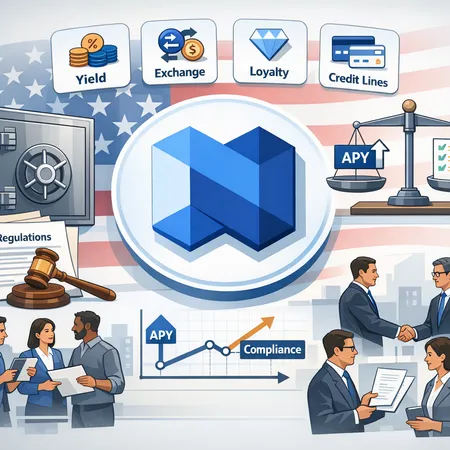
Nexo’s announced package in the U.S. bundles four customer-facing products that mirror its global offering but with a compliance-first overlay. According to industry reports, the relaunch includes:
Yield
A regulated yield product offering interest on deposited crypto and stablecoins. This will likely be structured with enhanced KYC/AML, clearer terms of service, and — crucially — limits or reserve practices designed to satisfy U.S. regulators and partners.
Exchange
A U.S.-compliant trading venue offering spot conversion between fiat and crypto. Exchange licensing and custody separation are central to rebuilding trust with U.S. counterparties and banking partners.
Loyalty
A loyalty program tied to the native NEXO token and customer activity. Loyalty mechanics can survive regulatory scrutiny if token incentives are carefully disclosed and structured to avoid securities issues.
Credit Lines
Collateralized borrowing against crypto holdings with underwritten credit terms and formal disclosure of margining, liquidation triggers, and borrower protections.
Both Benzinga and Bitcoin.com covered the relaunch and emphasize that these products are being offered under U.S.-specific compliance frameworks rather than simply porting overseas products back onto U.S. soil (Benzinga coverage, Bitcoin.com summary).
Regulatory backdrop that prompted the exit and shaped the relaunch
Nexo’s earlier pullback from the U.S. market followed intensified regulatory scrutiny across federal and state regulators who were tightening rules around custody, lending, and consumer disclosures. While the precise settlement terms and timeline vary by jurisdiction, public reporting shows Nexo repositioning its U.S. offering to meet regulator expectations and to remedy prior shortcomings.
The practical implications of that history are twofold. First, product design now embeds compliance mechanisms: clearer KYC/AML, contractual clarity on lending risks, custody segregation and third-party attestations, and an emphasis on licensed rails. Second, marketing claims like “best-in-class APY” must be tempered by legally defensible disclosures and caps that are far more explicit than in offshore markets.
How a compliance-first relaunch reshapes competition among custody providers and regulated lenders
A U.S.-compliant Nexo changes incentives across the ecosystem. Expect these dynamics:
Rate compression versus safety: Regulated offerings typically accept lower headline APYs because they internalize legal, operational, and insurance costs. That makes regulatory-compliant players less price-aggressive but more predictable counterparty choices for institutional accounts.
Standardization pressure: If Nexo’s approach is accepted by U.S. counterparts (banks, custodians, auditors), other providers will need comparable controls — proof-of-reserves practices, independent audits, insured custody relationships — to avoid losing institutional flow.
Custody specialization: Some custody providers will double down on bank-grade custody (bank trust charters, insured custodial solutions) while others will compete on integrated lending/custody stacks. That segmentation clarifies the market: self-custody for maximum control, bank-trust custody for legal protections, and integrated lenders for convenience but with explicit contract risk.
Token vs. cash economics: Loyalty/token programs such as NEXO’s will be scrutinized for securities law exposure and for economic fairness. That may limit aggressive tokenized APY boosts that were common in unregulated markets.
Collectively, these forces nudge the market from a “wild west” APY arms race toward a more utility-oriented competition where compliance, counterparty credit, and contractual clarity become differentiators.
Practical considerations for retail and institutional customers
Whether you’re a retail saver chasing yield or a compliance team vetting counterparties, the relaunch requires a new checklist of trade-offs.
APY trade-offs
Higher yields often imply higher counterparty or protocol risk. Under U.S. compliance, yields will likely be lower than offshore peers because of:
- KYC/AML costs and slower onboarding
- Legal and licensing costs passed to customers
- Collateralization and segregation requirements that reduce leverage-driven returns
Accept that a lower APY may buy you legally enforceable contracts, better disclosure, and reduced tail risk.
Counterparty and custody risk
Key items to evaluate:
- Custody model: Is customer crypto held in a bankruptcy-remote trust or with an insured custodian? Who is the custodian and what is the charter?
- Insurance: What does insurance cover (hot wallet theft vs. custodial insolvency)? Who underwrites it?
- Proofs and audits: Does the firm publish audited proof-of-reserves and undergo regular third-party attestations?
- Legal recourse: Which law governs the account agreement? Are there arbitration clauses that limit remedies?
Retail customers often underestimate the bankruptcy and commingling risks of custodial lending products; institutional compliance teams will focus on contractual remedies and operational due diligence.
Disclosure and transparency
Look for these concrete disclosures before committing funds:
- Clear APY methodology and caps (how rates are calculated and how often they can change)
- Liquidation mechanics and collateral haircuts for credit lines
- Counterparty exposure limits (how customer assets are used in the firm’s balance sheet)
- Regulatory licenses and enforcement history
A product that refuses or obfuscates these disclosures is not a fit for risk-sensitive investors.
A practical counterparty evaluation checklist
For teams deciding whether to use Nexo (NEXO ticker), or any regulated relaunch platform, use this checklist:
- Licensing: Does the provider hold relevant state or federal licenses for custody and lending?
- Custodian independence: Are custodial assets held by a separate trust or regulated custodian?
- Proofs and audits: Are there recent independent audits or proof-of-reserve attestations?
- Insurance scope: What incidents are covered and what are the exclusions?
- Contract clarity: Are borrower protections, liquidation triggers, and dispute mechanisms transparent and understandable?
- Token economics: If a loyalty token is offered (e.g., NEXO), are incentives clearly disclosed and legally vetted?
- Bank and partner relationships: Does the firm have visible U.S. banking or institutional custody partners?
These items separate marketing from enforceable protections.
Broader market implications and what to watch next
Nexo’s regulated relaunch is a case study in how legal constraints reshape crypto product economics. Look for these downstream effects:
- Institutional onboarding accelerates where compliance is credible, pulling liquidity into regulated rails and away from unregulated pools.
- Smaller offshore players may struggle to match the credibility of licensed U.S. entrants, driving consolidation or exit.
- Product innovation will shift toward compliance-enhancing features — e.g., loan agreements modeled on traditional financing, insured custody products, and standard audit practices.
For retail and compliance teams, this environment favors platforms that trade off some headline yield for contractual clarity, custody assurances, and regulatory visibility. Platforms and tools such as Bitlet.app that monitor counterparties and yields will become more valuable as the market stratifies between compliant and non-compliant providers.
Bottom line
Nexo’s U.S. comeback, built around regulated Yield, Exchange, Loyalty, and Credit Lines, is less about simply relaunching products and more about proving that crypto lending can operate within U.S. legal frameworks. Customers should expect lower nominal yields in exchange for clearer legal protections, improved custody segregation, and stronger disclosure. For regulated lenders and custodians, the bar has risen: compliance, audited transparency, and bank-grade custody will be the new competitive turf.
Sources
- Nexo makes a comeback in US with a comprehensive suite of digital asset services (Benzinga): https://www.benzinga.com/crypto/cryptocurrency/26/02/50641913/nexo-makes-a-comeback-in-us-with-a-comprehensive-suite-of-digital-asset-services?utm_source=benzinga_taxonomy&utm_medium=rss_feed_free&utm_content=taxonomy_rss&utm_campaign=channel&utm_source=snapi
- Nexo relaunches Yield, Exchange, Loyalty and Credit Lines in United States (Bitcoin.com): https://news.bitcoin.com/nexo-relaunches-yield-exchange-loyalty-and-credit-lines-in-united-states/