Why XRPL Claims the Lead in Tokenized U.S. Treasuries — and Why On‑Chain Activity Still Trails
Summary
Executive snapshot
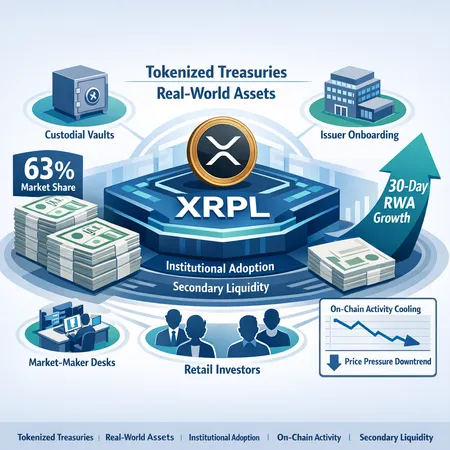
The XRP Ledger (XRPL) has quietly consolidated a leading position as a tokenization hub for U.S. Treasuries and other real‑world assets (RWA). A recent industry report estimates that roughly 63% of tokenized U.S. Treasury bills are now issued on XRPL, and short‑term RWA issuance metrics show rapid 30‑day growth. (CoinGape, Coinpaper).
But that market share and headline growth do not mean the chain looks necessarily busy from a retail on‑chain perspective. On‑chain activity indicators have cooled—active addresses and transactions are down—and price action for XRP hasn’t shown a durable lift. Understanding why issuance and on‑chain activity can diverge is critical for institutional product teams weighing XRPL for tokenized treasuries or other RWA programs.
For context, many product teams evaluate XRPL alongside public rails and permissioned tokenization platforms, and even DeFi ecosystems; for some workflows the comparison will be more with DeFi rails than with spot markets like Bitcoin. Bitlet.app and similar platforms highlight the practical gap between issuance and secondary liquidity in client deployments.
The evidence: XRPL’s market share in tokenized treasuries and RWA growth
Two recent data points are frequently cited by market participants:
A report showing that ~63% of tokenized U.S. Treasuries are issued on the XRPL. That figure reflects active issuer choice and a set of native token standards and tooling that favor programmatic issuance. (See the CoinGape write‑up.) (CoinGape)
Independent trackers reporting fast 30‑day growth in real‑world asset issuance on XRPL, placing it among the top chains for short‑term RWA inflows. This suggests institutional issuers are experimenting with XRPL for liquidity and settlement efficiency. (Coinpaper)
Together these metrics imply XRPL has become a preferred corporate route for tokenizing simple, high‑quality assets where stable, low‑cost settlement and compliance hooks matter. The ledger’s architecture—finality, predictable fees, and active efforts around tokenization standards—helps attract asset managers and custodians that need deterministic settlement.
Why issuance can outpace visible on‑chain activity
A headline like “63% of tokenized treasuries on XRPL” is meaningful for market structure, but it can mislead if one assumes issuance equals retail usage. There are several technical and market reasons for the divergence.
1) Custodial issuance and off‑chain settlement workflows
Many institutional issuers mint tokens into custodial wallets controlled by banks, broker‑dealers, or regulated custodians. Those tokens represent positions in legal contracts but may never touch a retail address or public exchange order book. Custody flows concentrate activity into a small set of addresses and reduce visible on‑chain transactions; most movement is internal to custody layers or reconciled off‑chain.
2) Sponsored and whitelisted issuance models
Issuers often use permissioned or whitelisted token models where transfers require pre‑approved counterparties. That reduces open market circulation and means tokens can be used for settlement between counterparties without producing high retail transaction volumes.
3) Issuers onboarding slowly and holding liquidity pools private
Onboarding institutional clients involves compliance checks, KYC/AML, legal wrappers, and integration of custody and accounting systems. That process takes time, so large notional issuance can sit in escrowed or issuer‑controlled accounts rather than circulating in public markets. Even when issuance is live, counterparties may prefer bilateral settlement or OTC trades rather than routing to public exchanges.
4) Thin secondary market liquidity and market‑maker economics
Secondary liquidity is expensive and strategic. Market makers provide two‑way pricing only when they can hedge and monetize risk. For tokenized treasuries, hedging often requires positions in cash treasuries or futures; if those hedges are imperfect or capital costs are high, MM capacity will be limited. The result: tokens can exist in large supply but trade infrequently on public order books, which depresses on‑chain trading volume and can place downward pressure on related native tokens like XRP.
5) Macro and sentiment pressures on token price vs. institutional demand
Network upgrades or institutional adoption don’t automatically translate to token price rallies. Short‑term macro risk, liquidity rotation, and concentrated holder behavior can keep XRP price and on‑chain activity muted even as institutional flows increase on the ledger. CryptoSlate and U.Today have both reported falling active addresses and commentary that XRPL upgrades haven't yet translated into consistent volume or price strength. (CryptoSlate, U.Today)
Strategic implications for institutional product teams
If your firm is evaluating XRPL as a tokenization channel for U.S. Treasuries or other RWA, treat issuance metrics and on‑chain user metrics as complementary but distinct signals. Below are practical considerations.
Due diligence checklist for asset managers and product leads
- Settlement model: Decide whether tokens will be custody‑only, permissioned transfers, or freely tradable. Each has tradeoffs for capital efficiency and compliance.
- Custody and legal wrappers: Validate custodians’ integration with XRPL wallets, redemption workflows, and regulatory reporting.
- Secondary liquidity plan: Require market‑making commitments or liquidity providers in commercial agreements if you expect exchange trading. Without it, tokens may remain illiquid despite large issuance.
- Hedging strategy: Design hedges that account for basis risk between tokenized instruments and cash markets. Treasury tokens may need explicit OTC or futures hedges.
- Operational maturity: Check issuer onboarding times, API reliability, and reconciliation tooling — issuance velocity matters less than predictable settlement for institutional clients.
For market makers and liquidity providers
Market makers should price the asymmetry between custodied token supply and expected retail demand. Consider: guaranteed buy/sell lines for primary issuers, cross‑venue hedges, and capital allocation to latency‑sensitive order books. If you can offer reliable two‑way liquidity, you unlock secondary markets and help issuers achieve broader adoption.
For retail investors
Retail participants should not equate issuance dominance with trading opportunity. Tokenized treasuries on XRPL are primarily institutional plumbing today; retail exposure often arrives later and may be limited to specific exchanges or wrapped products. Assess liquidity, redemption mechanics, and counterparty risk before trading.
Metrics and signals to watch moving forward
To monitor whether XRPL’s issuance leadership begins to translate into sustained on‑chain activity and healthier market structure, track these indicators:
- Net tokenized issuance vs. circulating supply: Are tokens remaining in issuer/custody accounts or being distributed widely?
- Exchange listings and order‑book depth for tokenized treasuries: Real secondary liquidity shows up in spreads and volume.
- Active address and transaction trends: Persistent declines in active addresses (like the ~26% fall reported recently) are a red flag for retail engagement. (U.Today)
- Market‑maker commitment documents or flow agreements: Firms that require MM support should contractually secure liquidity.
- Regulatory and legal developments around tokenized securities: A change there can rapidly shift on‑chain usage patterns.
Bottom line
XRPL’s emergence as a major hub for tokenized U.S. Treasuries and RWA is real and strategically important: it represents genuine issuer preference for a ledger that offers predictable settlement and tokenization features. But issuance dominance does not automatically deliver healthy secondary markets, retail activity, or upward price pressure for XRP. Custodial issuance, permissioned transfer models, onboarding friction, and market‑making economics explain much of the divergence.
For asset managers and institutional product teams evaluating XRPL, the right framing is pragmatic: design your product around settlement and custody first, then secure secondary liquidity through market‑making agreements and distribution channels. If you do that, XRPL can be an efficient, cost‑effective channel for tokenized treasuries and other RWA — but only if the whole market plumbing (custody, legal, hedging, and liquidity) is built to support real trading, not just issuance.
Sources
- Report on tokenized U.S. Treasuries and XRPL market share: https://coingape.com/63-of-tokenized-u-s-treasuries-now-issued-on-xrp-ledger-report/
- XRPL 30‑day RWA growth coverage: https://coinpaper.com/14670/xrp-ledger-surges-to-second-in-30-day-real-world-asset-growth?utm_source=snapi
- On‑chain activity decline and active addresses: https://u.today/xrp-network-activity-down-26-as-active-addresses-fall-to-40778?utm_source=snapi
- Analysis of XRPL upgrades vs. price/volume performance: https://cryptoslate.com/xrp-struggles-despite-xrpl-upgrades-and-rising-whale-activity/