Bitget Wallet x Hyperliquid: Permissionless Onchain Macro Markets and What They Mean for Traders
Summary
Executive snapshot
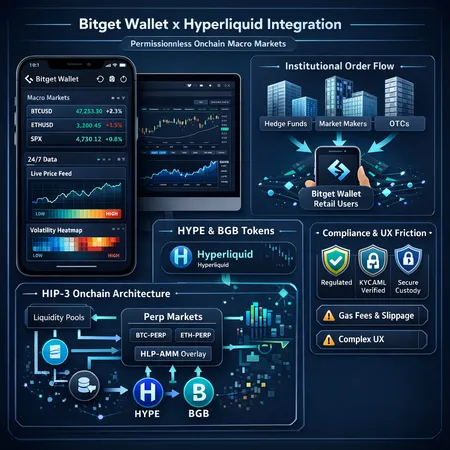
The Bitget Wallet integration with Hyperliquid embeds permissionless onchain macro markets into a self-custody trading app. That simple sentence understates the implications: you now have continuous, permissionless macro exposure accessible from a wallet UI, not only from centralized exchanges. The integration is built on Hyperliquid’s HIP-3 rails and aims to bring deep macro products — futures, perpetuals, macro swaps — into smart contracts that live in users’ wallets while preserving custody of keys.
For product and growth leaders at exchanges and wallets, and for sophisticated retail traders, the important questions are: how does HIP-3 work under the hood, how will liquidity and volatility change when Wall Street-like flows run onchain 24/7, and what UX, compliance, and risk controls must be put in place? I’ll walk through the technical design, token economics for HYPE and BGB where relevant, microstructure scenarios, and concrete risk-management recommendations.
What HIP-3 enables: a technical overview
HIP-3 is the infrastructure layer Hyperliquid describes as enabling permissionless macro markets and plug-and-play integrations for wallets and custodians. In practical terms HIP-3 provides several primitives:
- Permissionless market creation and settlement: smart-contract templates that can spin up derivatives markets (perpetuals, options, macro swaps) with onchain settlement logic and clear margin rules.
- Oracle and pricing layers: modular oracle inputs (for macro indexes or composite price feeds) and smoothing mechanisms to prevent short-term oracle manipulation.
- Margin, liquidation and clearing engine: onchain state machines that track collateral, unrealized PnL, maintenance margins, and liquidation paths, often backed by insurance funds and auction/routing mechanisms.
- Integration API for wallets: Light client or RPC-level hooks so wallets (like Bitget Wallet) can show positions, request signed actions, and display risk without surrendering custody.
This architecture lets a wallet act as a trading UI and signature provider while HIP-3 smart contracts handle trade execution and settlement. Hyperliquid’s product announcement and technical framing are summarized in reporting on the Bitget Wallet partnership and HIP-3 infrastructure here.
Design choices that matter
HIP-3 favors smart-contract-cleared markets rather than centralized custody; that reduces counterparty exposure but increases reliance on oracle integrity, gas economics, and smart-contract security. The design also tends toward composability: liquidity can come from AMMs, concentrated LPs, or offchain market makers that post onchain commitments.
Token economics: HYPE and BGB — roles and incentives
HYPE is Hyperliquid’s native token (used to bootstrap liquidity and align incentives), while BGB is Bitget’s ecosystem token. In integrations like this, tokens typically serve complementary roles:
HYPE: incentive layer for liquidity provision, fee rebates, staking to secure onchain market parameters, and possibly governance over market templates and risk parameters. If HYPE rewards are used for market-making incentives, they can quickly attract deep liquidity, lowering slippage but potentially increasing short-term speculative turnover.
BGB: used by Bitget to extend fee discounts, cross-promotion, and to subsidize user acquisition inside the Bitget Wallet UI. BGB could be layered into promotions (reduced fees for paying or staking BGB) and co-incentivized liquidity mining with HYPE.
Token design decisions matter because they affect who provides liquidity, for how long, and under what conditions. If HYPE emissions are front-loaded or short-term, liquidity might be ephemeral; sustainable rewards tied to realized fees and staking durations encourage longer participation and deeper market depth.
Institutional flow meets retail self-custody: onboarding dynamics
Bringing institutional-style macro products onto wallets is not just a UX change — it’s a distribution transformation. Institutional flows generally mean larger order sizes, algorithmic execution, and an appetite for leverage. When those flows interact with retail self-custody users:
- There’s potential for liquidity aggregation: pockets of retail liquidity in self-custody could be matched with institutional makers onchain, improving fills for both sides.
- Execution patterns shift: institutional TWAP/VWAP strategies will run around retail activity, and arbitrage bots may use funding-rate differentials and cross-exchange price gaps to extract profit.
- Onboarding frictions remain: institutions require audit trails, legal frameworks, and sometimes custody guarantees; retail users require simple UX and clear risk warnings. The integration reduces custody friction but does not remove KYC/regulatory requirements that institutions face.
News coverage framed the move as a step that "puts Wall Street onchain," noting potential volatility implications when macro desks can access onchain rails directly (see the NewsBTC analysis) here.
How 24/7 onchain macro markets could alter market volatility and microstructure
24/7 permissionless macro markets change the timing and shape of volatility in several ways:
- Persistent coverage of macro events: macro desks can trade reactions around news immediately; there’s no exchange close. That compresses the latency between news release and price discovery, potentially increasing immediate intraday volatility.
- Funding-rate mechanics become continuous signals: perpetual funding becomes a persistent cost signal that institutional players will arbitrage; funding spikes may induce leveraged position adjustments and cascade liquidations in shallower markets.
- Liquidity fragmentation and arbitrage: liquidity will be fragmented across onchain venues and CEXs. Efficient arbitrage will reduce long-term price discrepancies but may increase short-term volatility as bots chase cross-market spreads.
- Weekend and regional-event risk: previously thin periods (weekends, holidays) become hot windows for retail-led price moves, which institutional desks will either try to dominate or provide counterflow for — both can amplify short-term swings.
Microstructure scenarios to watch:
- Scenario A — Deep institutional provision: large makers post deep limits, spreads tighten, and retail execution improves; volatility becomes more tied to genuine macro events rather than execution noise.
- Scenario B — Episodic liquidity: incentive-driven liquidity dries after rewards end; funding and slippage increase; volatility spikes when large orders hit shallow books.
- Scenario C — Cross-market cascades: liquidation events on onchain markets propagate to CEXs and vice versa, creating faster and larger drawdowns unless unified risk models and cross-margining emerge.
Regulatory and compliance friction points
Permissionless onchain macro markets raise thorny regulatory questions:
- Securities and derivatives law: depending on jurisdiction, macro derivatives could be regulated products. Who is the regulated entity — the smart contract deployer, the interface provider (Bitget Wallet), or the liquidity provider? Clarifying liability and compliance responsibilities is crucial.
- KYC/AML: institutions will demand counterparties that meet KYC/AML standards. Permissionless markets complicate this, creating tension between censorship-resistant access and regulated onboarding.
- Cross-border trade and sanctions: self-custody + permissionless rails risk sanction exposure for participants and integrators. Wallet UIs might need to implement compliant access controls or segregated product offers per region.
- Consumer protection: presenting leveraged macro products in a self-custody app demands strong UX guardrails: clear margin math, simulated PnL, and explicit liquidation risk — regulators will expect these features.
Product leaders should coordinate legal, compliance, and engineering early: decide what activities are disallowed in given jurisdictions, whether wallets will enforce geofencing, and whether integrated KYC modules are offered for advanced product access.
UX and operational friction points for self-custody traders
Self-custody users gain control but also absorb operational complexity. Common frictions:
- Gas and UX abstraction: paying gas for margin updates, funding settlements, and liquidations creates cost uncertainty. Wallets must abstract costs or offer meta-transaction payers.
- Understanding leveraged onchain positions: many retail users underestimate how maintenance margin, funding rates, and slippage compound risk in perpetuals.
- Recovery and security risk: mixing high-leverage trading with single-key wallets increases catastrophic loss risk. Multisig or delegated signing models can be safer for larger positions.
- Liquidity and slippage: onchain depth varies; the UI must display expected slippage and visible onchain liquidity.
For many users, the first interface is a wallet. That means education overlays, simulated trades, and conservative default leverage should be standard UX decisions.
Risk-management recommendations (for traders and exchanges/wallets)
For exchanges/wallet integrators
- Implement progressive KYC tiers and matched product availability per compliance level.
- Enforce onchain circuit breakers and dynamic liquidation models that account for gas spikes and oracle delays.
- Maintain robust insurance funds and transparent rules for their use; incentivize third-party liquidity makers that will provide depth during stress.
- Offer meta-transaction relayers or gas credits for margin-critical actions to avoid liquidation spirals caused by failed transactions.
For traders (sophisticated retail and institutional desks)
- Treat onchain macro products as higher tail-risk: reduce position sizing compared to analogous CEX exposures until you understand funding and slippage.
- Use cross-venue hedging: monitor spreads to CEXs and be ready to execute offsetting trades if onchain fills are poor.
- Monitor funding rates as a persistent carry cost; factor them into expected returns and rebalancing frequency.
- Prefer multisig or delegated signing for large positions; consider automated stop-loss logic pinned to onchain conditions.
Product and go-to-market considerations
To onboard institutional flow while protecting retail users, teams should combine token-aligned incentives (HYPE, BGB) with durable liquidity programs and regulatory clarity. Joint marketing must not oversell leverage products without simultaneously rolling out education and built-in risk controls.
Integration plays like this are likely to accelerate wallet-led product innovation; expect more onchain macro rails to appear in other wallet ecosystems and apps (platforms such as Bitlet.app will watch closely for UX patterns and regulatory guardrails).
Conclusion
The Bitget Wallet × Hyperliquid integration via HIP-3 is a milestone: it makes permissionless, 24/7 macro markets accessible from self-custody apps. That opens realistic pathways for institutional flows to touch retail wallets, reshaping liquidity, volatility, and product distribution. The upside is deeper, more accessible markets and novel UX experiences; the downside is amplified tail risk, regulatory ambiguity, and UX pitfalls for unwary users. Product teams must design conservative defaults, robust onchain risk controls, clear legal boundaries, and token economics that encourage sustainable liquidity rather than short-lived spikes.
For many traders, Bitcoin will remain a primary instrument for macro exposure, and onchain macro primitives will increasingly intersect with broader DeFi infrastructure. Expect the next 12–18 months to reveal whether the new mix of institutional flow and retail self-custody smooths markets or increases episodic volatility — and design accordingly.