When a 10-Year-Dormant Wallet Wakes: Forensics, Coinbase, AML and the Market Risk of 500 BTC

Summary
What happened — the facts in brief
On March 2026 a decade-old Bitcoin address long linked to Irish criminal Clifton Collins reactivated and moved roughly 500 BTC into Coinbase. Initial reporting surfaced on U.Today and was independently covered by other outlets citing on-chain alerts from Arkham Intelligence and similar services. The timing matters: this flow arrived into a market already showing rising open interest and elevated leverage, a backdrop summarized in recent coverage from CoinDesk. The move is small relative to BTC’s total supply but large in absolute terms and consequential for short-term order flow and compliance.
For many traders, Bitcoin remains the primary market bellwether — which is why dormant-wallet awakenings tied to legal risk get disproportionate attention. In this article I unpack the on-chain forensic signals, how custodial platforms typically handle legacy tainted coins, the AML/compliance levers that come into play, and practical ways traders should price the risk of unexpected supply shocks amid a leveraged market.
Reading the on-chain evidence: who likely moved the coins?
On-chain forensics starts with a few core observations: the address cluster history, the timing and structure of transactions, whether the coins were consolidated or spent from many old UTXOs in a single sweep, and the destination pattern (direct to a known Coinbase deposit address vs. intermediary services).
Cluster history and attribution: chain-analytic firms maintain cluster tags linking addresses to entities (individuals, services, or known criminal wallets). Reports noted Arkham Intelligence flagged the movement, which is consistent with how researchers detect a long-dormant cluster becoming active. See the initial reports at U.Today and Benzinga which reference these flags.
Transaction pattern: a single consolidated sweep into one custodial deposit address is a strong signal the owner intended a fast on-ramp into a regulated exchange — possibly to liquidate, to launder through exchange liquidity, or to respond to enforcement pressure. Multiple small transfers or routing through mixers would indicate a different intent. Public reporting indicates a significant deposit to Coinbase rather than a complex mixing chain.
Time-of-day and order book context: combining the on-chain timestamp with exchange order-book snapshots (or trade tape) lets analysts infer whether the deposit preceded large sell orders or was parked awaiting KYC/AML screening. With elevated leverage in the market, a deposit can be the prelude to rapid liquidation if the owner shorts or triggers margin calls elsewhere.
Taken together, the simplest interpretation — and the one forensic signals currently favor — is that the wallet’s controller consolidated long-held UTXOs and deposited them to Coinbase, likely to access fiat/wrapped liquidity or to comply with a legal demand. But attribution on-chain is probabilistic; custody records and legal notices to Coinbase will ultimately reveal more.
How custodial platforms like Coinbase treat legacy "tainted" coins
When a regulated exchange receives coins linked to criminal activity, it sits at the intersection of technical screening and legal obligation. Exchanges like Coinbase operate multi-layered processes:
Automated screening: incoming deposits are scored by transaction-risk engines (internal tools plus third-party providers) that flag matches to tagged clusters, mixer heuristics, or OFAC-sanctioned addresses.
Manual review and escalation: high-risk deposits (especially large ones like 500 BTC) are escalated to compliance teams for additional review and KYC checks. That can delay crediting to the user’s account until identity and intent are verified.
Legal hold or freezing: if law enforcement submits a legal process (subpoena, court order), exchanges may be required to freeze funds or provide customer records. Past industry practice shows exchanges comply when presented with valid legal requests; the duration and outcome depend on jurisdiction and the nature of the alleged crime.
Reporting and SARs: suspicious activity reports (SARs) can be filed with regulators. The presence of a public criminal linkage makes SAR filing likely, even if the user appears to be the original holder.
It’s important to be cautious about assumptions: a deposit to Coinbase does not equal an automatic seizure. The exchange must balance user rights, KYC verification and legal orders. Nonetheless, from a compliance risk perspective, a large deposit from a flagged cluster will attract close attention and likely be subject to holds while Coinbase and authorities coordinate.
This combination of automated flags, manual compliance review and possible legal action is why custodial deposits of "tainted" coins often become multi-week stories rather than instant liquidations.
AML/compliance implications — what compliance teams should expect
For compliance professionals, a 500 BTC deposit from a decade-dormant, criminal-linked wallet triggers a predictable playbook:
Immediate transaction scoring and identity verification: the receiving account (if known) will be subject to KYC re-check. If the deposit arrives into a known Coinbase-managed wallet without onboarding identity, Coinbase’s internal controls determine next steps.
Coordination with law enforcement: regulators or police may request information or issue holds. Exchanges typically have established channels for emergency legal process.
Enhanced due diligence (EDD): compliance teams will seek provenance documentation. If the depositor claims inheritance, custody change, or court-ordered release, firms will validate documents and timelines.
Civil and criminal risk assessment: compliance counsel will evaluate asset seizure risk, potential civil forfeiture, and reputational exposure.
OFAC/sanctions screening: even older coins can be subject to new sanctions; screening is continuous. A historically clean coin can be tainted retroactively if new sanctions or findings appear.
Operationally, expect extended holds or delayed fiat withdrawals until compliance teams clear the deposit. From a policy perspective, firms will document chain-of-title and preserve evidence for potential litigation or regulatory review.
Market impact: why a dormant-wallet wake-up can move prices
Large dormant-wallet flows are market-moving for several reasons:
Liquidity absorption: 500 BTC deposited to an exchange represents potential immediate sell pressure if the owner intends to liquidate. Even if only a fraction is sold, it can cross multiple price levels and push through stop-loss clusters.
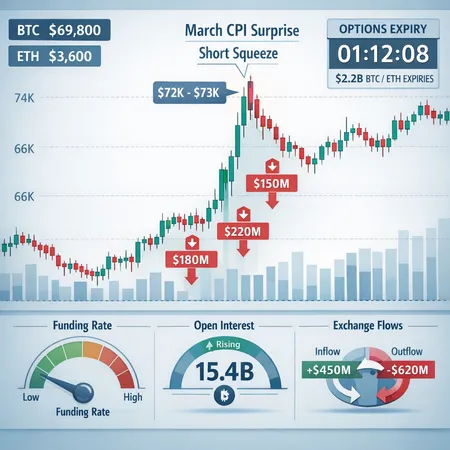
Signal amplification: markets interpret such deposits as supply entering the liquidity pool. When open interest is rising — as CoinDesk recently documented — there’s more leverage on both sides; a sudden sell can cascade into liquidations, amplifying a fall.
Behavioral reaction: algorithmic funds and systematic desks monitor exchange inflows as a risk signal. A rapid, large deposit can trigger algorithmic protective actions (reducing long exposure, widening spreads) which reduces available on-book liquidity.
Options and skew effects: sizable expected selling increases downside skew in options markets, pushing implied vols higher on puts and increasing hedging costs for dealers. That repricing can feed back into spot through delta-hedging dynamics.
Historical analogs are instructive. NewsBTC’s analysis of previous setups shows how certain order-flow patterns preceded large drops; the difference here is the mix of legal taint and size. In a choppy, leveraged market, even a single concentrated flow can act as a catalyst.
Pricing the risk: practical guidance for traders
Traders must convert forensic and exchange signals into position sizing and hedging decisions. Here’s a pragmatic checklist:
Monitor exchange inflows and reserve changes: a persistent increase in Coinbase reserves relative to other exchanges is a red flag. If 500 BTC stays on-exchange, treat it as potential future sell pressure.
Watch funding rates and open interest: rising open interest and positive funding make the long side vulnerable to liquidations. CoinDesk’s recent note on increasing open interest underscores this.
Track order-book depth and VWAP levels: large sells move through the book. Calculate the amount of BTC required to move price to key support levels and stress-test your position size.
Use options to hedge asymmetry: buying puts or constructing collars can limit downside while preserving upside. Watch implied volatility and skew — expensive puts may still be cost-effective when tail risk rises.
Stagger exit strategies: avoid executing a full liquidation into a thin book. Use TWAP/POV algorithms or OTC counterparties for large blocks.
Be mindful of news flow: compliance actions (freezes, subpoenas) or exchange statements can change market perception quickly. NewsBTC’s chart-structure comparisons remind traders that order flow and narrative combine to trigger big moves.
Reduce leverage ahead of known supply shocks: when a high-value dormant wallet is active, trimming leverage reduces liquidation risk and gives room to respond to cascading order flow.
Maintain a watchlist of flagged clusters and use third-party chain analytics to automate alerts.
These are not theoretical exercises — they’re real choices that intermediate traders can apply immediately. Hedging is not free, but in a highly leveraged market the cost of unhedged tail events can be many times greater.
For compliance teams: operational checklist
Compliance professionals should treat a large dormant-wallet deposit as a high-priority event:
- Run immediate provenance analysis and confirm cluster tags.
- Re-verify KYC on receiving accounts, escalate to EDD.
- Prepare for rapid interaction with law enforcement and legal counsel.
- Consider temporary holds consistent with jurisdictional rules and internal policy.
- Document every step: timestamps, chain evidence, communications.
- Coordinate with trading desks to understand market exposure and any potential internal use of the asset.
In short: act decisively, document thoroughly, and coordinate across legal, AML and trading functions.
Conclusion — balancing probabilities, not certainties
A reactivated 10-year-dormant wallet moving 500 BTC into Coinbase is a clear example of how on-chain signals, custodial practices, and market structure intersect. Forensics can point to intent and identity, but custodial and legal processes determine whether the coins become immediate market supply or remain under hold. In an environment of rising open interest and leverage, such flows increase the probability of amplified volatility.
Traders should price this event as a heightened short-term supply risk: reduce leverage, consider hedges via options or futures, and watch exchange reserves and funding rates. Compliance teams should expect an elevated workload: screening, EDD, and potentially working with law enforcement. Both sides benefit from better tooling — third-party chain analytics, clear escalation playbooks, and internal communication channels. Bitlet.app users and teams following liquidity events should incorporate these signals into risk models rather than treating them as one-off curiosities.
Sources
- Initial report: 10-year-old Bitcoin wallet of Irish criminal wakes up with 500 BTC move to Coinbase
- Independent coverage citing Arkham Intelligence: Bitcoin worth $35 million tied to drug dealer moves after a decade of dormancy
- Market context on leverage and open interest: Bitcoin nears USD72,000 as rising open interest signals growing leverage in choppy market
- Chart-structure comparison and order-flow risks: Bitcoin mirrors 30% crash setup — order flow is different