Ethereum’s Tug‑of‑War: Can a Short‑Term Breakout Survive Fading Volume and Cooling Fee Revenue?
Summary
Overview: a breakout that felt thin
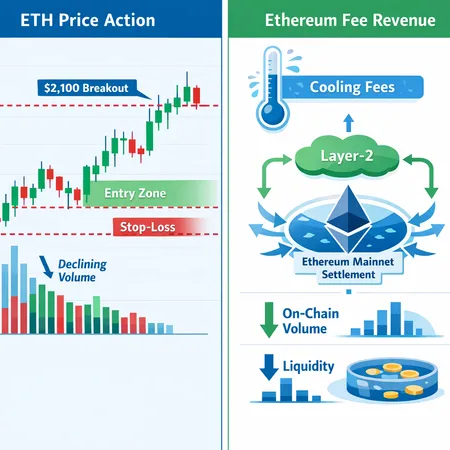
Ethereum’s recent intraday pop above $2,100 looked like a classic breakout: price cleared a sideways band that had contained ETH for months, drawing attention from traders and developers alike. TheCurrencyAnalytics documented the thrust higher, noting the move broke a six‑month sideways pattern and briefly shifted market psychology. Yet, within days that bullish headline faded as volume failed to follow through and price drifted back toward the $2,000 area, echoing coverage of renewed bearish pressure in other outlets.
This is the moment to parse more than price alone. ETH price action is being shaped by a structural shift: a drop in Ethereum fee revenue alongside growing Layer‑2 activity. The combination of a short‑lived breakout and cooling monetization raises the question — can ETH’s narrative as a high‑value settlement layer hold up while day‑to‑day fee income softens?
For context on the short‑term swings, see the coverage of the push above $2,100 and the subsequent pullback by TheCurrencyAnalytics and Bitcoinist respectively. The latter piece highlights how ETH struggled under $2,000 as volume dried up and bears reasserted control.
What the price action actually told us
The breakout past $2,100 showed interest — algorithms and momentum traders ran buys, and retail FOMO surfaced on some social channels. But the important nuance is how the breakout happened: it lacked elevated spot and on‑chain volume relative to recent spikes. When a breakout occurs on weak volume, it often marks a false start rather than durable regime change.
- A clean, sustainable bullish shift normally needs confirmation: rising traded volume across centralized venues, a pickup in on‑chain transfers and active addresses, and larger L2→L1 settlement batches signaling real value capture.
- Instead, the move above $2,100 was followed by dwindling volume and a fast reversion into the previous range — the exact behavior Bitcoinist described when noting the struggle below $2,000.
Put simply: the breakout was real in price, but the conviction behind it was shallow. Traders should treat such breakouts with caution until corroborating liquidity and settlement metrics turn supportive.
Ethereum fee revenue is cooling — why that matters
Daily Ethereum fee revenue has declined materially from its highs, and that matters because fees translate directly into on‑chain monetization that underpins the settlement narrative. TokenPost’s data‑driven piece highlights the trend and frames the debate: if execution migrates to Layer‑2s, can Ethereum still retain value as the ultimate settlement layer?
There are two ways to think about monetization:
- Execution fees: paid for transactions and contract operations directly on mainnet. These have shrunk as L2s and alternative chains handle more everyday activity.
- Settlement value: the premium users pay for a secure, final settlement on Ethereum mainnet when L2s periodically batch-rollup state.
A cooling of daily fee revenue suggests the immediate, transactional source of income is waning. That doesn’t automatically kill Ethereum’s long‑term value proposition — but it does force a recalibration. If settlement flows to mainnet are large and regular, ETH can still capture meaningful value through rollup sequenced settlements even while execution costs decline on L2s. If those settlement flows remain light, the network’s revenue base will look weaker.
Layer‑2 settlement flows: the structural wildcard
Layer‑2s change the locus of execution while preserving mainnet for finality. The economics depend on how frequently L2s settle to Ethereum and the size of those settlements. If rollups batch millions of micro‑transactions but settle large net values on L1, ETH benefits from periodic, high‑value fees. If rollups settle infrequently or rely on alternative security models, on‑chain fee capture diminishes.
In practice:
- Rapid, frequent L2→L1 settlement with significant value transfer increases mainnet fee revenue in concentrated bursts — a positive for the settlement thesis.
- Conversely, low settlement cadence or off‑chain compression of value reduces fee capture and depresses daily revenue metrics.
Monitoring L2 settlement inflows is therefore crucial for anyone weighing ETH’s fundamental case.
Technical volume and liquidity signals to watch
From a market‑structure view, several indicators give early warning of whether the breakout will stick or fail:
- Traded volume vs. moving average: look for spot volume to exceed the 20–30 day average on the breakout day and during retests. A breakout without volume expansion is suspect.
- On‑chain transfer value and active addresses: rising active addresses and total value transferred (esp. L2→L1 batches) suggest genuine usage.
- Order‑book liquidity near key levels: assess depth around $2,000–$2,150. Thin books make price moves easier but less durable.
- Exchange flows and stablecoin imbalance: sustained inflows to exchanges ahead of rallies often precede stronger moves; large stablecoin exits can signal buy pressure.
- Realized/Implied volatility divergence: collapsed implied vol with rising realized vol can indicate options markets are mispricing risk.
Combine these metrics to form a conviction score. No single indicator is decisive; the confluence of rising on‑chain settlement activity and spot volume is the strongest confirmation.
Actionable implications for traders (intermediate level)
Below are scenario‑driven plans and concrete execution rules. These are tactical, not investment advice — tie them to your risk limits.
Scenario A — Bullish continuation
- Confirmation rules: price reclaims and holds above $2,100 with spot volume >20–30% above the 30‑day average and an uptick in L2→L1 settlement value.
- Entry: scale in on a pullback into $2,050–$2,100 if confirmation metrics hold; or enter on a fresh momentum candle above $2,150 with volume confirmation.
- Stop: initial stop ~3–5% below entry (tight traders) or below $1,950 for broader tolerance (invalidates the breakout).
- Targets: trim into strength at $2,350–$2,500, re‑evaluate at each liquidity cluster.
Scenario B — Failure / consolidation
- Failure rules: price re‑tests $2,100 and rolls over, breaking below $1,900 with rising volume and falling on‑chain settlement flows.
- Entry: short on confirmed breakdown with a stop above the recent lower high (e.g., above $2,050).
- Stop: 3–6% above entry, or above $2,150 if riskier.
- Targets: initial support zone $1,700–$1,800, adjust if liquidity pools shift.
Risk management & sizing
- Size positions so that a full stop‑out costs no more than 1–2% of your portfolio.
- Use staggered entries and scale out as targets are hit.
- Monitor correlation with broader markets; if BTC rolls over aggressively, tighten stops.
Metrics to watch in real time
- Ethereum fee revenue trends (daily/7‑day averages).
- L2→L1 settlement volume and batch frequency.
- Spot traded volume and order‑book depth at key levels.
- Exchange net flows and stablecoin supply on exchanges.
- Active addresses and transfer counts.
What this means for the narrative: bull case vs consolidation
The bull case for ETH increasingly depends less on every‑day execution fees and more on being the court of final settlement for Layer‑2 systems. If rollups funnel large, regular settlement value back to mainnet, the settlement narrative remains intact and Ethereum fee revenue will reconfigure into bursty, high‑value events. If settlement flows remain modest and execution stays off‑chain, ETH’s fee base will look reduced — supporting a longer consolidation regime.
For intermediate traders and developers tracking fundamentals, the key is dynamic evidence: rising settlement flows and coordinated volume spikes point to a bullish regime change; fading fee revenue plus thin breakout volume argues for range‑bound behavior.
Bitlet.app users and market participants should keep these structural indicators on their dashboards — they’re as relevant as price levels when judging ETH’s next big move.