Ripple Treasury, RLUSD and the CLARITY Act: What Corporates and Exchanges Need to Know
Summary
Executive snapshot
The last quarter has accelerated a practical debate: can tokenized cash rails, issued by a payments firm like Ripple, actually transform how corporate treasuries move liquidity? Brad Garlinghouse has framed Ripple Treasury as a regulated gateway that lets companies manage cash and digital assets more directly. At the same time, a freshly traced mint of RLUSD with an exchange touchpoint (Gemini) offers a behind‑the‑scenes look at how these rails may connect to real‑world custody. Layer in price sensitivity for XRP and the potential legal clarity from the CLARITY Act, and you get a fast‑moving story that treasurers, exchange product leads, and institutional traders must parse carefully.
Why Garlinghouse’s ‘game‑changer’ claim matters
Brad Garlinghouse has positioned Ripple Treasury as more than a nicety: a regulated, enterprise‑grade bridge between fiat systems and tokenized settlement. His argument, summarized in industry coverage, is that a treasury product built on predictable compliance and settlement rails reduces the operational friction that normally deters corporate adoption (e.g., settlement delays, banking corridors, and counterparty complexity) Brad Garlinghouse’s comments.
Why this is important in practice: large treasuries prize predictability and auditability. If Ripple Treasury offers neat bookkeeping, standardized APIs, and regulated custody partners, treasurers can pilot tokenized cash for intraday liquidity, cross‑border intercompany settlements, or even short‑term yield allocation — without betting the firm’s balance sheet on market‑price swings.
What Ripple Treasury appears to deliver for corporates
- Regulated custody integration and compliance workflows to meet AML/KYC needs.
- Programmable settlement rails that shorten time‑to‑finality versus traditional banking in some corridors.
- Currency abstraction, letting firms use tokenized USD (like RLUSD) as an operational unit of account on ledger rails.
Those features, if realized at scale, cut the dependency on slow fiat rails and make on‑chain tools genuinely usable for treasury operations. That’s the core of the ‘game‑changer’ pitch.
The RLUSD mint and the Gemini touchpoint: what the trace shows
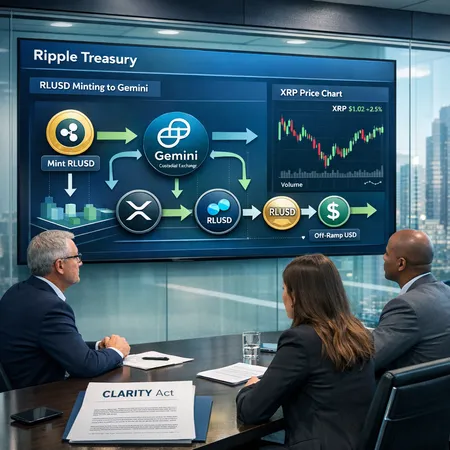
A recent trace of a 150 million RLUSD mint—tied to Gemini in reporting—changes the abstract product conversation into observable flow U.Today trace of 150M RLUSD. Why does this matter?
First, an exchange touchpoint matters because it signals a direct route between newly issued stablecoin supply and centralized liquidity venues. That shortens the on‑ramp for organizations that need quick convertibility into fiat or into traded assets. For exchange product leads, it’s an operational green flag: custodial and exchange infrastructure can be stitched to RLUSD without excessive gatekeeping.
Second, the mint suggests issuers and exchanges are confident enough in compliance and counterparty arrangements to handle large sums — not just speculative retail flows. This is the kind of activity that moves institutional risk perception from ‘experimental’ toward ‘operational.’
Custodial and exchange flow: practical implications
When an RLUSD mint touches an exchange like Gemini, three operational implications follow:
- Shorter settlement chains. Corporates can convert between fiat and RLUSD via familiar exchange rails instead of bank‑to‑bank messaging, reducing settlement latency.
- Liquidity plumbing becomes visible. Exchanges can offer instant book liquidity for RLUSD pairs, supporting treasury needs like intraday hedging or payroll flows.
- Custody decisions shift. Firms may choose a hybrid custody model (custodial stablecoin balances on exchange for liquidity; cold custody for long‑term reserves).
Taken together, these points reduce the friction cost for a treasury to hold tokenized cash on‑ledger. But there’s a tradeoff: using exchange custody raises counterparty risk and regulatory dependency. That’s not fatal — it’s a choice between speed and counterparty exposure.
What this means for XRP liquidity and price dynamics
The relationship between Ripple’s product moves and XRP price behavior is nuanced. On one hand, a stronger stablecoin and treasury product could reduce direct corporate demand for XRP as a pure liquidity bridge (if firms prefer RLUSD for settlement). On the other hand, Ripple’s ecosystem growth — more on‑chain volume and settlement activity — can increase demand for XRP where it still serves as a settlement token or liquidity rail.
Recent on‑chain patterns and calendar‑sensitive market signals point to short‑term price sensitivity around product and regulatory news. Analysts have flagged monthly and seasonal catalysts that historically correlate with XRP volatility; these should be watched alongside on‑chain flows and exchange inflows NewsBTC primer on April catalysts.
If corporates predominantly route cash through RLUSD and never convert to XRP, price pressure could ease. Conversely, if Ripple Treasury interoperates with XRP liquidity pools (for example, automated market makers or inter‑ledger conversions), we could see renewed velocity for XRP, particularly at corridor endpoints.
Regulatory catalysts: the CLARITY Act and enterprise adoption
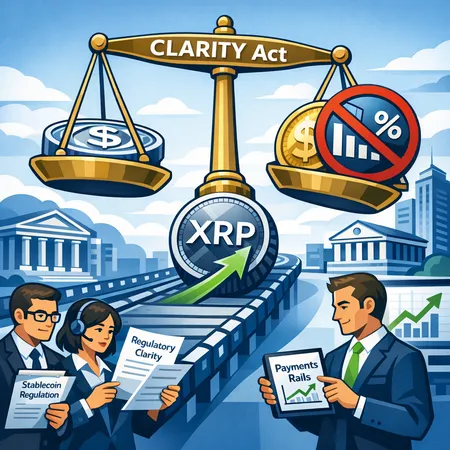
The legal tailwind that most directly affects enterprise adoption is legislative clarity. The CLARITY Act is being discussed as a framework that could distinguish between different crypto instruments and provide legal certainty for exchanges, custodians, and corporate users. Industry commentary links this Act to potential re‑rating of tokens like XRP in institutional contexts Legislative context (CLARITY Act).
A favorable CLARITY outcome would: reduce legal risk for exchanges and banks on‑ramping tokenized assets; make custodians more willing to custody enterprise RLUSD or XRP balances; and encourage corporate treasuries to run larger pilots. An unfavorable or delayed outcome keeps counterparty and litigation risk elevated, which will slow sizeable treasury deployments.
Recent market commentary stresses that regulatory clarity often trumps product features when firms put balance sheets on the line. So while Ripple Treasury and RLUSD build the rails, the CLARITY Act (and related enforcement precedents) will likely determine adoption speed.
Signals exchange product leads and treasurers should monitor
- Large mints and burns (on‑chain transparency can show where RLUSD supply is moving and whether exchanges are involved). The Gemini‑linked mint is an example to watch.
- Custodial contracts and audit disclosures from issuers and custodians; these reduce counterparty runway risk.
- On‑chain settlement volumes within Ripple’s rails and any linkage between RLUSD and XRP liquidity pools.
- Regulatory milestones for the CLARITY Act and related enforcement cases that affect token classification.
For exchange teams, ensure AML/KYC workflows can handle high‑value enterprise flows and consider product structures that separate liquidity pools for institutional clients (e.g., dedicated order books or settlement lanes).
Practical takeaways for institutional traders and corporate treasurers
- Build a small, time‑boxed pilot: test RLUSD for a subset of cross‑border flows while retaining traditional bank corridors.
- Hedging posture: use short‑dated hedges when converting between RLUSD and fiat to manage peg risk and conversion slippage.
- Custody split: consider keeping operational float on regulated exchanges for liquidity while holding strategic reserves with qualified custodians.
- Monitor regulatory signals closely — a legal greenlight will materially reduce the friction cost of scaling these pilots into production.
For markets teams, tracking exchange mints/burns and tying that data to order‑book changes gives an early read on whether RLUSD is being used for treasury operations or speculative flows.
Conclusion
Ripple Treasury and RLUSD are building blocks that can materially shorten on‑ramp/off‑ramp paths for corporates — but adoption depends as much on regulatory clarity as on tech. The recent 150M RLUSD mint with an exchange touchpoint signals that exchanges and custodians are already operationalizing the product. That’s a meaningful step toward enterprise usability.
Whether XRP benefits directly will depend on how Ripple designs interoperability between RLUSD rails and XRP liquidity, and on the pace of regulatory certainty such as the CLARITY Act. Institutions should continue cautious pilots while keeping close watch on on‑chain flows, exchange activity, and legislative progress. For practitioners experimenting with tokenized rails, platforms like Bitlet.app illustrate the practical line between experimentation and treasury‑grade tooling.
Sources
- Brad Garlinghouse calls Ripple Treasury a game‑changer for corporate finance
- Gemini tags Ripple community in newly minted 150 million RLUSD
- US CLARITY Act countdown and market implications for BTC, ETH, XRP
- What April could mean for XRP: past patterns and key price catalysts to watch
For broader context on crypto rails and settlement, many treasurers still watch macro bellwethers like Bitcoin and evolving liquidity in DeFi when assessing risk and return across tokenized and traditional cash strategies.