How GMX’s Chainlink-Powered Perps on MegaETH Rework Real-Time On-Chain Derivatives
Summary
Executive overview
GMX has launched Chainlink Data Streams–powered perpetual markets on MegaETH (MEGA), pairing high-frequency oracle feeds with a low-latency execution layer. The design goal is simple: bring real-time, programmatic price updates and sub-second settlement to on-chain perpetuals so traders and market makers can operate with execution characteristics closer to centralized venues while preserving on-chain settlement and composability. For teams evaluating new perp rails — whether for product design, risk engines, or market-making strategies — understanding how Chainlink Data Streams interact with 10-millisecond block times on MEGA is essential.
This piece is practical: architecture overview, how low latency alters market microstructure, comparisons to existing perp infrastructure, and concrete operational trade-offs (oracle latency, front-running, settlement risk). If you’re benchmarking rails for an institutional-grade perp product, these are the dimensions that matter. Also note Bitlet.app’s ecosystem view: faster perp rails change how installment, earn, and P2P exchange products price and hedge derivatives exposure.
Architecture overview: MEGA + GMX + Chainlink
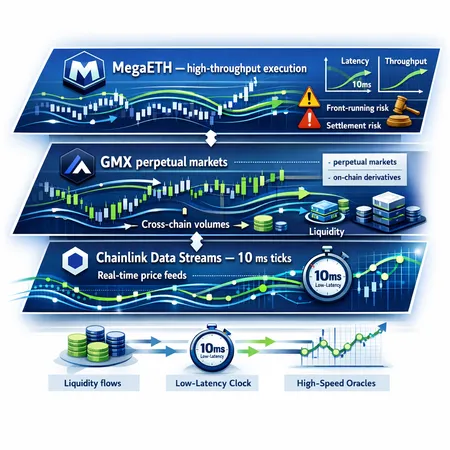
At a high level the stack looks like this: GMX smart contracts for AMM-style perpetuals run on MegaETH, MEGA provides the execution and sequencing layer with ~10-millisecond block cadence, and Chainlink Data Streams supply high-frequency price observations and aggregated signs (e.g., TWAPs and spot ticks). The result is an on-chain perp where price inputs can arrive at sub-second resolution and transactions can be ordered and finalized far faster than traditional Ethereum L2 blocktimes.
Architectural responsibilities are clear:
- MEGA (execution layer): batching, low-latency block production, sequencer ordering and finality guarantees.
- Chainlink Data Streams: continuous, signed price ticks and short-window aggregates specifically designed for low-latency feeds.
- GMX perp contracts: AMM oracles, margin accounting, liquidation logic, funding-rate calculations and settlement.
This arrangement reduces the gap between an off-chain order event and on-chain settlement, but it simultaneously tightens the coupling between oracle cadence and contract logic — which is both the upside and the key risk vector.
How Chainlink Data Streams and 10ms blocks interact
Chainlink Data Streams push timestamped, cryptographically signed ticks at high frequency. On MEGA, each ~10ms block can include new signed price observations, enabling perp contracts to reference very fresh prices for trade execution, margin checks, and liquidation triggers. Practically, the Data Streams feed moves oracle reference prices from a human-scale cadence (seconds) into the sub-second domain.
The industry writeups around this launch help explain the product specifics: Cryptonomist’s coverage outlines the GMX perpetual markets launch on MegaETH and the Chainlink integration, while Blockonomi provides a deep-dive on expectations for real-time DeFi trading and how Data Streams power the new perps. See this announcement from Cryptonomist and Blockonomi’s technical piece for additional details: GMX perpetual markets on MegaETH and Blockonomi’s analysis of the Chainlink-powered launch.
What low-latency execution means for market makers
Lower latency and faster oracle updates change three practical things for market makers: quoting strategy, hedging cadence, and risk capital allocation. When your perp settlement and price feed refresh at sub-second intervals, you can safely quote tighter spreads because your risk of being caught on stale reference prices is lower. That reduces realized slippage for takers and improves fee capture for LPs.
However, that opportunity comes with new demands. Market-makers must increase the frequency of hedging operations (delta-rebalances) to keep inventory risk under control. Hedging execution costs that were previously amortized across larger time windows now occur more often — demanding faster connectivity, colocated execution (or minimal sequencing latency on MEGA), and automated risk engines tuned to sub-second events. Liquidity providers will find capital efficiency improves: tighter intra-spread ranges mean the same capital can support larger notional. But operational complexity and the velocity of MEV-style risks increase in parallel.
Quant example: reducing effective latency from 300ms to 10ms can shrink expected adverse selection per trade by a large factor, allowing makers to narrow spreads and increase filled volume. That increases volume-based revenues, but it also amplifies sensitivity to rapid funding-rate swings and flash moves that happen within a few blocks on MEGA.
Comparison with existing perp infrastructures
Existing on-chain perps historically sit in two camps: L2 AMM perps and hybrid/off-chain orderbook solutions. L2 AMM perps on Optimism/Arbitrum have good composability but longer block times and oracle update frequencies measured in seconds; off-chain orderbook systems (or hybrid rollups) push matching off-chain to achieve low latency but rely on external settlement or sequencer trust to finalize trades.
MEGA+GMX with Chainlink Data Streams sits between these extremes. It preserves on-chain settlement and composability like L2 AMM perps, but it narrows the latency gap to off-chain matching engines by delivering 10ms blocks and high-frequency oracles. The result: near-real-time pricing and faster settlement without fully surrendering on-chain guarantees. But remember — faster block cadence can change finality semantics and reliance on sequencer honesty, so it’s not a direct substitution for decentralized finality found in base-layer consensus.
Comparatively, for highly latency-sensitive strategies (e.g., sub-100ms market-making), MEGA narrows the practical difference, but outsourcing matching to centralized orderbooks will still have edges in cost and absolute latency. The trade-off becomes: are you willing to accept sophisticated sequencer and oracle trust assumptions in exchange for near-instant composability and settlement?
Cross-chain perp volumes and routing implications
Friction on canonical L1s has historically fragmented perp liquidity. MEGA’s design and the GMX deployment are likely to concentrate a slice of perp volume onto a high-throughput rail because traders and LPs chasing tighter spreads will migrate capital where execution costs fall. That said, cross-chain routing and capital efficiency tools will determine how much aggregate volume moves.
Expect three near-term effects:
- Concentration of aggressive market-making on MEGA-led perps, increasing depth and reducing slippage there.
- Cross-chain arbitrage flows that use fast bridges and messaging layers to exploit price differentials; these flows both provide liquidity and increase backend stress on bridge relayers and on-chain settlement engines.
- Potential fragmentation of liquidity if other chains or L2s cannot match MEGA’s latency/fee profile, forcing hedgers to manage multi-rail exposure and dynamic capital allocation.
For product managers, cross-chain volume growth means rethinking margin models, funding-rate assumptions, and how to supply capital across multiple rails with minimal slippage and predictable hedging costs.
Risk vectors: oracle latency, front-running, and settlement risk
Chainlink integration reduces stale-price risk by providing frequent ticks, but it introduces three new levers that teams must monitor closely.
- Oracle latency & staleness: while Data Streams are designed for high frequency, network congestion, node outages, or feed aggregation issues can still cause gaps. Contracts must handle short-term oracle unavailability with explicit fallback logic and conservative behavior during degraded states.
- Front-running & MEV: sub-10ms blocks compress the window for transaction inclusion and ordering; that can reduce some latency-based arbitrage but also concentrates MEV opportunities into denser, faster windows. Sequencer design (fair ordering, batch auctions, or latency-equalizing mechanisms) becomes a primary defense.
- Settlement risk & finality: MEGA’s fast block cadence may trade off long-tail finality properties present on L1. If sequencer misbehavior or reorgs are possible within the MEGA model, perp contracts must consider extended contestability windows or on-chain proofs for critical settlement operations.
Concrete mitigations include: multi-source oracles, short TWAP fallbacks, per-trade slippage caps, liquidity-aware liquidation engines, and a beefed-up insurance fund calibrated to rapid, high-magnitude price moves.
Operational checklist: what product managers and quants should measure
Operationalize the launch by tracking a small set of high-signal metrics and processes:
- Latency distribution: measure end-to-end latency from external price tick publication to contract-accessible state (p50/p95/p99).
- Oracle health: gaps between ticks, node diversity, signature verification latency, and fallback trigger frequency.
- Fill quality for market-making: realized spreads, adverse selection, and reprice frequency.
- Funding-rate volatility and correlation with on-chain liquidations.
- MEV/ordering events: frequency and value of extractable value captured around perp trades.
- Cross-chain settlement times: bridge finality windows and capital round-trip times for hedges.
Operational playbooks must include automated pause logic for feed degradation, liquidation throttles to prevent cascade liquidations in thin markets, and clearly defined escalation paths for on-call engineers.
Mitigations and design patterns
There are practical design patterns that reduce downside while preserving most upside of MEGA + Chainlink perps:
- Multi-epoch TWAPs as soft guards: compute short-window TWAPs alongside spot ticks and require sanity checks for large divergences before triggering mass liquidations.
- Sequencer fairness primitives: implement batch auctions or randomized inclusion windows to blunt front-running incentives.
- Oracle fallback layering: prioritize Data Streams but maintain a secondary aggregated feed or longer-window TWAP on a different provider to avoid single-point failure.
- Insurance funds and dynamic margining: increase margin requirements temporarily when oracle health metrics indicate risk, and adjust funding mechanics to reflect realized volatility.
- Continuous stress testing: replay historical high-volatility periods at MEGA block cadence to validate liquidation and settlement behaviors.
These patterns reduce the attack surface and provide predictable behavior for traders and LPs while still exploiting lower latency.
Final thoughts for product leads and quant traders
GMX’s Chainlink-powered perps on MegaETH represent a meaningful step: they bring closer to real-time oracle inputs together with a very low-latency execution layer to make on-chain derivatives operate more like off-chain venues in many practical ways. For market makers, that means narrower spreads and higher fill rates — but it also demands faster hedging, better MEV defenses, and more operational sophistication. For product managers, the new rail increases the importance of oracle resilience, sequencer policy, and cross-chain liquidity engineering.
If your team is evaluating MEGA as a primary rail, start by instrumenting latency and oracle health metrics end-to-end, iterate your hedging cadence, and design conservative fallbacks for degradation windows. Remember the trade-offs: lower latency improves capital efficiency and user experience, but it shifts risk into areas — oracle integrity, sequencing fairness, and settlement semantics — that require explicit mitigation.
For more technical context on the launch and Chainlink’s role, see the project coverage in Cryptonomist and Blockonomi linked earlier. And if you’re cataloging new rails across the market, don’t forget to benchmark against other leading perp providers and consider how cross-chain bridges and messaging amplify both liquidity and risk.
Sources
- GMX perpetual markets on MegaETH — Cryptonomist: https://en.cryptonomist.ch/2026/04/02/gmx-perpetual-markets-megaeth
- GMX launches Chainlink-powered perpetual markets on MEGA — Blockonomi deep-dive: https://blockonomi.com/gmx-launches-chainlink-powered-perpetual-markets-on-megaeth-for-real-time-defi-trading/
Additional internal context: For background on DeFi market dynamics and related topics, see DeFi and for macro price signaling references many teams still watch Bitcoin.