Drift Exploit Post‑Mortem: Durable Nonce, USDC Flows, and Solana’s Market Shock
Summary
Executive summary
On April’s incident involving the Drift protocol, attackers exploited transaction-approval mechanics tied to durable nonces and moved an amount that reports peg near $280–300 million in USDC. The heist not only drained protocol funds but triggered sharp market reactions for SOL and local liquidity pools. Investigations have focused on how durable‑nonce approvals and program-level authorities enabled extended movement windows, and why USDC transfers were not frozen rapidly once the theft became obvious.
This post reconstructs the timeline, walks through the technical mechanics, examines why stablecoin freezing didn’t stop the outflows, quantifies price and on‑chain impacts, and draws operational and regulatory takeaways for DeFi teams and security engineers.
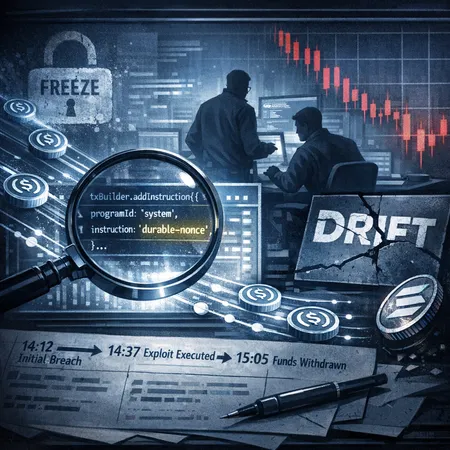
Timeline reconstruction: how the attack unfolded
Initial compromise and execution window — Public reporting tied the drift of funds to a single coordinated exploit on Drift’s program-controlled accounts. Early coverage flagged a rapid sequence of signed transfers that departed the protocol before widespread mitigation could be put in place (CryptoNews report).
Rapid outbound movement — Follow‑ups documented a near‑$300M drain as attacker addresses moved USDC in a chain of transfers and swaps, exploiting the speed and composability of on‑chain Solana programs to launder funds and break on‑chain heuristics (crypto.news follow‑up).
Questions about approvals and durable nonces — Investigators observed unauthorized approvals tied to durable‑nonce usage that allowed transactions to be valid and replayed beyond typical blockhash lifetimes, complicating real‑time response (Cointelegraph investigation).
Market signals and liquidity responses — Within hours, SOL experienced a sharp drawdown as on‑chain flows and social sentiment pushed traders to de‑risk; some on‑chain metrics such as DEX volume suggested pockets of defensive liquidity even as price technicals moved into oversold territory (Coinpaper context on DEX strength and RSI).
Technical mechanics: durable nonces, approvals, and how they helped the attacker
What is a durable nonce and why it matters
On Solana, a durable nonce is a mechanism allowing a transaction to remain valid beyond the short-lived blockhash window; the transaction references a nonce account rather than a recent blockhash, enabling pre‑signed operations to be submitted later. That capability is handy for offline signing and long‑lived workflows, but it increases the blast radius if approvals or keys are compromised.
How approvals and delegates can be abused
The exploitation vector reported in this incident centers on programmatic approvals and delegation patterns. If a program‑controlled account (or a delegated authority) is compromised, an attacker can submit sequences of pre‑signed durable‑nonce transactions, or reuse approvals, to move tokens in multiple steps. Durable nonces let the attacker keep submitting valid transactions without requiring a fresh blockhash per submission — effectively lengthening the window defenders have to detect and neutralize signed operations.
Practical attack chain (abstracted)
- Obtain either a signing key, a compromised wallet, or a delegated approval for a program-controlled token account.
- Craft and sign a set of transactions that use a durable nonce so they remain valid across multiple blocks and can be broadcast at leisure.
- Submit transactions rapidly to move USDC out of the protocol and into mixer addresses, DEX liquidity pools, and accounts that make on‑chain tracing harder.
Cointelegraph’s coverage highlighted the presence of unauthorized durable-nonce approvals in investigative traces — which aligns with a model where the attacker leveraged delegated approvals rather than one-off opportunistic key theft alone (Cointelegraph link).
Why stolen USDC moved for hours: operational and chain-level friction
Circle and other stablecoin issuers have a technical ability to freeze certain on‑chain USDC balances when they can conclusively identify issuer‑specific account identifiers and legal ownership. But several factors created friction that allowed the attacker to move funds for hours:
Transaction speed and batching: Durable‑nonce transactions extended the attacker’s submission window and allowed rapid chain hopping and swapping that outpaced manual human decision‑making.
Complexity of affected accounts: If stolen USDC moved from program‑owned or escrow accounts, the account metadata Circle would need to freeze might not be straightforward to map to a single issuer-controlled address. Cointelegraph explicitly flagged operational questions about why USDC transfers weren’t frozen sooner, noting durable‑nonce unauthorized approvals complicated the identification and freeze process (Cointelegraph link).
Cross‑protocol composability: Attackers used DEXs, cross‑program invocations, and rapid on‑chain swaps that moved value across custody domains. Each intermediate step requires coordination among custodians and, often, legal review before takedowns.
Human/manual gating: In many cases, stablecoin freezes are manual or semi‑automated processes involving legal and compliance signoffs; when funds are moving fast and through many addresses, the freeze window can slip away.
These frictions are not unique to Circle or this event; they expose a broader operational reality: centralized controls over a token can be effective, but only if the issuer can quickly map on‑chain movements to the accounts they control and can act before value is dispersed beyond freezeable endpoints.
Quantifying the on‑chain and price impact
Stolen value: Multiple reports converged on a figure around $280–300 million in USDC drained from Drift and associated accounts. The investigative coverage frames the loss in that band (crypto.news follow‑up; Cointelegraph investigation).
Immediate SOL price reaction: Markets reacted quickly. SOL saw a sharp intraday drawdown as traders balanced liquidity and contagion risk; social and on‑chain signals pushed SOL into a bearish technical posture, with some analyses noting a bearish crossover and oversold RSI conditions in the short term (CryptoNews; Coinpaper). The market move was amplified by algorithmic deleveraging in perpetuals and margin positions tied to SOL and Solana‑ecosystem tokens.
Liquidity and DEX impact: DEX liquidity pools that concentrated USDC pairs experienced slippage and temporary depth reductions as arbitrageurs reacted to the altered on‑chain liquidity. However, some on‑chain metrics showed resilient DEX volumes — liquidity providers who remained active absorbed part of the flow, limiting a deeper freefall in token prices (Coinpaper).
Market microstructure effects: The combination of a large USDC outflow and the speed of Solana’s execution meant on‑chain swaps could materially affect local prices on DEXes before centralized exchanges updated orderbooks or paused trading. That mismatch is one reason the market impact was non‑trivial.
Protocols, exchanges, and custodians — typical response playbook
When a large exploit like this occurs, the practical response steps (and the pain points) are:
Triage and containment — Protocol teams attempt to pause vulnerable program functions and withdraw admin keys where possible. Drift’s immediate priority would be to isolate the exploited authority.
On‑chain tracing and tagging — Security teams and analytics firms trace the stolen funds, tag addresses, and share indicators of compromise with exchanges and stablecoin issuers.
Coordination with custodians and stablecoin issuers — Token issuers (e.g., Circle) are contacted to request freezes on clearly identified issuer‑controlled accounts; custodial partners may block deposits from tagged addresses.
Exchange interventions — Centralized exchanges typically freeze deposits from blacklisted addresses and may coordinate asset freezes if custody lies with them. For non‑custodial DEX activity, technical intervention is limited.
Legal and compliance escalation — Formal requests, subpoenas, and law‑enforcement coordination are pursued to recover value that is frozen on custodial platforms.
The core practical challenge is speed: when attackers use durable nonces and programmatic approvals to keep transactions valid and to move funds rapidly through DEXes and bridges, manual processes struggle to keep up.
Systemic risk: what this means for Solana DeFi and stablecoin operations
This incident highlights several systemic risk vectors for high‑throughput L1 ecosystems:
Design tradeoffs in L1 UX: Features like durable nonces improve developer ergonomics and offline signing flows, but they increase transaction validity windows — raising the attack surface if delegated approvals are mis‑managed.
Centralized choke points: Stablecoin issuers remain centralized risk managers. Their ability to freeze tokens is a double‑edged sword: it reduces long‑term counterparty risk but exposes operations to intense scrutiny when freezes are slow or incomplete. Cointelegraph’s reporting underscores operational questions about why USDC transfers were not frozen sooner in this case (Cointelegraph link).
Composability speed vs. control: The very composability that makes DeFi powerful also lets attackers automate laundering flows across multiple protocols in minutes. This speed mismatch stresses institutional and human response models.
Liquidity fragility: Large on‑chain drains create localized liquidity vacuums, inducing slippage, widening spreads, and triggering margin liquidations. Even if on‑chain DEX liquidity holds up in aggregate, concentrated pools can suffer catastrophic price impact.
Reputational and regulatory exposure: High‑profile exploits attract regulatory attention to both the protocol and the broader ecosystem, especially when a centralized stablecoin like USDC is involved. Expect heightened scrutiny of incident response playbooks and issuer operational controls.
Remediation and recommended mitigations for security engineers and risk teams
This section compiles practical, actionable mitigations.
Limit delegation scope and lifetimes: Avoid long‑lived delegated approvals where possible. If durable nonces are required, design short explicit expiry semantics at the program level and log nonce usage aggressively.
On‑chain observability: Implement real‑time monitors for large approvals, sudden increases in allowance or delegation changes, and unusual durable‑nonce signing patterns. Integrate alerts into incident playbooks.
Program-level safety switches: Add on‑chain governance or timelocks that can pause critical functions. Keep admin key practice conservative — cold storage, multisig, and time‑delays matter.
Coordinated freeze readiness: Pre‑establish channels and SLAs with stablecoin issuers and large custodians (including exchanges) so freeze requests and address mappings can be performed faster. Practice tabletop exercises that simulate rapid outflows.
Rapid automated heuristics: Adopt automated heuristics to temporarily block or rate‑limit outgoing program transfers that exceed defined thresholds while human teams validate the flows.
Insurance and diversification: Consider protocol-level insurance, streaming reinsurance, or diversified collateral custody to reduce single‑failure blowups.
Regulatory and long‑term implications
Expect three durable impacts:
Operational scrutiny for stablecoin issuers — Regulators and counterparties will demand faster freeze capabilities, clearer APIs for request handling, and audit trails that show why a freeze did or did not happen.
Higher standards for on‑chain key/approval governance — Auditors and insurers will require explicit design patterns for nonce usage, approval revocation, and emergency pause mechanics.
Market behavior changes — Traders and DeFi risk teams will price in operational risk for high‑throughput L1s differently; the implied cost of capital and funding lines for protocols may shift if exploit risk is deemed structural.
Closing thoughts
The Drift exploit underlines a hard truth: technical primitives that improve throughput and developer experience can create systemic vectors when combined with program‑level authority patterns. For security engineers and DeFi risk managers, the takeaways are pragmatic — limit long‑lived delegations, harden emergency controls, and coordinate pre‑packaged operational responses with stablecoin issuers and exchanges.
For traders and liquidity providers, the event is a reminder to watch not just token flows and orderbooks, but also account‑level approvals and the on‑chain signals that presage rapid value movement.
This incident will be analyzed for months, and while Solana’s throughput remains an advantage for many applications, teams building on such L1s must accept that speed increases the premium on automated monitoring, rapid coordination, and pre‑defined operational SLAs. Bitlet.app and other risk‑aware platforms will continue to track these developments as teams and regulators respond.
Sources
- Initial reporting on price and market reaction: CryptoNews — Solana price prediction: Drift exploit drop
- Follow‑up reporting and near‑$300M drain detail: crypto.news — Solana price confirms bearish crossover following Drift exploit
- Investigation on durable‑nonce approvals and Circle operational questions: Cointelegraph — Drift $280 million hack questions Circle response
- Context on DEX activity and technical resilience vs panic: Coinpaper — Solana price prediction: DEX strength meets oversold RSI
Additional contextual reading: see ecosystem coverage for Solana and broader DeFi risk discussions.