Optimizing Bitcoin Mining Ops: Luxor Commander, Hashrate Geography & Mining Capex Playbook
Summary
Why operational efficiency matters now
Bitcoin mining is no longer just about buying the latest ASICs. With BTC prices, power markets, and regulation in flux, operational efficiency and smart fleet orchestration are the dominant levers for squeezing margin out of existing capacity. Whether you're a CTO of a hash-farm, a head of operations, or an investor sizing a new build, the question is the same: how do you run more reliably and more profitably with the equipment you already own?
Two big trends are reshaping answers: software-driven fleet management and growing geographic concentration of hashrate. Both influence where you place machines, how you route work, and what capex makes sense for expansion. Platforms such as Bitlet.app illustrate how services across the crypto stack are converging on efficiency and liquidity, but the core levers remain fleet controls, power procurement, and disciplined maintenance.
Luxor Commander: what it is and why it matters
Luxor’s Commander is a fleet-management suite designed to automate profitability and consolidate operations across large mining deployments. The product aims to be the command center that reduces manual firefighting and makes profit optimization repeatable. Luxor shipped Commander to market with a focus on two problems operators always face: keeping machines online, and routing hashing power where it earns the most.
Key capabilities that matter to ops teams:
- Dynamic pool routing and profitability switching: Commander can redirect rigs to the most profitable pools or algorithms based on predefined rules without manual intervention. This reduces the lag between price/payout changes and action.
- Centralized monitoring and alerts: real-time telemetry with standardized alerting cuts mean time to repair (MTTR) and gives engineers one pane of glass for hundreds or thousands of units.
- Firmware & configuration orchestration: deploy firmware updates, power profiles, or vendor-specific configs across the fleet from a single control plane to avoid inconsistent behaviour.
- Scheduling and maintenance workflows: built-in maintenance windows, rolling reboots, and health checks keep uptime high while minimizing cluster-wide shocks.
These features are not theoretical. Luxor’s announcement emphasized automation and consolidation of fleet operations as the route to sustained profitability in thin-margin cycles (Luxor Commander announcement). For operators, the immediate benefit is fewer manual swaps and more consistent mining revenue streams—especially important when electricity price spikes or difficulty adjustments compress margins.
How Commander improves miner profitability in practice
Think of profitability as a function of three variables: uptime, yield (hashrate * payout), and operating cost (primarily power). Commander nudges each variable:
- Increase uptime: proactive alerts + orchestrated reboots = less unplanned downtime.
- Increase yield: automatic switching to higher-paying pools or algorithms reduces time spent mining suboptimal chains or pools.
- Reduce cost per BTC: power profile management and throttling allow rigs to avoid inefficient operating points during price squeezes.
A conservative case: improving fleet uptime by 2–4% via centralized monitoring and faster incident response often translates directly to equivalent increases in quarterly BTC output—an easy boost without spending on additional ASICs.
Q1 2026 hashrate distribution: concentration and implications
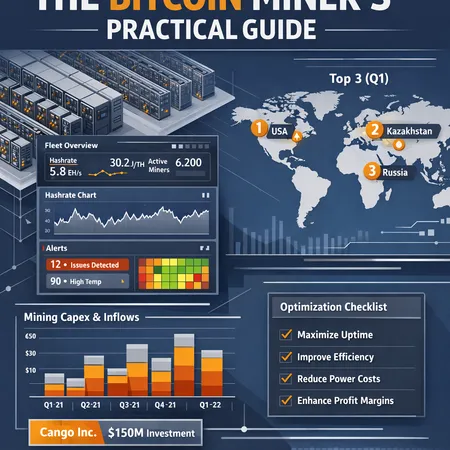
Geography matters. Q1 2026 data shows that a majority of global BTC hashrate is concentrated in a handful of countries. According to a recent breakdown, roughly 68% of global BTC miners came from the U.S., Russia, and China in Q1 2026. This concentration creates operational, regulatory, and pricing risks that operators and investors must account for (Finbold hashrate breakdown).
Why that concentration matters:
- Regulatory exposure: changes in power policy, import/export controls, or crypto-specific rules in any of the major host countries can cause abrupt migration of rigs or sudden downtime.
- Power market correlation: when a region shares power grid characteristics or seasonal demand patterns, peak pricing events can affect a large share of global supply simultaneously.
- Latency & logistics: concentrated supply chains for parts, firmware updates, or spares create single points of failure during global disruptions.
For operators, geographic diversity in deployments reduces systemic risk. For investors, concentration implies geopolitical and grid-risk premiums should be embedded into valuation and expected returns.
You should also pair geographic decisions with smarter fleet controls—tools like Luxor Commander make it easier to coordinate distributed assets, shift load across pools, and implement geo-aware throttling.
Capital flows into mining expansion: what Cango Inc. shows
Fresh capital has returned to mining. Cango Inc.’s recent $75 million capital close to fund AI and bitcoin-mining expansion is a useful case study in how new money alters the capex landscape (Blockonomi coverage). There are three practical takeaways:
- Capex scale-up is back: larger rounds mean bigger orders for ASICs and infrastructure, which can push lead times, bid prices, and shipping dynamics. Operators should model procurement timing aggressively.
- Diversified use of capital: Cango’s mix of AI and mining investment highlights a trend—owners are looking for multiple revenue lines from the same compute or facility footprint, improving capital efficiency.
- Margin pressure in early expansion: new deployments often run at suboptimal utilization during ramp-up; expect near-term margin dilution as capacity spins up unless paired with software and operational programs that accelerate stable operations.
For existing operators, capital availability from new entrants can be both a threat (competition for power and machines) and an opportunity (secondary market for used rigs, co-location partnerships, or services like fleet-management software sales). Investors should insist on conservative ramp assumptions and strong operational KPIs before underwriting growth capex.
Operational playbook: tactics to boost uptime and margins
Below are tactical levers that CTOs and ops managers can apply within 90–180 day horizons.
- Monitor at the rig level: collect power draw, hash rates, temperatures, and pool returns. Standardize telemetry across firmware variants so your dashboards are comparable.
- Automate profitability rules: implement dynamic pool switching thresholds and rollback policies. Use safeguards to avoid ping-pong flips that can create instability.
- Optimize power contracts: negotiate time-of-use (TOU) clauses and demand-response measures. Work with local utilities to secure interruptible tariffs where possible.
- Streamline firmware updates: test updates on a subset of machines, stage rollouts, and always have rollback images. Use centralized orchestration to reduce version fragmentation.
- Spare-part strategy: maintain critical spares (PSUs, controllers, fans) on-site for fastest MTTR; keep a second buffer in a regional hub.
- Cooling and airflow: incremental improvements to airflow often yield better returns than another ASIC refresh. Measure inlet temperatures and prioritize low-cost fixes.
- Pool and payout diversity: avoid over-concentration in a single pool; diversify to reduce payout and counterparty risk.
- Use fleet management tools: adopt solutions like Luxor Commander to orchestrate large fleets and reduce manual ops burden.
These tactics are not mutually exclusive. The most resilient operators build a playbook that combines contract-level protections (power, logistics) with software-level automation and disciplined spares & maintenance operations.
Hands-on checklist for mining operators
Use this checklist as an operational runbook you can assign to teams and review weekly.
Pre-deployment
- Confirm site-level PUE and expected TOU schedule.
- Lock logistics lead times for upcoming ASIC orders; plan for 12–20 week shipping windows.
- Budget for commissioning (racking, power, network) at ~8–12% of hardware cost.
Week 0–12 (ramp)
- Enable centralized telemetry and set alert thresholds for hash drops, temp spikes, and idle power.
- Deploy firmware to a pilot cluster; validate rollback and config orchestration.
- Implement dynamic pool switching rules (with hysteresis) and test during low-risk windows.
Ongoing operations
- Track weekly uptime and MTTR; target <1% unplanned downtime within three months of launch.
- Review pool payouts vs. electricity costs twice weekly and adjust routing rules.
- Maintain a 4–6 week spare-parts inventory for critical failures; keep a 10–15% spare PSU reserve if sourcing is constrained.
Financial & capex
- Model break-evens under 3 power-price scenarios (base, +25%, +50%).
- When raising capex, require a 6–12 month phased deployment tied to performance milestones.
- Re-evaluate ROI on used ASIC buys versus new procurement every quarter.
Risk & compliance
- Monitor host country regulatory updates; model the migration cost of redeploying racks to alternate jurisdictions.
- Maintain incident playbooks for grid outages and major firmware bugs.
Final thoughts
Mining today rewards not just scale but coordination. Software — especially fleet-management tools that automate routing, updates, and monitoring — is fast becoming the differentiator between break-even producers and consistently profitable operators. With hashrate concentrations still dominated by the U.S., Russia and China, and fresh capital flowing into expansion plays like Cango Inc., operators must pair capex discipline with operational excellence.
Adopt the checklist above, measure the right KPIs, and consider centralized orchestration tools such as Luxor Commander as part of the standard stack. For investors, the safest bets will be teams that demonstrate repeatable operational improvements and clear mitigation strategies for geographic and power-market concentration risks.
Sources
- Luxor ships Commander: https://news.bitcoin.com/luxor-ships-commander-software-to-optimize-bitcoin-mining-fleet-profitability/
- Finbold on hashrate geography: https://finbold.com/bitcoin-hashrate-scramble-68-of-global-btc-miners-came-from-the-u-s-russia-and-china-q1-2026/?utm_source=snapi
- Blockonomi on Cango Inc.: https://blockonomi.com/cango-inc-closes-75m-in-capital-deals-to-fund-ai-and-bitcoin-mining-expansion/
For context on broader market dynamics and tools that connect operations to liquidity, see Bitcoin and operational pieces on Mining.