What a Tether Executive Chairing a Crypto Super PAC Means for U.S. Stablecoin Rules

Summary
Executive snapshot: who moved and why it matters
This month a senior executive affiliated with Tether was installed as chair of a major crypto super PAC — a move that converts private market influence into organized political muscle at exactly the moment U.S. lawmakers are wrestling with how to regulate stablecoins. The appointment is more than optics: it signals that large issuer-aligned interests intend to play a decisive role in shaping the legislative outcomes that determine whether stablecoins like USDT and USDC face strict banking-style controls or lighter, market-oriented rules. The original announcement captures the immediate political implications and the timing of this power shift in Washington (see the press report on the appointment).
For many market participants and PR teams the question is not only what the PAC will push for, but how this lobbying will reshape compliance expectations, market access, and the reputational calculus for issuers and service providers.
The three core sticking points in U.S. stablecoin policy
Legislative debate centers on a handful of durable, technical flashpoints. Each is politically charged and will determine what a compliant stablecoin looks like in practice.
Freezes and operational control
One political and operational flashpoint is whether issuers or intermediary custodians should retain the technical and legal ability to freeze addresses or redeem tokens unilaterally. High-profile incidents and hacks raise questions about whether freezes are necessary safety tools or liabilities that undermine the core property rights that make crypto attractive. Debates around freezes intersect with custody rules, criminal enforcement, and customer protection.
Reserve transparency and attestations
Policymakers and institutional counterparties want reliable evidence that stablecoins are fully backed and liquid. Regulators have pushed for clarity on reserve composition, frequency and rigor of audits, and legal segregation of assets. The tradeoff is between investor protection through stringent disclosure and the potential exposure of commercial counterparties if overly granular, public disclosures are required.
Systemic risk and bank-like activity
A core policy question is whether large stablecoin issuers function like banks — taking maturity and liquidity transformation risks that could create systemic exposure. If Congress deems major stablecoins systemic, issuers could face capital, liquidity, and supervisory regimes that would dramatically alter product economics and market structure.
How a crypto super PAC can influence the CLARITY Act and other pending measures
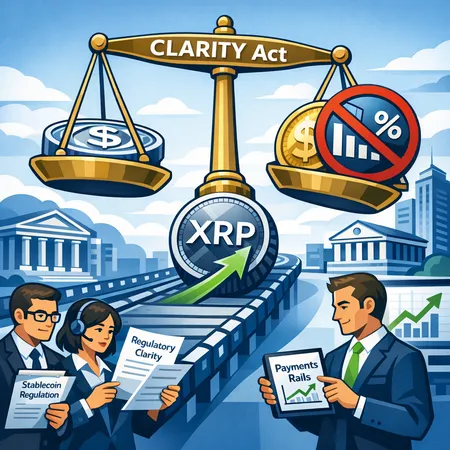
Congressional outcomes are shaped as much by political resources and messaging as by technical policy arguments. The CLARITY Act — currently a central legislative vehicle for stablecoin rules — will be a primary target for any well-funded PAC that represents issuer interests. Analysis of the CLARITY Act’s progress highlights the timing and stakes for industry lobbying.
Practical levers the PAC can use:
- Campaign funding and targeted supporter mobilization to shape committee priorities and staff attention.
- Coalition-building with fintech trade groups, payment processors, and crypto-friendly lawmakers to broaden the narrative beyond a single issuer.
- Commissioning or amplifying studies that emphasize innovation and financial inclusion costs of onerous rules.
- Seeking technical amendments: carve-outs for existing issuers, phased compliance windows, narrower definitions of “systemic” thresholds, or alternative reserve frameworks emphasizing attestations rather than bank-style supervision.
Those levers are blunt political tools but can be effective, particularly when legislation is still in committee and negotiators are looking for workable compromise language.
Why the Drift exploit and the USDC response matter to the argument
Operational incidents become political leverage. The recent Drift exploit and the ensuing questions about USDC freezes and operational limits provide concrete, public examples of why regulators and lawmakers worry about operational control and market safety. Coverage of the exploit laid bare the tensions between immediate risk mitigation (freezing funds to stop illicit flows or limit damage) and longer-term market confidence (users fearing discretionary intervention). That real-world context makes both regulatory caution and issuer defensive arguments more salient.
Any PAC arguing for lighter controls will need to reconcile these operational risks with credible governance and transparency commitments from issuers.
Reputational and lobbying trade-offs for stablecoin issuers
There are explicit trade-offs when an issuer — or one closely associated with an issuer — takes a prominent political stance.
- Credibility vs. influence: Aggressive lobbying can produce favorable law but can also erode public trust if users see the issuer as prioritizing market share over consumer protections. That diminished trust can increase counterparty risk and lead counterparties or custodians to de-risk.
- Short-term wins vs. long-term legitimacy: Winning narrow regulatory carve-outs may boost growth but invite stricter oversight later, or litigation, if the market experiences shock events.
- Reputation spillover across the ecosystem: Actions by a single PAC chair can affect how banks, exchanges, and institutional investors view all stablecoins — including competitors like USDC.
For Circle and other market participants, the public reaction to policy advocacy is a central part of reputation management. The Drift episode in particular fed the narrative that operational controls and emergency powers are messy and politically salient, which raises the reputational cost of lobbying that appears to oppose those controls.
Likely policy-and-market scenarios and their implications
Below are three plausible outcomes if the PAC is successful to varying degrees, and what they would mean for markets, institutions, and compliance teams.
Scenario A — Issuer-favorable rules (strong PAC influence)
If the PAC helps secure legislation that protects issuer operational latitude and adopts lighter reserve rules (for example, allowing quarterly attestations rather than bank-style audits or narrower "systemic" thresholds), incumbents like USDT could consolidate market share. Pros:
- Faster product innovation and lower compliance costs for issuers.
- Continued deep retail and trading liquidity on-chain.
Cons:
- Intensified political scrutiny and reputational risk; some banks or partners may still de-risk to avoid regulatory headlines.
- Greater regulatory backlash if another major incident occurs, potentially triggering retroactive reforms.
Scenario B — Compromise (partial influence)
Legislation lands in the middle: stronger transparency requirements and operational guardrails but with phased implementation and limited exemptions for established issuers. Outcomes:
- Predictable, incremental compliance costs; issuers can plan migrations and audits.
- Market fragmentation risk is lower; institutional uptake resumes cautiously.
Scenario C — Restrictive regime (PAC fails)
Congress enacts stringent rules: bank-like supervision for large stablecoins, mandatory real-time reserve audits, and restrictions on freezes. Outcomes include:
- Higher operational costs and possible product exits or migration offshore.
- Exchanges and institutional players prioritize fully compliant, possibly non-U.S. alternatives or collateralized on-chain solutions.
- Short-term market turbulence and reduced peg stability if liquidity shifts quickly.
Across scenarios, firms that run P2P, earn, or custody services — including platforms like Bitlet.app — should anticipate changes to partner onboarding, delta-risk management, and disclosures.
A tactical playbook for policy-aware legal and PR teams
Legal and communications teams need an integrated plan that treats lobbying as only one part of a broader risk-management strategy.
- Coordinate lobbying with demonstrable operational changes
- Fund advocacy that is tied to measurable governance upgrades: better attestation cadence, independent reserves testing, and third-party incident response protocols.
- Proactive transparency
- Move beyond marketing claims to publish clear legal frameworks for reserve custody, asset segregation, and counterparty exposures. This reduces the political argument that issuers hide risks.
- Incident-ready communications
- Prepare short- and long-form narratives for incidents (exploit, liquidity stress) that explain why certain operational controls exist and what checks prevent abuse of those controls.
- Legal contingency planning
- Evaluate multi-jurisdictional product paths, dual-currency rails, and migration scripts to move customer balances if a U.S. regime becomes untenable.
- Coalition and third-party validators
- Build alliances with payments firms, fintech trade groups, and consumer-protection NGOs where possible. Fund neutral research or third-party verification to reduce accusations of self-interested messaging.
- Institutional partner management
- Share scenario models and stress tests with banks, custodians, and exchanges to maintain bilateral trust even amid political noise.
- Regulator engagement
- Maintain open, documented dialogues with supervisory staff. Offer pilots and sandbox data to demonstrate safe, auditable operations.
Conclusion
A senior Tether executive chairing a crypto super PAC reframes the lobbying battlefield: it concentrates influence at a moment when Congress is shaping the rules that will define stablecoins’ legal and economic future. That influence can steer outcomes, but it also attracts scrutiny and raises reputational stakes. For policy-aware professionals and senior PR/legal teams, the prudent response is twofold: engage political processes strategically, and at the same time harden governance, transparency, and incident-readiness so that any policy victory is durable and credible.
For readers focused on market practicalities, remember that technical robustness and believable third-party validation will matter as much as any legislative win — and that a fractured U.S. policy outcome could push activity into offshore markets or alter the role of DeFi primitives in dollar liquidity. Meanwhile, broader market bellwethers such as Bitcoin will continue to reflect risk-on/risk-off shifts driven in part by regulatory clarity or its absence.
Sources
- Announcement that a Tether executive was appointed chair of a major crypto PAC: Crowdfund Insider
- Progress and stakes of the Digital Asset Market CLARITY Act: CoinGape
- The Drift exploit and questions about USDC freezes: Cointelegraph