How the CLARITY Act's Stablecoin Rules Could Accelerate XRP Adoption
Summary
Executive overview
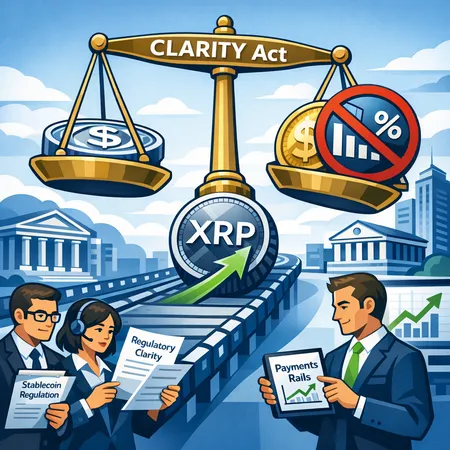
Legislative moves on stablecoin rules are now a central driver of market structure. The CLARITY Act — primarily discussed for how it codifies stablecoin guardrails — includes a ban on passive yield for dollar-backed stablecoins that could materially change product economics for issuers, custodians, and payments rails. That change opens a credible strategic window for non‑dollar settlement tokens, and some market participants argue it could accelerate XRP adoption if the law delivers the promised regulatory clarity.
This piece breaks down the ban, explains why custodians and rails care, summarizes Evernorth’s thesis that the Act might “open the floodgates” for XRP, and maps pragmatic adoption pathways and tactical steps for institutional traders and compliance officers.
What the CLARITY Act would change for dollar-backed stablecoins
The ban on passive yield — what it means in practice
Under the CLARITY Act proposals widely discussed in industry analysis, dollar-backed stablecoin issuers would be prevented from offering passive yield on token balances that derives from traditional reserve activities (for example, lending reserve deposits or investing in interest-bearing instruments) to ordinary holders. The idea is to sharply separate payment‑style stablecoins (meant for medium-of-exchange) from interest-bearing investment products to reduce run risk and the regulatory complexity that comes with deposit-like features.
Why that matters: many current stablecoin business models rely on returns generated by reserves to offset operational costs or to deliver yield to counterparties and users. A regulatory ban would force issuers and their custodial partners to change funding strategies, charge explicit fees, or reclassify products — all of which have downstream effects on liquidity, UX and product take-up.
Custodians, reserve mechanics and the liquidity hit
Custodians that hold fiat reserves or treasuries on behalf of stablecoin issuers will see their economics shift. If reserves can no longer be used to flow passive yield back to users, custodians and issuers face at least three immediate effects:
- Revenue compression: fees previously offset by yield must be replaced by explicit charges or new commercial arrangements.
- Liquidity provisioning stress: market-makers and rails that relied on yield-subsidized inventories may need more capital to maintain spreads, or they will widen costs to end users.
- Compliance and accounting complexity: shifting funds from income-generating reserve models to truly custodial safekeeping raises operational and reporting changes for banks and trust companies.
For payments rails, stablecoins that don’t pay yield are less attractive to treasuries who want short-term returns on idle balances. That creates a gap: firms still need cheap, fast settlement and a liquid medium of exchange, but the commercially attractive dollar-stable option becomes more expensive to hold.
Why the rules matter for payments rails and cross-border flows
Payment providers and banks think not only about legal form but also about operational costs. When a treasury desk holds a dollar stablecoin overnight, the implicit yield (or absence of it) changes the calculus versus a bank deposit or money-market product. If regulatory changes force stablecoins into a narrower payments-only box, institutions that desire low-cost, instant settlement with minimal credit exposure will start to evaluate new rails and native crypto liquidity that sidestep the constrained stablecoin economics.
This is where the strategic comparison to XRP becomes relevant: XRP is not a dollar-backed liability and is used as a bridge asset in cross-border liquidity solutions like Ripple’s On-Demand Liquidity (ODL). With stablecoin revenues constrained by regulation, using a native settlement token as a temporary bridge for FX conversion can look relatively more attractive — especially if legal clarity reduces counterparty or custody fears.
Evernorth’s 'open the floodgates' thesis and market reaction
Evernorth has argued that the CLARITY Act could "open the floodgates" for XRP by removing a key barrier — regulatory uncertainty — that has kept many institutions on the sidelines. Their core point: clearer rules that limit stablecoin yield create a structural wedge. Firms that need instant, low-cost settlement but cannot accept the economics of regulated dollar-stable products may pivot to alternatives that are well-understood from a payments perspective and have established rails and liquidity providers.
Their full argument is worth reading in context; Evernorth lays out how behavior could change if the legal fog lifts and banks feel comfortable integrating XRP for liquidity delivery Evernorth's analysis.
Market participants already price regulatory signals. For example, short-term price movements in XRP have responded to both geopolitical easing and regulatory news, demonstrating how quickly capital can reallocate when perceived risk declines. See coverage of recent price responses tied to easing tensions and regulatory narratives FXEmpire.
Concrete pathways for XRP adoption if regulatory clarity arrives
If the CLARITY Act (or an equivalent regulatory framework) provides a clear, predictable regime for stablecoins and constrains their economic features, Ripple and XRP could scale via a few practical channels:
- Payments rails integration: banks and payment processors could adopt XRP as a wholesale settlement rail or intraday liquidity tool, integrating via RippleNet and ODL to minimize pre-funded nostro balances.
- Liquidity services by custodians and market-makers: institutional custody providers could offer short-term XRP liquidity pools or instant conversion rails that mirror current stablecoin wallet integrations, but use XRP as the bridge asset.
- Tokenized FX and rails interop: stablecoin issuers still exist under the CLARITY regime but become pricier to hold; connectors that automatically route to XRP for on‑chain FX conversion could appear in treasury platforms and FX desks.
- Niche product innovation: exchanges and institutional apps could build yield-agnostic payment primitives that use XRP for settlement and overlay compliance controls to fit bank-grade requirements.
Coinpedia’s breakdown of ways the CLARITY Act affects both XRP and the stablecoin market highlights specific mechanisms — from product reclassification to implications for reserve management — that would make the above pathways operationally sensible Coinpedia deep-dive.
Each pathway depends on three conditions: (1) legal clarity that reduces counterparty/legal risk; (2) mature custodial and exchange liquidity for XRP; and (3) integration work by payments processors and treasury systems to accept an alternative bridge asset. Those are solvable, but not instantaneous.
Tactical angles for institutional traders and compliance teams
For the compliance officer and institutional trader evaluating scenarios, preparation should be pragmatic and staged. Below are tactical actions to consider now.
For compliance officers
- Update risk frameworks: include scenarios where dollar-backed stablecoins change character (fee-based vs. yield-bearing) and where alternative settlement tokens like XRP are used in production rails.
- Revisit counterparty due diligence: ensure custodians, market-makers and on‑chain settlement vendors have bank-level controls, and clarify how KYC/AML flows operate when XRP is used as a bridge.
- Draft policy addenda: create modular policy language that can be toggled as regulators finalize rules — e.g., a specific annex addressing stablecoin holding limits, permissible yield arrangements and use of non-sovereign bridge assets.
- Engage regulators early: meaningful dialogue with banking supervisors and payments regulators reduces surprise and accelerates permitted production use-cases.
For institutional traders and treasury desks
- Scenario test liquidity: run stress tests comparing the cost of pre-funded nostro balances, regulated stablecoin-backed flows under CLARITY constraints, and XRP-enabled ODL-like routing at different market depths.
- Counterparty and execution playbook: pre‑approve market-makers and custody providers who can offer instant XRP liquidity, and define transaction limits and slippage tolerances for programmatic routing.
- Hedging and inventory management: design hedging rules to mitigate XRP price volatility during settlement windows, including timed conversions and options overlays if needed.
- Integrate technology: evaluate vendors and APIs that can route FX conversion via XRP with enterprise controls. Platforms in the ecosystem — from custody to execution — will offer different trade-offs; solutions like Bitlet.app integrate several institutional features that can be part of testing and pilots.
Risks, caveats and timing
Regulatory intent is not identical to final rule text. The CLARITY Act discussions are influential, but the exact scope, definitions, and enforcement approach will determine real-world outcomes. Key caveats:
- If regulators carve out exceptions or allow limited yield through tightly supervised channels, stablecoin economics could remain viable and blunt the migration to XRP.
- Market infrastructure and custody for XRP must improve in parallel; without deep, reliable institutional custody and settlement rails, adoption stalls even with favorable law.
- Price volatility risk: using a native token for interim settlement requires robust operational hedging; firms must be comfortable with that trade-off.
Final thoughts
The CLARITY Act’s proposed ban on passive yield for dollar-backed stablecoins would change more than product labels — it would alter incentives across custodians, payment rails, and institutional treasuries. That change creates a plausible opening for bridge assets like XRP to gain commercial traction if, and only if, legal clarity arrives alongside mature custody and liquidity solutions.
For compliance officers and institutional traders, the prudent path is to design modular policies, run comparative liquidity and cost tests, and engage custody and market-making partners for pilot routing scenarios now. When regulatory clarity lands, firms that have already stress-tested XRP-integration and updated their compliance frameworks will be best positioned to act quickly.
Sources
- https://coinpedia.org/news/what-does-the-clarity-act-mean-for-xrp-in-five-specific-ways/
- https://coinpaper.com/15906/xrp-s-big-moment-evernorth-says-clarity-act-could-open-the-floodgates?utm_source=snapi
- https://www.fxempire.com/forecasts/article/xrp-news-today-easing-us-iran-tensions-send-ripple-token-rising-1589014