Solana’s $2B RWA Milestone: Product-Market Fit or Tokenized Wrappers?
Summary
Why the $2.0B headline matters — and why it doesn’t tell the whole story
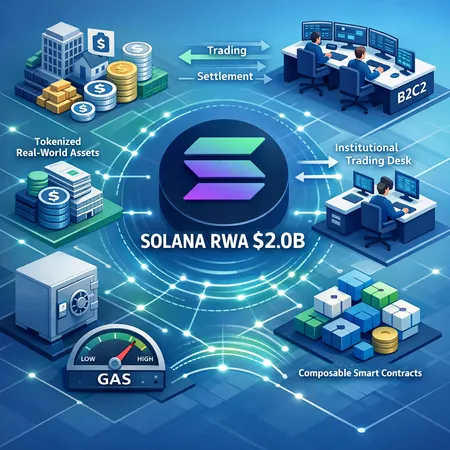
RWA.xyz’s snapshot showing roughly $2.0B in distributed real‑world asset (RWA) value on Solana is an important milestone: it signals institutional and developer interest in bringing off‑chain assets on‑chain. Headlines like this attract capital, developer attention, and media coverage, and they feed narratives about blockchains moving beyond speculative tokens into payments, lending, and regulated finance.
But the raw number needs unpacking. Tokenized asset counts on RWA.xyz reflect distributed tokenized value, not necessarily on‑chain settlement flows tied to actual custodial transfers or bank settlement. A large fraction can be wrappers, synthetics, or token representations issued by custodians with their own off‑chain liability structures. In short, $2B is a meaningful metric of ecosystem activity, but it’s not proof alone of product‑market fit for settlement or custody models.
What RWA.xyz measures — token supply vs. economic utility
RWA.xyz aggregates tokenized positions and distributed value across networks. That includes tokenized bonds, invoices, real estate fractions, and other assets that have been minted as on‑chain tokens. While this captures supply and ownership distribution, it doesn’t always capture the underlying settlement plumbing: whether asset transfers on‑chain correspond to reconciled off‑chain settlement and regulated custody.
Put differently:
- Some tokenized assets are direct wrappers of custodial holdings — a 1:1 claim on an asset held by an intermediary.
- Others are synthetic representations where exposure is created by contracts and market makers.
- A smaller share represents fully integrated custody and settlement where transfers trigger or reflect reconciled off‑chain ownership changes.
These distinctions matter for institutional product teams: wrappers increase on‑chain liquidity and composability, but they also introduce counterparty exposure to the issuing custodian.
Tokenized wrappers vs. true product‑market fit
When evaluating whether $2B equals product‑market fit, ask: are institutional players using Solana for actual settlement, or are they simply using it as a liquidity layer for wrapped exposures? There are indicators for each side.
Signs of wrapper‑led growth
- Concentrated issuance from a handful of custodians or issuers. Large single‑issuer pools can inflate TVL without broad market demand.
- Heavy trading volume but limited movement between on‑chain and regulated off‑chain accounts, implying purely on‑chain re‑pricing rather than settlement.
- Rapid mint/burn activity used to create synthetic exposures for AMMs and lending markets.
Signs of settlement demand and product‑market fit
- Institutional routing and settlement agreements with liquidity providers and market makers (a structural step toward off‑chain reconciliation).
- Integration of banking rails and custodial reconciliation where an on‑chain transfer is matched by off‑chain title change.
- Counterparties choosing the network for finality, low latency, and interoperable smart contracts to automate reconciled settlements.
The recent news that B2C2 — an institutional liquidity provider — will route and settle stablecoin flows on Solana is a concrete signal moving the needle from wrapper narratives toward operational settlement. Coverage from The Block details B2C2’s role in enabling institutional stablecoin settlement on Solana, which is a pragmatic endorsement of Solana’s throughput and latency profile for high‑frequency institutional use cases (see reporting here).
The operational case for institutional settlement on Solana
For institutions, settlement is about more than low fees: it’s about predictability, finality, operational SLAs, and integration with existing custody and compliance flows. Solana’s architectural strengths align with many institutional needs:
- Low latency and high throughput. Millisecond‑level block times and high TPS enable near‑real‑time settlement, attractive for trading desks and market makers.
- Low per‑transaction cost. Cheap on‑chain operations make frequent settlement economically viable compared to high gas chains.
- Composability. Solana’s single‑state and program model allow contracts to interoperate without cross‑chain bridges, reducing reconciliation complexity for multi‑party workflows.
B2C2’s planned routing and settlement of stablecoin flows is a practical test: if liquidity providers are comfortable holding and routing stablecoins on Solana while meeting their institutional counterparty obligations, it materially strengthens the settlement thesis. This move complements market coverage suggesting RWA adoption is influencing SOL momentum and market narrative (see industry coverage here).
UX, custody, and composability risks to manage
The benefits above come with real tradeoffs. Builders and institutional teams should consider these categories carefully.
Custody and counterparty exposure
- Custodial model risk. Many tokenized RWAs are claims on assets held by custodians. Institutional counterparties must evaluate the custodian’s legal structure, segregation of assets, and insolvency waterfall.
- Wrapped token risk. A token saying “1 unit = 1 real‑world asset” only promises value if the issuer keeps the reserves and redemption mechanisms intact. Redemption cadence, dispute resolution, and audits are critical.
- Counterparty concentration. Large exposure to single issuers or market makers increases systemic risk if that counterparty fails.
Composability and protocol risk
- Economic linkages. Once wrapped RWAs are fungible inside AMMs, lending markets, and derivatives, failures can cascade through liquidations and oracle feed issues.
- Smart contract risk. Token wrappers and custodial integration software expand the attack surface. Protocol audits and insurance are necessary but not sufficient.
- Governance and upgradeability. Flexible wrappers can be upgraded by issuers or governance boards, which may create legal and technical uncertainty for holders.
UX and operational friction
- Onboarding enterprise users. Institutional UX is still immature compared to traditional banking — custody integrations, KYC automation, AML controls, and reporting need work.
- Reconciliation and settlement finality. For many back‑office systems, definitive finality and time‑stamped proof of transfer that map cleanly to accounting systems are essential.
Gas, latency, and composability: why Solana is attractive for settlement workflows
Solana’s economic argument for settlement is straightforward: the network can deliver high frequency settlement at micro‑costs, making atomic movements of value (settlement on trade execution, margin transfers, intraday netting) feasible. For institutional settlement:
- Lower transaction costs reduce the friction of settling small lots or frequent microtransactions.
- Faster confirmations lower counterparty risk between trade execution and settlement finality.
- Single‑chain composability avoids cross‑chain reconciliation delays and reduces bridge dependency for multi‑party workflows.
That said, institutions will also measure availability and incident response norms. Network outages or congestion — while less common on Solana today — have outsized consequences when a network becomes a settlement rail.
Implications for SOL and Solana’s on‑chain economy
If tokenized RWAs on Solana grow into genuine settlement demand, the on‑chain economy could benefit in several ways:
- Sustained fee revenue. More settlement and market‑making flows increase transaction fees, improving validator revenue and network utility.
- Deeper liquidity on‑chain. RWA pools can attract stablecoins and trading counterparts, improving market depth for DeFi builders.
- Staking and security incentives. Increased economic activity can raise the opportunity cost of network attacks, making staking more valuable.
However, the upside depends on whether assets represent sustainable use rather than parked supply. If RWA growth is driven by a few issuers minting wrappers that never result in off‑chain settlement, fee growth may be brittle and reputational risk for the network may rise in the event of a custody failure.
Checklist for builders and institutional teams evaluating Solana for RWA and settlement
Below is a practical due diligence checklist to help teams assess readiness and risk.
Operational and legal
- Confirm the legal enforceability of tokenized claims and redemption rights in served jurisdictions.
- Evaluate custodian solvency, audits, and segregation practices.
- Define SLAs for settlement finality and dispute resolution.
Technical and integration
- Verify on‑chain and off‑chain reconciliation flows; implement webhook/notification systems for custody events.
- Test settlement latency and throughput under realistic load scenarios.
- Ensure oracle architecture is robust for price and state feeds tied to asset redemptions.
Risk management
- Model counterparty exposure and concentration limits for wrapped issuers and market makers.
- Stress‑test composability scenarios: large redemptions, mass liquidations, and oracle failures.
- Procure custody insurance and consider third‑party guarantees where available.
Partnerships and liquidity
- Engage with institutional liquidity providers (for example, B2C2‑style partners) to secure routing and intraday settlement lines.
- Build relationships with regulated stablecoin issuers and monitor their reserve attestation cadence.
UX and compliance
- Instrument clear UX flows for reconciliation, on‑chain receipts, and accounting exports.
- Bake KYC/AML flows into token minting/redemption and counterparty onboarding.
What this means for DeFi builders and product teams
For builders, the $2B milestone is a call to design defensible products that bridge on‑chain liquidity with off‑chain settlement integrity. That means:
- Prioritizing composability use cases that add real operational value (e.g., automated settlement, margin netting, treasury management).
- Designing wrappers with transparent redemption mechanics, auditability, and fail‑safe settlement paths.
- Partnering with institutional market makers and custodians to ensure off‑chain reconciliation and liquidity commitments.
DeFi projects that can couple programmatic on‑chain workflows with reliable off‑chain settlement will capture the most durable value. Mention of ecosystems like DeFi is no accident: composability unlocks rapid product iteration, but it also multiplies counterparty linkages.
Realistic outlook and next milestones to watch
The next signs that Solana’s RWA market is maturing beyond wrappers will include:
- A growing number of distinct custodians with auditable reserves and interoperable redemption APIs.
- Formal settlement agreements and routing commitments from multiple liquidity providers, not just a single market maker.
- Observable on‑chain flows that reconcile with off‑chain custody trails and banking settlements.
If B2C2’s routing of stablecoin flows proves resilient, and if additional institutional parties mirror that behavior, we’ll see a clearer path from tokenized supply to operational settlement demand. Keep an eye on protocol‑level transparency, issuer concentration metrics from RWA.xyz, and market commentary around SOL liquidity and momentum (industry coverage is tracking this dynamic closely; see coverage here and broader price context here).
Conclusion: cautious optimism, practical diligence
Solana’s $2.0B RWA milestone is an exciting inflection point — it demonstrates developer and issuer creativity and shows that tokenized assets can scale on high‑throughput chains. But for builders and institutional product teams, the headline should prompt a deeper operational conversation: are these assets facilitating true settlement and reconciled custody, or are they largely wrapped liquidity playing inside composable markets?
The operational case for Solana is strong on latency, cost, and composability. The counterbalance is custody design, counterparty concentration, and the need for concrete settlement agreements such as the B2C2 routing described in The Block. Getting RWA right on Solana will require both protocol‑grade engineering and enterprise‑grade operational guardrails.
For teams building on Solana or evaluating it as a settlement layer, focus on custody, transparency, diversified liquidity partners, and clear redemption mechanics. The network can be a high‑performance rail — but its long‑term success for RWA will be decided in the trenches of legal contracts, audits, and robust operational playbooks. Bitlet.app users and other builders should weigh these factors when designing tokenized asset products or institutional settlement rails.