Ripple, Escrow and Whales: Reconciling a $50B Valuation with a 1B XRP Release
Summary
Executive snapshot
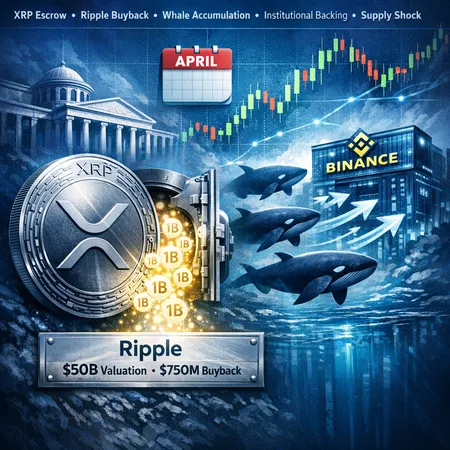
April’s scheduled escrow release of 1 billion XRP has raised a simple but urgent question: how can Ripple simultaneously tout a roughly $50 billion private valuation and execute a $750 million share buyback while a material supply event looms for the token? The short answer is that equity moves and token mechanics are related but distinct, and the market reaction will depend on how much of the released XRP enters liquid markets, who buys it, and whether institutional demand can absorb supply without creating a sustained sell pressure.
For many macro traders, Bitcoin still sets risk appetite. But for XRP holders the variables to watch are on-chain flows, exchange reserves, and large wallet behavior — all of which can create a fast, short-lived supply shock or a muted non-event depending on execution.
Ripple’s $50B private valuation and $750M buyback: what it means
The buyback announced by Ripple — reported around a $750M program against a reported ~$50B private valuation — is largely an equity-level action that signals confidence from management and insider liquidity preferences. A buyback can: reduce outstanding shares, signal confidence to secondary investors, and provide price support for Ripple’s private stock. Token holders often conflate corporate capital returns with tokenomics, but they are different instruments. The corporate buyback does not directly remove XRP from circulation.
That said, the optics matter: a strong private valuation and buyback can encourage institutional managers and asset allocators to look closer at the project. Coverage around the event highlighted the buyback and valuation as part of Ripple’s maturation story reported here.
Mechanic of the 1 billion XRP escrow release and immediate market impact
Ripple’s monthly escrow mechanism is public: 55 billion XRP were originally placed into monthly releases of up to 1 billion XRP, with unused amounts returned to escrow. The specific report that a 1 billion XRP tranche will be released on April 1, 2026 frames the near-term event as a potential supply injection (see the Finbold write-up on the scheduled release).
Key market mechanics to understand:
- Not all released XRP is sold into spot order books. Ripple uses escrowed XRP for partnerships, employee compensation, liquidity provision, and OTC deals — some of which are off-exchange.
- If a substantial portion is sold on exchanges, it will increase immediate sell-side pressure, widening spreads and causing slippage for market takers.
- Conversely, if large OTC buyers or institutions absorb the tranche, the release can be sterile from a price perspective.
Practically, the difference between a realized supply shock and a muted distribution depends on execution: how much goes to exchanges, how much is allocated via OTC desks, and whether whales or institutions are net buyers.
Whale accumulation signals — what on-chain shows now
Recent chain data and reporting show increased large-movement activity: more than 200 million XRP moved in a single week and significant outflows from Binance have been highlighted as signs of whale accumulation. Reporting on these movements is summarized in coverage like this zyCrypto piece.
Why large transfers matter:
- Exchange outflows often indicate accumulation into cold wallets or vaults — a reduced exchange float can support higher prices if demand returns.
- Big transfers into non-custodial wallets can be a precursor to long-term staking/holding (or preparation for OTC settlement), while transfers to unknown exchanges or mixing services could mean distribution.
On balance, the recent 200M+ movement and Binance outflows point to meaningful interest from large holders. If these flows represent genuine accumulation, they act as a counterweight to the impending escrow release.
Institutional backing and the demand-side narrative
Institutional interest changes both perception and practical demand. Reports that Franklin Templeton and other institutional players have shown interest in Ripple-related solutions provide another demand pillar; coverage discussing Franklin Templeton’s backing is available at Coinpedia (noting institutional exposure and commentary from Ripple’s CTO) here.
Institutions can absorb large blocks via custody and OTC channels without pressuring public order books. Their participation can: reduce effective circulating float, add credibility to market structure, and lengthen investment time horizons. But institutional demand is not guaranteed — it depends on product approvals, custodial solutions, regulatory clarity, and macro liquidity.
Reconciling supply events and corporate moves: a synthesis
- Ripple’s equity buyback and $50B private valuation are positive signals for the company but do not mechanically remove XRP from circulation.
- The escrow release is a token-level event that could temporarily increase sell-side pressure if XRP lands on exchanges.
- Whale accumulation and institutional demand offer the absorbing liquidity that could turn the release into a non-event or even a bullish catalyst if OTC and custody channels soak up large blocks.
In short: the narrative is not binary. A large escrow release can be neutralized by pre-existing accumulation and institutional bids, or it can exacerbate volatility if liquidity is thin and market makers are unprepared.
Short-term technicals and likely catalysts or dampeners
From a price-structure perspective, expect heightened intraday volatility around the release window. Useful signals to monitor:
- Exchange reserves and order-book depth — falling reserves and thin asks imply stronger bullish absorption potential.
- Big on-chain transfers to cold wallets or custodians — accumulation reduces sell-side risk.
- Macro catalysts — broad risk-on or risk-off moves tied to Bitcoin and global liquidity will amplify XRP’s move; BTC flows and spot volatility are leading indicators.
Potential catalysts: institutional allocations, large OTC buys, positive regulatory developments, Ripple operational wins, or a sudden drop in exchange reserves. Dampeners: heavy exchange selling, sudden macro deleveraging, or a coordinated profit-taking event by whales.
Practical trading and risk-management strategies for the April escrow event
For XRP traders and tokenholders seeking an evidence-based playbook:
Size positions and stagger entry: avoid single-ticket market orders on or just before the release. Use dollar-cost averaging or scale-in layers.
Use limit orders and iceberg sizing: during expected volatility, limit orders reduce slippage; iceberg or spread-out orders prevent front-running and orderbook depletion.
Monitor exchange flows in real time: watch for spike in exchange deposits or sudden withdrawals. Significant deposit spikes could presage visible selling.
Hedge selectively: if available, use options or inverse products to hedge event risk. For traders without derivatives, reduce exposure near the event and re-enter after volumes normalize.
Plan stops conservatively: wide stops reduce the chance of being clipped during a volatility spike, but balance that with risk tolerance.
Watch OTC desks and institutional desks: large blocks may be executed off-exchange. If you can access OTC liquidity, that’s a lower-impact route for big buys or sells. Bitlet.app users, for instance, should be mindful of liquidity and slippage when buying or selling around large events.
Keep a watchlist of whale wallets: identify known custodial wallets versus cold storage; transfers to custodial addresses usually presage selling while transfers to cold storage imply holding.
Final assessment
The April escrow release is a measurable source of risk but not a foregone bearish outcome. Ripple’s corporate actions (buyback, private valuation) improve the narrative for institutional interest — which, combined with observed whale accumulation and exchange outflow patterns, increases the probability that much of the released XRP will be absorbed off-exchange or into long-term custody.
That said, liquidity mismatches can produce sharp price moves in the short term. Traders should approach the event with a plan: size positions conservatively, monitor on-chain and exchange flows in real time, and be prepared for higher spreads and slippage around the release window.
Sources
- Report on Ripple completing a $750M share buyback and its $50B private valuation: https://tokenpost.com/news/business/19471
- Coverage of large whale accumulation moving over 200M XRP in a week: https://zycrypto.com/ripples-xrp-boom-imminent-as-whales-snap-up-over-200-million-xrp-in-a-week/
- News of Ripple preparing to release 1 billion XRP from escrow on April 1, 2026: https://finbold.com/ripple-prepares-to-dump-1-billion-xrp-tomorrow/?utm_source=snapi
- Franklin Templeton and institutional attention toward Ripple/XRP: https://coinpedia.org/news/franklin-templeton-backs-xrp-while-ripple-cto-explains-why-price-rising-is-a-good-thing/