Uniswap Foundation FY2025: $85.8M Treasury, UNIfication Overhaul, Risks & Playbook
Summary
Executive snapshot
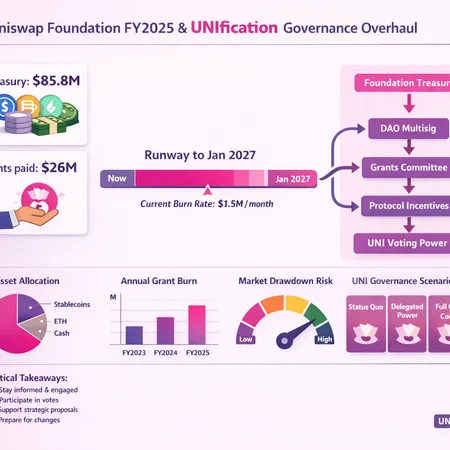
The Uniswap Foundation closed FY2025 with $85.8 million in reported assets and committed about $26 million in grants during 2025, according to recent public reporting. Those figures—summarized by Coindesk and recapped by Blockonomi and other outlets—are more than bookkeeping; they set the baseline for how long the Foundation can underwrite grants, incentives and ecosystem programs while the UNIfication governance overhaul reshapes who gets to decide.
This article parses the numbers, explains how UNIfication changes governance mechanics around the DAO treasury and grants, models downside scenarios (market drawdowns and burn rate risk), and finishes with tactical takeaways for DAO participants and UNI holders. It’s aimed at active DeFi governance participants who need to convert headline figures into vote-level strategy.
The FY2025 numbers — what $85.8M and $26M really mean
Public reporting shows two headline items: $85.8M in total assets at year-end and $26M committed in grants during 2025. The Coindesk piece lays out the unaudited FY2025 snapshot, while Blockonomi and local coverage provide context around runway and commitments. Read the original reporting for the accounting detail: Coindesk summary, Blockonomi recap, and regional analysis at Cryptonomist.
A few framing points:
- The $26M reported in grants is what was committed during 2025, not necessarily equivalent to cash outflows in a single year—some grants are multi-year or milestone-based. That distinction matters for runway math.
- Blockonomi's headline that reserves give a runway to January 2027 is a practical estimate that likely includes other ongoing commitments (operational spend, incentive pools, and reserved but unspent grant tranches) and assumes no large market drawdown.
- Treasury size is reported in nominal USD-equivalent. A sustained crypto market drawdown (e.g., -30% or more) would compress USD runway materially because asset holdings are primarily crypto or crypto-linked.
Simple runway scenarios (illustrative)
Below are conservative, illustrative scenarios to convert headlines into decision-relevant thinking. Exact outcomes depend on portfolio composition and future commitments.
- Low-burn scenario: If the Foundation continues to commit roughly $26M/year in grants and has minimal additional operational spend, runway = 85.8 / 26 ≈ 3.3 years (mid-2029). This is a best-case reading if most grant commitments are disbursed slowly and the market is stable.
- Moderate-burn scenario: If annual outflows (grants + ops + incentive programs) total ≈ $40M/year, runway = 85.8 / 40 ≈ 2.1 years (≈ mid-2028).
- Downside shock + moderate burn: A -30% market shock reduces assets to ~60M and with $40M/yr outflows runway ≈ 1.5 years (late 2027).
Blockonomi’s Jan 2027 runway implies either higher effective annual commitments or conservative liquidity assumptions (for example, including committed but unpaid grants or earmarked incentive allocations). The point is not to pick one exact date but to show the runway is highly sensitive to grant burn and market moves.
UNIfication: what the governance overhaul changes (and why it matters)
UNIfication is framed as a governance modernization: aligning the Foundation, on-chain governance, and protocol incentives so decision-making is clearer and more accountable. In practice, the overhaul touches three tight feedback loops: treasury governance, grant allocation, and protocol incentive mechanics.
Treasury governance
Under UNIfication, expect a clearer separation (or formalization) of roles: who proposes budgets, who executes spending, and who monitors outcomes. That can mean more on-chain proposals that directly touch treasury allocations, formal budget cycles (quarterly/annual), and clearer checks such as timelocks, delegated authorities, or independent stewards.
The practical implication: the DAO will likely gain tools to tie funding to deliverables, but it may also create new decision friction as competing stakeholders compete for allocation seats. If properly designed, UNIfication reduces ad-hoc spending; if poorly designed, it risks pushing more of the decision-making off-chain into committees or multisigs, which can reduce token-holder control.
Grant allocation
UNIfication's grant changes appear aimed at professionalizing grantmaking—prioritizing strategic, measurable programs over ad hoc donations. Expect more milestone-based grants, clearer reporting requirements, and possibly a bifurcation between small community microgrants and larger strategic grants for infrastructure and developer incentives.
This is good for capital efficiency: grants with KPIs and clawbacks reduce waste. But it raises two new governance questions: who sets KPIs, and how are disputes over milestone achievement adjudicated? Those questions determine whether grants are a durable mechanism for public good or a recurring drain on treasury.
Protocol incentives and UNI
UNIfication also impacts how incentives (liquidity mining, buybacks, or other UNI-linked incentives) are funded and authorized. Bringing incentive design into standardized budget cycles increases predictability for market participants and market-makers, but it creates a direct link between treasury solvency and ongoing protocol competitiveness. If the treasury is constrained, the DAO may have to reduce incentives, potentially harming market depth.
For many readers, there's a broader ecosystem angle: as trading incentives and grant flows change, cross-protocol interactions—whether for NFTs, memecoins, or DeFi primitives—can shift liquidity and developer attention to or away from Uniswap.
Risks to the treasury: what keeps a treasury steward up at night
Treasury risk is multi-dimensional. The three that matter most here are: market exposure, grant burn rate (including velocity), and governance capture.
- Market drawdowns: With crypto assets, dollar-denominated reserves are volatile. A 30–50% drawdown quickly reduces runway and can force the DAO to cut programs or sell at bad prices. The Foundation's runway estimate to Jan 2027 likely assumes no catastrophic market move; participants should stress-test for sharp drawdowns.
- Grant burn rate and velocity: Committing $26M in grants in a year is meaningful. If commitments accelerate or if grant recipients draw funds quickly (high velocity), the effective annual outflow can exceed expectations and shorten runway. Multi-year grants are less risky for runway than single-tranche payments.
- Governance capture & concentration: If a small group of large UNI holders or off-chain committees gain disproportionate control over treasury allocations, proposals may skew toward short-term rent-seeking rather than long-term public goods. That kind of capture is an operational risk: it changes how funds are used and can damage community trust.
Other risks: regulatory and legal exposures (which can freeze or restrict funds), operational custody risk (private-key theft, multisig failures), and reputational risk from poorly run grant programs.
Scenarios for UNI governance power (three plausible outcomes)
Token-empowered outcome (decentralized control): UNI holders retain direct, meaningful control over large treasury decisions through transparent on-chain voting. Treasury actions are auditable and reversible via community proposals and timelocks. This strengthens long-term alignment but requires high voter engagement.
Delegate/committee outcome (mixed control): The DAO delegates routine treasury management to elected stewards or committees who run day-to-day decisions within approved budgets. This can increase execution speed and professionalize operations but concentrates power and requires trust mechanisms (audits, recalls).
Capture/centralization outcome (reduced token power): Off-chain actors or large holders effectively steer the treasury through off-chain deals, multisig control, or repeated delegation. Token power becomes symbolic; the treasury could be steered toward partner priorities rather than community-first public goods.
Each outcome shapes the value proposition of UNI as a governance asset. More tangible on-chain control generally preserves token-holder optionality; capture reduces it and can create negative feedback on token value if stakeholders feel disenfranchised.
Tactical takeaways for DAO participants and UNI holders
Below are concrete steps that active governance participants can propose, defend, or implement to protect runway and preserve token-holder power.
- Push for transparent budget cycles and tranche-based disbursements: Require multi-stage funding with milestone KPIs and public reporting. This reduces velocity risk and aligns spending to outcomes.
- Insist on treasury diversification: Allocate a portion of reserves to stablecoins or hedged positions to create a defendable cash runway. Hedging strategies (options collars or conservative stable allocations) can blunt downside during market drawdowns.
- Adopt explicit reserve ratios and an emergency buffer: Define a minimum USD-equivalent buffer (e.g., 20–30% of reserves) that is only deployable via supermajority governance to reduce panic selling.
- Demand on-chain visibility and audits: Regular third-party accounting and an on-chain spend dashboard reduce information asymmetry and make capture harder.
- Use delegated governance cautiously: If the DAO elects stewards or a grants council, build recall mechanisms and transparent charters. Delegation should speed execution, not hide decision-making.
- Monitor grant velocity and require clawbacks or reallocation clauses: Grants should have clear milestones and, where reasonable, clawback provisions if milestones aren't met.
- Coordinate across token holders: Large and small holders should form working groups (open, on-chain) to align on budget priorities to avoid fragmented voting that enables capture.
For individual UNI holders: participate in votes, vet delegates, and treat treasury health as a key input to token valuation. Consider diversification if your personal exposure to UNI and protocol liquidity incentives is high—tools and services like Bitlet.app and other DeFi tooling can help program recurring payments or automate certain risk management flows.
Checklist for proposals that should get your vote
When evaluating future treasury or UNIfication-related proposals, look for these features:
- Clear budget and timeline, with milestones
- Partial or staged disbursement (not full up-front payments)
- Public reporting cadence and audit plan
- Built-in clawbacks or reprioritization clauses
- Defined KPIs tied to measurable protocol health (liquidity, active addresses, fees)
- Emergency buffer and treasury diversification rules
Proposals missing these elements should trigger requests for amendments or be tabled for further scrutiny.
Final assessment
The Uniswap Foundation’s $85.8M balance sheet is meaningful but not bulletproof. The $26M in grants for 2025 shows an active commitment to ecosystem growth, yet the headline runway projections (like Blockonomi’s January 2027 estimate) underline how sensitive the treasury is to spending choices and market volatility. UNIfication offers a chance to professionalize treasury management and strengthen on-chain accountability—but it must be executed with guardrails to prevent capture, manage burn rate, and protect USD-equivalent runway.
For DAO participants and UNI holders, the near-term work is governance hygiene: demand transparency, enforce staged funding, diversify reserves, and design recallable delegation mechanisms. Those steps convert headline figures into durable public goods spending rather than ephemeral PR.
Sources
- Coindesk: Uniswap Foundation FY2025 summary — https://www.coindesk.com/business/2026/04/01/uniswap-foundation-held-usd85-8m-at-year-end-committed-usd26m-in-grants-during-2025
- Blockonomi recap of Uniswap Foundation reserves and runway — https://blockonomi.com/uniswap-foundation-reports-85-8m-in-total-assets-for-fy2025-runway-extends-to-january-2027/
- Cryptonomist local coverage on FY2025 and governance context — https://en.cryptonomist.ch/2026/04/01/uniswap-foundation-fy2025/
Internal links mention: for governance context, consider how Uniswap remains the bellwether for automated market-making trends across DeFi.