XRP's Turning Point: Japan's FSA, Whale Accumulation, and Ripple's $13T Narrative
Summary
Executive snapshot
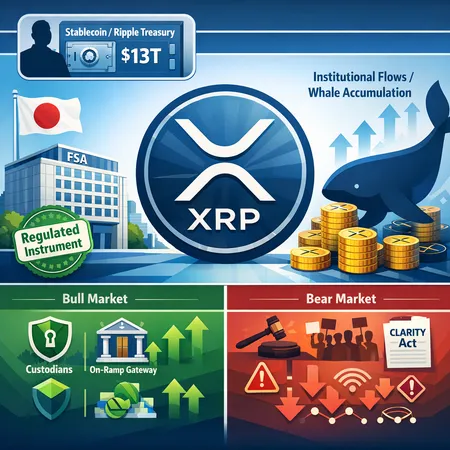
Three near‑term shifts are reframing the institutional risk/reward for XRP: Japan’s Financial Services Agency (FSA) discretion to reclassify XRP as a regulated instrument, on‑chain whale accumulation and exchange flow signals, and Ripple’s own public push for a large stablecoin/treasury role. Each item on its own is meaningful; together they change how allocators should think about XRP regulation, institutional flows and the token’s path to real‑world payment utility.
For allocators evaluating a position size in XRP, the key questions are straightforward: will regulation lower the friction for custodians and product issuance? Are large holders moving into position in advance of demand? And does Ripple’s payments‑and‑stablecoin narrative materially expand long‑term real‑world demand, or invite political and competitive headwinds?
Why Japan’s FSA reclassification matters now
Japan is one of the most important regulatory jurisdictions for crypto liquidity and product rollout in Asia. The recent announcement that the FSA reclassified XRP as a regulated financial instrument is more than symbolic — it alters the compliance and product engineering landscape for custodians, exchanges and institutionals. The FSA update means clearer product eligibility for things like tokenized custody, exchange‑traded products, and institutional settlement rails, reducing a class of operational and legal uncertainty that has historically kept conservative allocators out of certain tokens. See the initial report on this action for the regulatory framing.
Practically, the reclassification can enable: larger custodians to list XRP without ad hoc exemptions; banks and trust companies to build custody and settlement services; and regulated funds to include XRP in structured products. That drives a virtuous cycle: more product eligibility leads to more institutional flows, which can increase on‑exchange demand and reduce free float. If institutional on‑ramps materialize in Japan, they become a visible channel for northbound flows into XRP liquidity pools.
On‑chain and exchange signals: what whale accumulation implies
On top of regulatory clarity, price action often follows supply dynamics. Recent analysis flagged a notable uptick in XRP whale accumulation, with some indicators at 30‑day highs. Large wallets moving off exchanges and accumulating on‑chain can tighten exchange liquidity and make the market more reactive to demand surges. Analysts interpreting these flows suggest whales may be positioning ahead of catalyst events — regulatory clarity, custodian listings, or product rollouts.
Why does that matter operationally? When a meaningful percentage of supply moves from exchange custody to long‑term addresses, the available sell‑side becomes thinner. That makes price more sensitive to incoming buy pressure from institutions or large counterparties. Conversely, if whales are strategically concentrated and decide to rebalance quickly, they can also amplify downside. Watch the ratio of exchange reserves to total supply and large transfer clusters: they tell you whether accumulation is organic or exchange‑led arbitrage. For a contemporary take on the accumulation signal, see the recent accumulation analysis.
Ripple’s $13T stablecoin/treasury pitch: opportunity and realism
Brad Garlinghouse, Ripple’s CEO, has publicly framed a vast stablecoin and treasury market opportunity — numbers as high as $13 trillion have been suggested for tokenized treasury and stable value flows. If Ripple can capture even a small share of tokenized corporate treasury activity, cross‑border settlement and embedded liquidity services, that would generate sustained demand for on‑chain rails and potentially for XRP as a settlement or corridor token.
That said, the jump from an addressable market figure to realized demand is nontrivial. Stablecoin issuance, bank integration, regulatory approvals, and counterparty onboarding are all multi‑year, heavy‑lift processes. The $13T framing is useful as a directional—large—market indicator, but allocators should separate headline TAM from credible near‑term revenue or token‑velocity assumptions. For Garlinghouse’s public positioning, refer to the interview and analysis on the topic.
Political backlash and the CLARITY Act critique
Big narratives draw critics. Charles Hoskinson, founder of Cardano, publicly accused Ripple of influencing the CLARITY Act in a way that could disadvantage competitors. Political allegations like this are a reminder that as firms push for regulatory frameworks that match their product roadmaps, incumbents and rivals will push back. The risk is not just reputational: it can translate into slower legislative processes, hostile amendments, or targeted enforcement that changes the economics of token usage.
For allocators, the CLARITY Act debate underscores two realities. One, regulatory frameworks are being written in public and are shaped by industry lobbying; they can advantage early movers. Two, the broader the commercial pitch (stablecoins, treasuries, remittance rails), the more likely businesses will face competitive and political scrutiny. Expect contested hearings, industry whitepapers, and public campaigns that can create episodic volatility around major policy milestones. See coverage of the CLARITY Act critique for context.
How these threads interact for price and adoption
Put together: Japan’s FSA reclassification reduces a layer of jurisdictional uncertainty that historically slowed product rollout. Whale accumulation indicates some market participants anticipate tighter supply or imminent demand. Ripple’s payments and stablecoin ambition outlines a plausible long‑duration demand path for on‑chain liquidity. That combination is the core of the institutional bull thesis: legal clarity + product availability + demand narrative = sustained institutional flows.
But the converse is equally plausible. Regulatory backlash in other jurisdictions, protracted legislative fights like the CLARITY Act, or failure to convert the stablecoin narrative into bank and corporate traction would mute long‑term adoption. Whale accumulation can amplify both outcomes: if whales panic sell on a negative catalyst, volatility can cascade; if whales hold and demand materializes, price appreciation can be rapid.
For many allocators, the balance will come down to the probability and timing of institutional on‑ramps (custodians listing XRP, funds creating XRP products) and whether Ripple can actually operationalize treasury and stablecoin rails without incurring prohibitive compliance costs.
Scenario analysis
Bull case
- Japan FSA’s reclassification triggers multiple Japanese custodians and exchanges to list XRP for institutional custody and product issuance.
- Major global custodians announce support or pilot programs, enabling regulated funds and ETFs to include XRP.
- Whale accumulation continues off‑exchange, reducing float; Ripple’s treasury/stablecoin offerings secure partnerships with corporates and payments firms, translating into steady demand.
- Result: tighter liquidity, higher institutional flows, sustainable price appreciation and deeper real‑world payments adoption.
Bear case
- Political pushback or new regulatory interpretations (domestic or international) introduce constraints on how XRP can be used by banks and custodians.
- Whale accumulation proves tactical rather than strategic; a coordinated sell during a liquidity shock amplifies downside.
- Ripple’s stablecoin/treasury ambitions falter against incumbent bank systems and regulatory hurdles.
- Result: muted adoption, episodic volatility, and range‑bound price action with limited institutional product issuance.
Practical monitoring checklist for allocators
- Regulatory milestones: Track Japan FSA guidance and any follow‑up rulemaking; monitor similar actions in EU/US. (Keyword to watch: Japan FSA and XRP regulation.)
- Custodian & exchange listings: Watch announcements from major custodians and regulated exchanges for formal XRP custody support and product eligibility.
- Exchange reserve metrics: Monitor the ratio of XRP held on exchanges vs. off‑chain addresses and major transfer clusters for signs of accumulation or distribution.
- Whale activity: Follow large transfers, concentration in top addresses, and sudden on‑chain moves flagged by analytics providers (whale accumulation signals).
- Product rollouts: Track Ripple announcements and corporate partner integrations around stablecoin rails and treasury services; distinguish PoCs from commercial rollouts.
- Political/regulatory signals: Monitor legislative proposals and public criticisms like the CLARITY Act debate for amendments that could change market access.
- Volume & liquidity depth: Observe order‑book depth across top venues and slippage on larger blocks to assess the true institutional execution capacity.
- Counterparty risk: Evaluate Ripple’s business counterparties and settlement partnerships for credit and operational exposure.
Closing perspective
The recent convergence of a more permissive regulatory posture in Japan, renewed whale accumulation, and an ambitious corporate narrative from Ripple creates a time‑sensitive opportunity set for institutional allocators. It is not an unalloyed green light: political backlash, execution risk, and the gap between TAM and realized demand remain real. Allocators should trade on evidence—custodian listings, measurable exchange reserve declines, and credible partner integrations—rather than headline TAM figures alone.
For those managing exposure, a staged allocation tied to observable milestones (custody listings, stablecoin partner pilots, sustained outflows from exchanges) offers a balanced approach. And for those building execution playbooks, tools such as regulated custody, vetted counterparties and measured order execution across venues will matter as much as macro conviction.
Bitlet.app users and institutional teams should fold these signals into both strategic allocation and operational readiness: custody plans, settlement testing and compliance checklists will determine whether theoretical demand can be captured when it arrives.
Sources
- Japan FSA reclassification report — TokenPost
- XRP whale accumulation analysis — Blockonomi
- Ripple CEO on $13T stablecoin/treasury opportunity — DailyCoin
- Charles Hoskinson accuses Ripple over CLARITY Act — Coinpedia
For comparative context on market bellwethers and cross‑asset flow behavior, many allocators also watch how Bitcoin and DeFi narratives evolve alongside token‑specific regulatory developments.