Why the Fed Naming XRP Redraws the Regulatory Playbook and What Traders Should Do
Summary
Introduction — from litigation footnote to a policy-calibration tool
XRP spent years defined by its legal battle and an image as a peripheral market actor. That narrative shifted when the Federal Reserve explicitly named XRP among instruments to consider in a crypto risk-calibration framework. This is not symbolic window‑dressing. When a central bank folds a token into its policy vocabulary, it changes how counterparties, custodians, and market‑makers evaluate counterparty risk, operational risk, and market access for that asset.
For many traders, Bitcoin remains the primary market bellwether, but the Fed’s move forces a reassessment of XRP’s institutional footprint and the regulatory premium embedded in its liquidity.
What the Fed naming actually means for XRP
The Federal Reserve’s inclusion of XRP in its risk proposal — covered by CoinPaper as part of a broader Fed push to calibrate crypto exposure across the system — effectively elevates XRP into the menu of assets that touch supervisory stress tests and policy considerations. Practically, three things follow:
- Visibility in supervision: Banks and large custodians will be asked to consider XRP-specific scenarios when modelling risk, not just generic crypto tails. That changes the keystone assumptions used by treasury desks.
- Liquidity repricing: When compliance and risk teams treat a token as policy-relevant, market-makers widen spreads and adjust inventories to insulate against regulatory shocks. That can increase transaction costs and reduce depth in stressed conditions.
- Narrative control matters more: Regulatory design is partly shaped by perceived market impact. PR/IR teams that can articulate custody, provenance, and compliance measures will materially affect how XRP is treated in policy exercises.
CoinPaper’s coverage shows this is more than a tick-box: it’s a change in how policy architects perceive which tokens can transmit systemic or operational risk.
Macro triggers: CPI prints and ETF inflows that move price fast
Short-term price action in XRP has become unusually sensitive to macro updates. Two recent episodes illustrate the point.
- After a softer CPI print, XRP spiked above $1.40 on fresh buying and short-covering, with reports noting the rebound and the context of upcoming Fed and Beige Book releases. The immediate reaction was documented by U.Today, which highlighted a jump to roughly $1.42 after the CPI surprise.
- Analysts and commentators tying ETF inflows to renewed XRP demand argued that a further move toward $1.50 was plausible if inflows sustained; FXEmpire framed $1.50 as a near‑term level "in play" given the confluence of softer CPI and ETF demand.
These reactions underline an important new coupling: macro data (CPI) and institutional flows (ETF inflows) now act as speedboats on the same lake. A positive data/flows combo can trigger squeeze dynamics; the reverse triggers liquidity evaporation.
Price targets, scenarios, and explicit risk levels
Quantifying expectations in a policy‑sensitive environment requires scenario thinking rather than single-point forecasts. Below are illustrative scenarios traders and IR teams can use to map exposures. These are not trading advice but structured frameworks to think about risk.
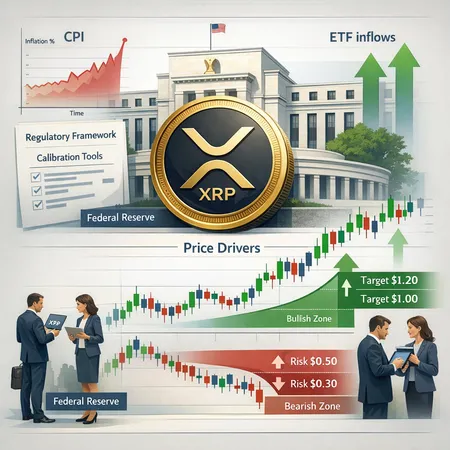
Bull / Policy‑clarity scenario (high conviction, low short-term risk): sustained ETF inflows + constructive regulatory guidance on custody and settlement. Technical momentum pushes XRP toward and above $1.50 within weeks. Market‑maker depth improves, spreads tighten, and institutional participation increases.
Base / Macro‑sensitive scenario (moderate conviction, elevated short‑term noise): mixed CPI prints and intermittent ETF demand. XRP oscillates in a $0.80–$1.40 band as liquidity providers price in episodic volatility. Short squeezes occur, but durability is uncertain.
Bear / Regulatory shock scenario (low conviction, high risk): adverse regulatory findings, enforcement headlines, or a shift in supervisory guidance leading to custody restrictions. XRP could reprice below $0.50 as institutional desks withdraw exposure and OTC liquidity dries up.
FXEmpire’s coverage points to the bullish $1.50 target as a tactically reachable level given ETF flows and softer CPI, while U.Today documents the near‑term $1.42 print that traders used as validation of momentum. Conversely, AI models referenced by Finbold suggest subdued action into March, reinforcing the view that momentum can be fragile.
Reconciling policy relevance with short-term price noise
Two tensions define the present trading environment:
- Policy relevance increases structural risk considerations (supervisory scenarios, custody standards), which are slow-moving and persistent.
- Macro and flow-driven price noise (CPI, ETF inflows, liquidity squeezes) creates fast-moving, often transient trading opportunities.
Traders and PR/IR professionals should treat these as complementary, not competing, inputs.
For traders
- Use scenario-sized positions: allocate exposure based on a policy‑risk budget and a separate flow‑trade budget for event-driven plays (e.g., CPI prints, ETF rebalancing days).
- Tighten execution rules around policy events: when regulatory notices or Fed communications cite XRP, expect widened spreads and potential liquidity blackouts for a short window.
- Apply layered stop management: place stops that account for elevated intraday volatility — avoid single-stop one-size-fits-all methods during CPI or Fed days.
For PR / IR teams
- Treat regulatory framing as market infrastructure: when the Fed discusses a token, your disclosure, custody proofs, and compliance narratives directly affect liquidity providers’ risk models.
- Proactively engage with counterparties: provide custodial assurances, settlement flow data, and stress-test results that address the scenarios supervisors will cite.
- Coordinate messaging around macro events: if CPI or ETF inflow stories lift price, ensure communications emphasize sustainable demand drivers (custody, on‑ramps) to convert momentum into durable liquidity.
Why AI forecasts and human policy analysis can diverge
AI models that forecast subdued XRP action into March (as noted by Finbold) often rely on historical pattern recognition, volume‑based signals, and macro correlations. That can underweight regime changes—like the Fed explicitly integrating XRP into its risk framework—which are structural and may not be fully present in historical data.
AI = good at short‑run pattern recognition. Policy shifts = slow, regime‑level changes that alter equilibrium values. Reconciling them means overlaying model outputs with qualitative policy analysis: use AI forecasts for intraday and short‑window probability curves, and use policy intelligence to adjust priors for medium‑term positioning.
Practical checklist before taking an XRP position
- Confirm custody and settlement counterparties’ appetite: has your custodian updated their internal memos since the Fed mention?
- Size trades relative to policy‑risk tolerance: what fraction of your seat is exposed to regulatory reclassification risk?
- Monitor scheduled macro events: CPI prints, Fed minutes, the Beige Book, and ETF creation/redemption windows can all trigger outsized moves.
- Coordinate with PR/IR: if you represent a project or institutional holder, have a rapid‑response regulatory narrative ready.
Traders using platforms like Bitlet.app or institutional execution providers should map their order-flow strategies to this checklist to avoid being caught on the wrong side of a liquidity repricing.
Conclusion — policy framing changes the game, but so do flows
The Fed’s decision to name XRP in its risk‑calibration toolkit reframes the token from a litigation‑era outlier to a policy‑relevant instrument. That elevates supervisory visibility and changes how custodians and market‑makers price exposure. At the same time, macro drivers — softer CPI prints and renewed ETF inflows — remain potent near‑term catalysts that can produce rapid, tradable moves (the $1.40–$1.50 area is being discussed openly by market commentators).
For policy‑minded traders and PR/IR professionals, the right posture is dual: respect the slow, structural shift in regulatory framing while retaining nimble, scenario-based approaches to ride or defend against macro-driven noise.
Sources
- Coverage of the Fed naming XRP and its implications: XRP enters the Fed’s crypto playbook — a game-changing risk framework shake-up
- Short-term rebound, ETF inflows, and the $1.50 level in play: XRP news — ETF inflows and CPI spark rebound; 1.5 in play
- Near-term price reaction to CPI and a $1.42 print: XRP rises to 1.42 after CPI print; Fed/Beige Book next
- AI forecast suggesting subdued action into March: AI predicts XRP price for March — subdued outlook