XDC + BitGo Custody and Brazil’s $100M RWA Move: An Enterprise Playbook
Summary
Executive summary
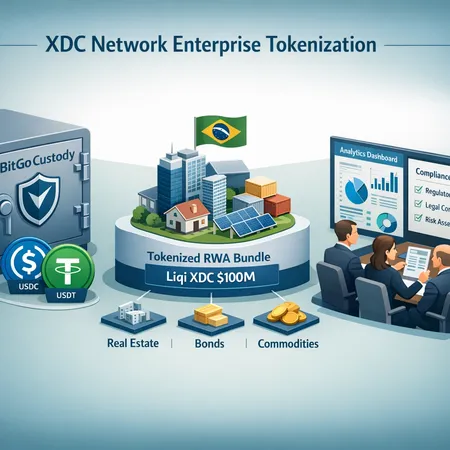
The XDC Network’s integration with BitGo custody is not just a marketing milestone — it answers a basic enterprise requirement: who controls the keys and who bears the liability. For institutional token issuers, regulated custodians provide auditable control, insurance primitives, and compliance workflows that turn experimental token models into bankable products. At the same time, Brazil’s Liqi XDC $100M program demonstrates live market demand for tokenized real‑world assets (RWA) on regional rails. Together these developments illustrate how custody, stablecoin plumbing (USDC/USDT), and clear legal frameworks converge to make scaled tokenization feasible.
This explainer is written for enterprise blockchain decision‑makers assessing custody and tokenization infrastructure readiness. It covers: what regulated custody via BitGo enables; how custody of USDC/USDT changes counterparty risk; why the Liqi Brazil RWA deal matters as a case study; and a practical operational and legal checklist for institutions launching tokenized products on XDC. For a quick primer on the chain itself, see XDC.
Why regulated custody matters for institutional token issuers
Institutional participation requires predictable legal liability, strong operational controls, and reliable auditing. A regulated custody arrangement with a qualified provider such as BitGo delivers several enterprise properties at once:
Key custody and segregation: regulated custodians manage private keys using best‑practice HSMs, multi‑party computation (MPC) or multi‑sig architectures, reducing the probability of single‑operator failure. That changes the threat model for issuers and investors.
Insurance and indemnity: many institutions require explicit insurance over custodial holdings. Custodians typically provide insured coverage or access to underwriters, which underpins client risk acceptance.
Compliance plumbing: custodians integrate KYC/AML, transaction monitoring, and reporting workflows that align with institutional compliance teams and regulators.
Auditability and attestation: regulated custodians produce periodic proofs, internal control reports (SOC 2 / SOC 1) and reserve attestations that issuers and auditors can rely upon.
Operational SLAs and dispute resolution: institutional contracts with custodians define service levels, incident response and legal remedies — critical when large sums are tokenized.
These are not theoretical benefits. The announcement that the XDC Network integrated BitGo custody highlights precisely this set of enterprise capabilities: custodial custody for XDC tokens and tokenized assets can now be offered with a regulated, institutional control layer in place (see Blockonomi coverage for details). That control layer is what turns token issuance from an experimental smart contract into an asset management offering that compliance teams can sign off on.
How custody for USDC/USDT changes counterparty risk
Stablecoins such as USDC and USDT are commonly used to settle tokenized asset flows due to familiar pricing and wide liquidity. But using a stablecoin on a given chain introduces several counterparty considerations that custody changes materially improve.
Counterparty exposures separate into distinct buckets: stablecoin issuer risk, bridge/peg risk (if cross‑chain), custody key risk, and custodian solvency risk. Placing custody with a regulated provider, rather than a proprietary hot wallet, moves the key‑management risk to a party with contractual obligations and insurance.
Reserve and redemption transparency: when the stablecoin issuer (e.g., a tokenized USDC instance) and the custodian coordinate, institutions can orchestrate redemption and reserve attestations more efficiently. This reduces settlement friction when on‑chain tokens must convert back to fiat for investor redemptions.
Operational segregation of duties: custody separates the issuer’s operational ability to mint/burn tokens from private‑key control. This reduces insider and operational fraud risk and supports audit trails that fiduciaries need.
Mitigating bridge risk: many tokenized stablecoins on regional chains use wrapped or bridged mechanisms. Custodial setups often include formal bridge monitoring, rollback procedures and contingency liquidity arrangements — all of which reduce the effective counterparty risk when cross‑chain movement is necessary.
In short: custody doesn’t eliminate issuer or stablecoin counterparty risk, but it converts key and operational risk into contractual and insurable counterparty risk — a profile many regulated entities prefer.
Brazil’s Liqi XDC $100M: a case study in regional RWA tokenization
The Liqi XDC $100M initiative in Brazil — covered by BeinCrypto — is instructive because it demonstrates demand for large, regionally focused RWA programs built on a public chain with institutional custody available. A few takeaways relevant to enterprise decision‑makers:
Demand synergy: Brazil has large institutional pools (pension funds, asset managers) that are actively exploring tokenized credit, real estate and receivable structures. A $100M program signals that tokenization is moving from pilot to production for sizable asset classes.
Local rails matter: issuing on a chain where local exchanges, custodians and market makers can operate without prohibitive frictions simplifies liquidity provisioning and regulatory alignment.
Custody as enabler: for a regional RWA program, working with a custodian that can provide regulated custody for both the native chain token (XDC) and tokenized stablecoins (USDC/USDT) reduces onboarding friction for institutional investors. See the market write‑up to understand the structure and participant roles in the Liqi transaction.
Legal framing and investor comfort: tokenized RWA tied to local legal instruments (mortgages, receivables) needs custody and issuance structures that respect local property law, insolvency regimes, and investor protection rules — custody helps operationalize those legal protections.
The Liqi example is a practical validation: when token issuers pair clear RWA legal frameworks with institutional custody and stablecoin rails, large capital becomes willing to participate.
Operational and legal checklist for institutions launching tokenized products on XDC
Below is a pragmatic checklist covering the main operational, technical and legal areas institutions must resolve before launching tokenized products. Use this as a living document to adapt to local regulation and asset class specifics.
1) Custody & key management
- Select a regulated custodian (e.g., BitGo) with documented SOC reports, insurance limits and custody tech that supports XDC and the stablecoins you plan to use. Confirm cold/warm/hot storage policies and MPC or multi‑sig standards.
- Define SLA, incident response, and access control for signing operations; ensure separation of duties between issuer, custodian and transfer agent.
- Verify insurance scope and exclusions; obtain clarity on claims process and underwriting counterparties.
2) Token economics and stablecoin plumbing
- Decide whether to use native XDC tokens, a bridged USDC/USDT, or an on‑chain stablecoin issuance model. Each choice affects liquidity, settlement finality and regulatory treatment.
- Establish redemption mechanics and settlement windows with the custodian — how will on‑chain tokens convert to fiat or bank deposits in stressed scenarios?
- Model liquidity needs: market‑making arrangements, guaranteed buybacks, or reserve buffers to support redemptions.
3) Smart contract & bridge security
- Require third‑party audits plus follow‑up mitigations and a responsible disclosure program. For bridges or wrapped token systems, require bridge audits and attestation schedules.
- Plan for on‑chain upgrade paths, pausing controls, and multisig backstops that align with legal governance.
4) Legal, regulatory & tax
- Obtain legal opinions covering the token’s status (security vs utility vs hybrid) in target jurisdictions; ensure token design and marketing align with the opinion.
- Register or notify regulators as required (VASP registration, MSB licensing, securities filings). Consider engaging local counsel in each market where tokens will be sold.
- Confirm tax treatment of issuance, transfer, and redemption events; design reporting systems for investor K‑1 / tax reporting.
5) Compliance & KYC/AML
- Integrate KYC/AML flows into onboarding and custodial controls. Ensure transaction monitoring covers on‑chain movement and fiat rails.
- Determine counterparty screening and sanctions screening rules; implement periodic re‑KYC.
6) Accounting & custody reconciliation
- Define accounting treatment and reconciliation cadence with custodians. Ensure the ability to produce monthly reserve attestations and reconcile on‑chain balances to custodial statements.
- Build or buy tooling for automated reconciliation between smart contract positions and custodian ledgers.
7) Governance & disclosures
- Draft investor disclosures covering custody model, redemption mechanics, custody insurance and failure modes. Make disclosures a part of subscription documents.
- Establish governance for contract upgrades, emergency keys, and decision rights among issuer, custodian and trustee.
8) Market infrastructure & liquidity
- Pre‑arrange market makers and exchanges that support XDC on your target rails. Ensure custodial flows integrate with exchange onboarding for warm wallet transfers.
- Test settlement workflows end‑to‑end under normal and stressed conditions, including fiat settlement to local bank accounts.
9) Operational runbooks & crisis simulations
- Build runbooks for incidents (lost keys, bridge failure, regulatory orders). Run tabletop exercises with custodians, exchanges, and legal counsel.
- Ensure continuity planning for custodial providers: alternate signers, emergency committees, and rapid transfer protocols.
Practical risks and mitigants — a short risk matrix
- Custodian insolvency: mitigate with segregation, insurance and contractual priority rights.
- Bridge exploit: mitigate with conservative bridge exposure limits and active monitoring.
- Regulatory action: mitigate with pre‑filing conversations, transparent disclosures and local counsel engagement.
- Liquidity squeeze: mitigate with committed liquidity lines, on‑chain reserve buffers and staggered redemption windows.
Implementation timeline (high level)
- Project kickoff: legal scoping, custodian selection, business model design (1–2 months).
- Tech build: smart contract development, audits, custodian integrations, reconciliation tooling (2–4 months).
- Compliance & market prep: KYC, custodian onboarding, exchange/market maker agreements (1–2 months).
- Pilot and stress tests: small issuance, settlement validation, incident drills (1 month).
- Go‑live and scale: staged issuance and continuous attestations.
Timelines vary by jurisdiction and asset class; for RWA tied to local law (real estate, receivables) allow additional time for legal perfection and title searches.
Conclusion — why custody + RWA = institutional scale
Regulated custody on XDC via BitGo provides the contractual, operational and insurance primitives institutions need to underwrite tokenized products. When stablecoins like USDC are integrated into the custody and settlement model, you get operational rails that let investors move between tokenized assets and fiat with greater confidence. Brazil’s Liqi $100M program is a tangible example: regional demand, paired with proper custody and legal structures, can rapidly scale tokenized real‑world asset markets.
For enterprise decision‑makers: focus first on custody selection, legal opinions and liquidity mechanics. Those three together determine whether a tokenized product is marketable to fiduciary investors. If you’re evaluating providers, test custody SLAs and dispute mechanisms early — they’re often the gating factor for institutional approval.
Bitlet.app tracks these infrastructure developments closely as institutional flows begin to use regulated custody layers and stablecoin rails to scale tokenized offerings.
Sources
- "XDC Network integrates BitGo custody to enable institutional blockchain adoption" — Blockonomi: https://blockonomi.com/xdc-network-integrates-bitgo-custody-to-enable-institutional-blockchain-adoption/
- "Brazil RWA tokenization: Liqi XDC $100M" — BeInCrypto: https://beincrypto.com/brazil-rwa-tokenization-liqi-xdc-100m/