January 2026: How USDC's $8.4T Surge Rewrote Stablecoin Payments
Summary
The January 2026 shock: numbers that change assumptions
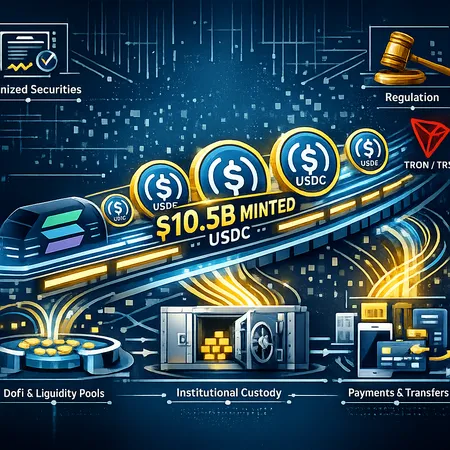
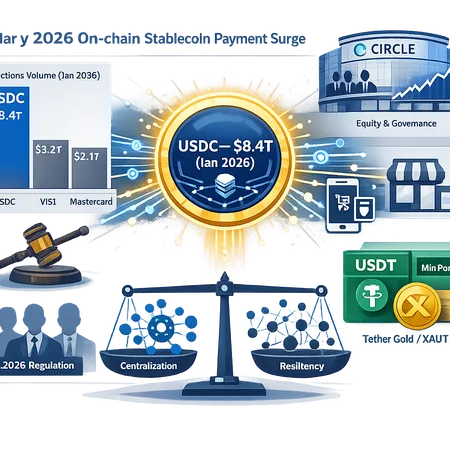
January’s on‑chain stablecoin flows weren’t just a jump — they were a rewrite of scale assumptions. Industry trackers reported total stablecoin on‑chain volume in the month topped $10 trillion, with USDC alone processing about $8.4 trillion. That single‑month figure immediately repositions stablecoins from niche settlement rails to a payments layer that, at least in throughput, rivals the biggest card networks.
To put it bluntly: a single stablecoin’s monthly throughput measured in trillions forces product managers and regulators to stop thinking of crypto as “small” or experimental. For many payments designers, Bitcoin remains the primary market bellwether, but January’s data shows stablecoins — and especially USDC — are executing real‑world value transfer at massive scale.
(Reporting on these figures and the market implications can be found in industry coverage of the month’s flows.) Source link
Why USDC dominated: product, trust, and plumbing
Several factors combined to make USDC the dominant rail in January:
- Integrations and rails: Circle’s focus on APIs, banking partners, and direct integrations with custodians and exchanges lowered friction for high‑volume on‑chain settlement. Institutional integrations and treasury use cases mean large transfers run through USDC by default.
- Perception of transparency and compliance: Market participants often cite Circle’s readiness to publish attestations and engage with regulators as a deciding factor for treasury teams and payment processors choosing an on‑chain dollar. That credibility leads to network effects: the more counterparties accept USDC, the more counterparties need to hold it.
- Network effects inside DeFi and payments apps: USDC is widely used across automated market makers, lending protocols, and payments stacks. When stablecoin rails are layered into apps, they become the default settlement token.
Those elements turned USDC into the path of least resistance for large settlement flows. The size of that flow is important because it changes counterparty risk assumptions — what was once a niche on‑chain transfer now looks like strategic infrastructure.
Scale comparison: how this stacks up against Visa/Mastercard
Headlines compared USDC’s monthly throughput with card networks like Visa and Mastercard — not to argue that stablecoins are identical to card rails, but to illustrate scale. Card networks have long been the yardstick for payments volume; when a single stablecoin processes trillions in a month, it compels businesses and regulators to ask: who controls that money, how final is settlement, and what happens in an outage?
The operational models differ — card networks are centralized switching networks with issuer/acquirer relationships, chargebacks, and regulatory oversight; stablecoin rails are on‑chain settlement layers where finality, custody, and issuer solvency take on new meaning. But in practical terms, payment architects and treasury teams must now include on‑chain liquidity and settlement risk in the same conversations where they previously considered card rails and bank wires.
Market reaction: Circle’s equity and governance questions
The huge payment volumes helped shine a spotlight on Circle’s commercial and governance position. While increased usage can be a vote of confidence in product‑market fit, market pricing of equity and governance instruments can be more volatile. Coverage of the surge noted a link between the USDC growth story and market reactions in Circle‑related stock and token discussions. That volatility reflects investor concerns about reserve backing, regulatory scrutiny, and long‑term cash flows tied to payment settlement volumes.
Practically, large flows raise two governance issues for Circle:
- Reserve management and transparency — as settlement volumes scale, so do the stakes of how and where reserves are held. Markets will demand clearer, more frequent attestations or audits and robust liquidity arrangements.
- Corporate governance and contingency planning — heavy reliance on a single issuer for wide swathes of payments raises questions about succession planning, emergency controls, and the interplay between corporate solvency and stablecoin redemption promises.
Those are not academic points. When on‑chain flows become systemically significant, shareholder activism, regulatory inquiries, and counterparties’ contractual demands will accelerate.
Centralization vs resiliency: the architectural trade‑off
That brings us to an essential tension: centralized issuance enabling network convenience vs. decentralized resiliency.
- Centralized issuers (like Circle and Tether) provide fast upgrades, compliance controls, and banking relationships, which help businesses onboard and scale payments.
- But centralization concentrates risk: a single legal entity’s failure, regulatory clampdown, or banking relationship severance can disrupt large volumes of payments.
From a product manager’s perspective, the practical response is hybrid: design for multi‑stablecoin rails, build automated fallback paths, and ensure custody and settlement workflows can switch between USDC, USDT, and on‑chain settlement tokens without manual intervention. Platforms such as Bitlet.app and other payments integrators are already exploring multi‑rail strategies to reduce single‑issuer exposure while preserving UX and settlement speed.
Tether’s competitive moves: MiniPay, USDT, and XAUT
Competitors reacted fast. Tether expanded the addressable market with product moves targeted at emerging markets and alternative asset access. Notably, Opera’s MiniPay added Tether Gold (XAUT0) and later widened support for USDT and XAUT in its MiniPay wallet—moves that are explicitly aimed at broadening on‑ramp access for users outside traditional banking corridors. See coverage of Opera and Tether’s MiniPay activity for the details and market framing.
Those integrations do two things:
- Increase choice: USDT and XAUT options give end users and local apps alternatives to USDC for settlement and store‑of‑value uses, especially where local banking access is limited.
- Pressure test liquidity: If flows can migrate to USDT or tokenized gold rails like XAUT, issuers must compete on network availability, custody convenience, and local compliance.
Tether’s moves are pragmatic: expand distribution where USDC’s banking relationships are weaker, and offer product variants (like tokenized gold) that appeal to specific user preferences. Reporting on the Opera integrations and Tether’s extension of MiniPay support gives concrete evidence of this competitive response. Opera adds Tether Gold to MiniPay and Tether expands MiniPay support
Custody, settlement finality, and operational controls
When trillions move on‑chain, custody is no longer a back‑office checkbox. Key operational areas now under scrutiny:
- Custodial segregation: where and how reserves are held, and whether custodial models separate issuer balance sheets from client funds.
- Settlement finality: on‑chain transfers have cryptographic finality, but off‑chain claims and redemption promises create legal complexity. What counts as final for regulatory or accounting purposes?
- Operational continuity: blockchain congestion, smart contract bugs, or key management failures can halt settlement flows. Backup rails and multisig arrangements are now part of enterprise risk assessments.
Product and compliance teams must design flow charts that map funds from fiat on‑ramp, through custody, into on‑chain settlement, and back to fiat off‑ramp — and test those charts under stress.
What regulators will likely focus on in 2026
January’s numbers make regulatory action predictable, not random. Expect concentrated attention in these areas:
- Reserve certainty and auditability: tighter rules on attestation frequency, scope, and independent audits to ensure stablecoins’ redemption promises are credible.
- Licensing and charter regimes: clearer frameworks for payment stablecoin issuers — possibly separate licensing for entities that operate at systemic scale.
- AML/KYC and on‑ramp gating: regulators will push for stronger controls at fiat on‑ramps and wallet providers (like MiniPay) to curb illicit flows without killing innovation.
- Interoperability and contingency planning requirements: rules that require issuers and major custodians to publish contingency plans and ensure multi‑rail operability to limit contagion.
- Oversight of corporate governance: regulators will ask whether governance structures are sufficient to manage systemic risks when a private company’s token processes trillions monthly.
Policy makers will likely borrow from both payments regulation and securities/banking law. The result will be a hybrid regime that treats systemically important stablecoins as financial infrastructure.
Practical takeaways for product managers and regulators
- Product teams should plan multi‑rail support (USDC, USDT, tokenized assets like XAUT) and build automated routing and failover for liquidity.
- Custody strategies must be revisited: segregation, attestations, and live audits should be contractual requirements for large counterparties.
- For regulators, the priority is preventing single‑issuer failure modes: require reserve transparency, clear redemption terms, and contingency protocols for critical infrastructure.
- Competitive moves by issuers (e.g., Tether’s MiniPay integrations) will push settlement closer to end users in emerging markets; regulators should coordinate cross‑jurisdictionally to avoid regulatory arbitrage.
Conclusion: a payments landscape remade — cautiously
January 2026 transformed stablecoins from a high‑growth feature to a core payments consideration. The scale of USDC flows forces realistic conversations about custody, issuer governance, multi‑rail resilience, and regulatory frameworks. Competition — including Tether’s MiniPay and XAUT expansions — will diversify options but also complicate oversight.
For product managers and regulators, the path forward is pragmatic: design for interoperability and resilience, demand auditability and clarity from issuers, and craft proportionate rules that keep innovation alive while limiting systemic risk. Platforms across the ecosystem, from wallets to processors (including companies like Bitlet.app), will need to adapt quickly to a world where stablecoin payments are large, global, and consequential.
Sources
- https://beincrypto.com/usdc-stablecoin-growth-circle-stock-drop/
- https://news.bitcoin.com/opera-adds-tether-gold-to-minipay-for-emerging-markets/
- https://invezz.com/news/2026/02/03/tether-expands-support-for-usdt-and-xaut-in-operas-minipay-wallet/?utm_source=snapi
- https://beincrypto.com/usdc-stablecoin-growth-circle-stock-drop/