Why the $280M Diamond Tokenization on XRPL Could Make Ripple’s Ledger an RWA Hub
Summary
Executive summary
The announcement that a $280 million certified polished diamond batch will be tokenized on the XRP Ledger (XRPL) — a project led by Billiton Diamond and Ctrl Alt with Ripple involvement — is more than a PR milestone. It’s a real test of whether XRPL can host high‑value, compliance‑sensitive real‑world assets (RWA) at scale. The combination of an on‑ledger decentralized exchange, low cost settlement, and Ripple’s market relationships gives XRPL structural advantages over many permissionless chains, but the tough parts remain off‑chain: custody, certification, provenance and legal frameworks.
This analysis walks through the mechanics of diamond tokenization on XRPL, the participant roles, custody and provenance models for luxury goods, how secondary liquidity could form, enterprise use cases, and how rumors of strategic moves by Ripple (including chatter about a potential Circle play) might speed adoption. Where relevant, I reference primary coverage of the project and industry reporting to ground the discussion.
What the $280M XRPL diamond project actually is
Billiton Diamond and Ctrl Alt are partnering to mint tokens that represent a certified batch of polished diamonds on XRPL, a deal reported across crypto outlets that highlights Ripple’s involvement in supporting the initiative. Coverage described the batch as a certified, polished lot valued at roughly $280 million, with Ripple participating in infrastructure and market integration discussions (U.Today; Coinpedia). Additional reporting indicates Ripple’s role is substantive and not merely advisory (Coinspeaker).
This project is an archetype: high unit value items, existing certification regimes, and an identified custodial chain. For infrastructure investors and enterprise strategists, the important questions are not whether the project exists, but how custody, attestations, issuance, and secondary markets will be arranged and governed.
How tokenization on XRPL works (mechanics and standards)
XRPL supports both issued currencies (IOUs) and a non‑fungible token standard (NFToken). For RWA like diamonds, issuers typically mint a token that embeds metadata and links to off‑chain attestations. On XRPL you get several features that matter:
- Native token issuance: any account can issue an IOU or NFToken representing an asset, with trustlines controlling who can hold it.
- Built‑in decentralized exchange (DEX): XRPL includes an order‑book model allowing direct on‑ledger trading between issued assets and XRP or other issued tokens.
- Low fees and fast finality: sub‑second settlement and micro‑fees reduce frictions for high‑frequency or high‑value transfers.
- Escrow and multi‑sign: XRPL supports escrowed payments and multisig accounts which enterprises can use for custodial controls and staged releases.
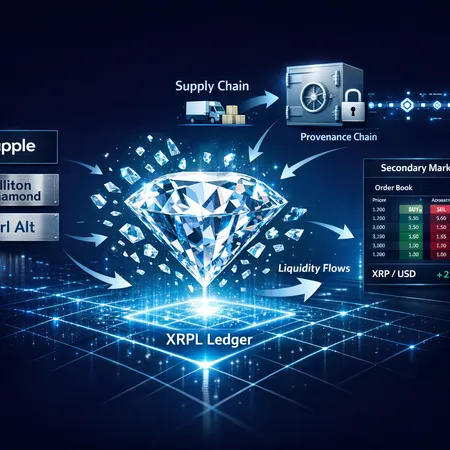
For the diamond project, issuers will likely create an IOU (or a set of fungible tokens representing fractions of the lot) or NFTokens for uniquely identified stones. Each token must point to a verifiable off‑chain registry that holds the certificate, grading, and chain‑of‑custody metadata. That registry can be an enterprise database or a decentralized attestation layer, but the integrity of that off‑chain mapping is the primary trust assumption.
Custody, provenance, and attestations
Tokenizing a diamond does not remove the need for secure physical custody. Typical enterprise approaches include:
- Custodial vaults with tamper‑evident storage and insured inventories held by trusted custodians.
- Certification by recognized labs (e.g., GIA or equivalent) whose reports are referenced by the token metadata.
- Third‑party attestations and periodic audits that reconcile the on‑chain token supply against the physical inventory.
- Hardware roots of trust for vaults and oracles that push custody events (e.g., transfer of possession, re‑grading) on‑chain.
The project participants must define who is the custodial trustee, who holds the insurance, who performs audits and which legal jurisdiction governs ownership rights. These are the real levers that determine whether tokenized diamonds are investable by institutional customers or merely tradable collectibles.
Market structure and secondary liquidity for tokenized jewels
High‑value tokenized goods require both primary issuance clarity and secondary liquidity mechanisms. XRPL’s native DEX provides an immediate, on‑ledger venue for exchanging issued tokens. That has several implications:
- Price discovery is public: order books and trades are visible on‑chain, which increases market transparency compared with off‑chain OTC only models.
- Atomic settlement reduces counterparty risk: trades settle on‑ledger with native settlement primitives, lowering settlement latency compared with traditional securities trading.
- Liquidity will likely be fragmented across venues: institutional counterparties may prefer OTC or CLOB (central limit order book) integrations, while retail and smaller buyers use on‑chain DEX markets.
Fractionalization is key to liquidity. A $280M lot tokenized without fractional units will have limited market depth, but if the issuance supports fungible shares (or a wrapped funding token) then you create a product that portfolio managers, funds and retail platforms can trade. Projects elsewhere have combined NFTs for unique stones with fungible tokens representing shares in a pooled inventory — XRPL’s model supports both approaches.
An important practical note: XRPL’s DEX charges tiny transaction fees denominated in XRP, so the ledger’s native token (XRP) naturally becomes a settlement and bridge asset between tokens. For platforms building custody and marketplace UX, integrating XRP rails and stablecoin on‑ramps will be a product design priority. For many traders, Bitcoin remains the market bellwether, but for settlement rails and micro‑payments inside tokenized ecosystems, XRPL’s cost model is attractive.
Enterprise use cases beyond collectible trading
The diamond project demonstrates several enterprise patterns that generalize to other RWAs:
- Collateralized lending: tokenized diamonds can be pledged on‑chain as collateral for loans. Lenders can enforce on‑chain triggers tied to escrow and multisig arrangements.
- Trade finance and supply chain: provenance and title transfer can be executed on‑chain while financing utilities (letters of credit) integrate with token settlements.
- Fractional investment and securitization: pools of tokenized items can be tranche‑structured and sold to investors, unlocking institutional productization.
- Retail and loyalty integrations: retailers or marketplaces can offer tokenized ownership models and instant settlement for cross‑border purchases.
Each use case increases the need for compliance plumbing: KYC, AML, beneficial‑owner registries and regulatory reporting. Platforms planning to build RWA businesses should evaluate how on‑chain token standards map to off‑chain legal title and whether custodial arrangements permit enforceable on‑chain transfers.
NFT volumes on DeFi platforms have taught the market that liquidity requires composability — lending markets, AMMs and custody custody integrations. XRPL’s approach to composability is different from EVM chains, but integrations (for example, wrapped tokens or bridge rails) can enable DeFi‑style liquidity for tokenized assets.
Ripple’s strategic positioning and M&A rumors: why it matters
Reports and industry chatter that Ripple could pursue big strategic moves — including acquisition rumors involving Circle — change the calculus for enterprise adoption. If Ripple were to integrate Circle’s fiat‑stablecoin infrastructure or other institutional rails, the implications would include:
- Stronger fiat on/off ramps and native USDC liquidity inside XRPL ecosystems, lowering friction for institutions that need dollar‑settled exposure.
- A tighter integration between stablecoins and XRPL’s DEX, increasing secondary market depth and making settlement between tokenized assets and fiat‑pegged units seamless.
- Expanded regulatory and compliance capabilities if the acquirer brings mature KYC/AML tooling and custody expertise into Ripple’s stack.
Industry coverage on these rumors suggests the market is watching for strategic plays that would position Ripple not just as a payments company but as an enterprise infrastructure provider for tokenized assets (Coinpaper). Even without an acquisition, Ripple’s commercial relationships and ongoing participation in tokenization projects signal that it is actively courting the RWA market. For investors, the key is whether Ripple will productize custody, stablecoins and compliance as integrated services around XRPL.
Risks, regulatory considerations and open questions
Tokenizing diamonds exposes participants to several non‑technical risks that will affect valuation and adoption:
- Legal title vs. token ownership: jurisdictions differ on whether a token equals legal ownership. Clear legal frameworks, custodial contracts and title transfer mechanics are necessary.
- Provenance fraud and mis‑grading: if certificates are forged or grading disputed, token holders may face losses; robust audit trails and recognized grading authorities are essential.
- Insurance and valuation liquidity: insurance markets must price and underwrite tokenized inventories. Valuation models for luxury goods are opaque compared with commodities.
- AML/KYC and sanctions exposure: diamonds have a history of regulatory scrutiny; platforms must implement rigorous compliance checks to avoid reputational and legal risk.
- Concentration and market manipulation: a single $280M lot opens the risk that a dominant holder or issuer can influence price discovery in thin markets.
Technically, XRPL reduces settlement and counterparty risk, but oracles and off‑chain attestations remain single points of failure for RWA projects. Investors should evaluate the governance of those oracles and the frequency and transparency of audits that reconcile tokens to physical holdings.
Recommendations for infrastructure investors and enterprise strategists
Vet custodians and auditors: insist on vaulting contracts, insurance limits, periodic third‑party attestation and public reconciliations between on‑chain supply and physical inventory.
Design hybrid legal‑technical models: combine XRPL token issuance with enforceable legal contracts that specify governing law, dispute resolution and ownership transfer rules.
Plan liquidity pathways: support both on‑chain DEX order books and OTC desk integrations; consider fractionalization strategies to broaden investor pools.
Assess oracle and metadata architecture: prefer multi‑party attestation, hardware‑anchored custody signals and verifiable certificate links rather than opaque centralized registries.
Monitor strategic consolidations: a Ripple move to integrate stablecoin and fiat rails (organic or via M&A) could materially lower friction for RWA products. Build for composability but keep options open for multiple settlement rails.
Think insurance and market‑making: ensure early market makers and insurance partners are in place to provide initial depth and confidence for price discovery.
Platforms like Bitlet.app and other infrastructure providers that intend to offer tokenized RWA products will need to combine custody, compliance and marketplace UX to capture institutional flows.
Conclusion
The $280M diamond tokenization on XRPL is a high‑value experiment in bringing certified luxury goods on‑chain. XRPL’s native DEX, low fees and settlement finality give it architectural strengths as an RWA host. But technology alone won’t win adoption: custody integrity, certification transparency, legal clarity and insurance will determine whether tokenized diamonds become institutional‑grade assets or remain niche collectibles.
Ripple’s active involvement — and the possibility of strategic moves that strengthen fiat and stablecoin rails — increases the probability that XRPL can become a practical RWA hub. For investors and enterprise strategists, the project offers a useful template: prioritize auditability, custody and liquidity design, and watch whether market infrastructure evolves from pilot to regulated, insured production.
Sources
- Announcement and coverage of the $280M diamond batch landing on XRPL with Ripple involvement: U.Today
- Detail on Billiton Diamond and Ctrl Alt partnership to mint $280M in diamonds on XRPL: Coinpedia
- Additional coverage highlighting Ripple’s role in the diamond tokenization project: Coinspeaker
- Reporting on Ripple strategic and M&A rumors including Circle chatter: Coinpaper