XRP Supply, Upgrades and Regulation: Near‑Term Catalysts Traders Must Track
Summary
Why the near‑term picture for XRP matters
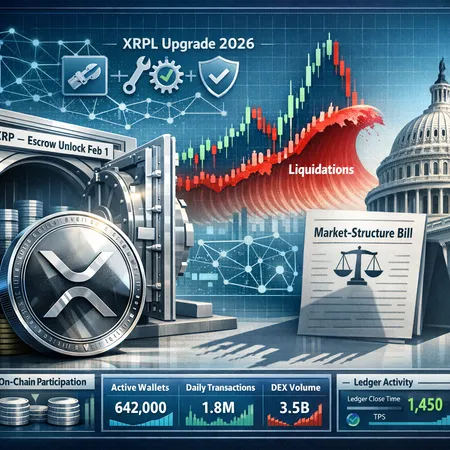
XRP’s price moves are increasingly determined by an intersection of supply mechanics, protocol changes and regulatory clarity. Over the next few months, three concrete catalysts could reframe market expectations: Ripple’s scheduled escrow unlocks (1 billion XRP on Feb 1), a set of XRPL upgrades coming in 2026, and a U.S. crypto market‑structure bill that could change XRP’s legal/regulatory footing. Layered on top of those are fragile momentum dynamics: leverage and liquidation risk can turn apparent strength into fast drawdowns.
This piece is aimed at intermediate traders and long‑term holders who need actionable signals — not bullish bromides or bearish hot takes. It focuses on what to watch (escrow cadence, on‑ledger participation, leverage metrics, legal milestones) and how to size positions and manage risk.
The supply lever: recurring escrow unlocks and why 1B XRP matters
Ripple’s escrow mechanism releases chunks of XRP on a predictable cadence. While the market often prices this in, the flow of supply matters more than any single unlock. The unlock scheduled for Feb 1 — a release of 1 billion XRP — is the immediate example of that flow. News outlets reported Ripple’s unlocking plan for this tranche, and traders should treat it as a known incremental supply event rather than an unpredictable shock (see the report on the Feb 1 unlock).
Two practical implications:
- Known supply can still create sell pressure if market appetite is thin (low bid depth) at the time of release.
- Recurrent unlocks accumulate — the rolling cadence matters for multi‑week liquidity budgets.
The market’s reaction depends on who absorbs that supply: exchanges, OTC desks, large market‑makers, or new on‑chain utility demand. For many traders, XRP will trade like any other asset: timing and liquidity determine whether the unlock is a non‑event or a catalyst for downside.
(Reference: a news summary of the Feb 1 escrow unlock is useful reading: Ripple to unlock 1 billion XRP tomorrow).
XRPL 2026 upgrades — technical changes that can change token economics
XRPL maintainers and engineers have been flagging 2026 upgrades that require node/operator preparation. These upgrades could shift on‑ledger participation — for example, changing fee dynamics, validator behavior, or support for new smart contract features — which in turn affects utility demand and how quickly supply is reabsorbed.
An XRPL engineer recently issued reminders to operators ahead of the 2026 upgrades; that kind of advance notice means the technical transition is likely planned but still carries operational risk (software bugs, node fragmentation, temporary indexing slowdowns). Higher on‑ledger activity after an upgrade — more payments, decentralized apps or liquidity channels — would make unlocks easier to digest. Conversely, a rocky upgrade could suppress participation and tighten liquidity.
So, don’t treat upgrades as only “technical.” They change the market’s plumbing. Monitor node counts, ledger close times, and adoption metrics after upgrade windows.
(Reference: engineer reminder about 2026 upgrades: XRPL engineer sends key reminder ahead of 2026 upgrades).
The regulatory tilting point: what a market‑structure bill could do for XRP
A pending U.S. crypto market‑structure bill now circulating in policy discussions could be pivotal for XRP. Coverage suggests the bill might clarify exchange rules, custody standards and the classification of certain tokens. For XRP specifically — which has historically had legal ambiguity in U.S. courts and regulatory dialogue — a market‑structure bill could change access for U.S. investors and the risk premium traders assign to the token.
If the legislation tightens or clarifies securities definitions in a way that treats XRP differently from other cryptocurrencies, several outcomes are possible:
- Easier exchange relisting or clearer custody pathways could raise demand and compress risk premia.
- Adverse classification could reduce U.S. liquidity and increase fragmentation of order books globally.
Market analysts are already parsing how such a bill could affect XRP’s structure and narrative; follow legal milestones and major amendments closely. For deeper reading on the interplay between policy and XRP, see analysis tying a market‑structure bill to XRP’s prospects.
(Reference: analysis on the bill’s potential impact: US market‑structure bill could be pivotal for XRP).
Momentum rallies: why leverage makes rallies brittle
Momentum rallies that aren’t supported by broad liquidity and fundamental demand are especially vulnerable to leverage‑driven reversals. When retail and institutional traders use margin, futures and perpetual swaps, a cascade of liquidations can accelerate selling and push prices sharply lower.
Key dynamics to watch:
- Rising futures open interest and concentrated long positions increase systemic liquidation risk.
- Funding rates that go persistently positive indicate long bias and potential crowdedness.
- Sudden macro or liquidity shocks (e.g., Fed uncertainty) can trigger deleveraging across markets — XRP has shown sensitivity to macro‑led sell‑offs in past episodes.
A recent piece linked XRP weakness to Fed uncertainty and leverage unwind dynamics; that pattern is instructive: macro events can be the ignition even if the spark is purely on‑chain positioning.
(Reference: price analysis linking XRP weakness to Fed uncertainty and leverage unwind: XRP breaks $1.75 as Fed uncertainty triggers sell‑off).
What to watch — a tactical trader’s and holder’s checklist
Monitor these indicators in near real‑time and on a rolling basis:
On the supply and on‑chain side
- Escrow cadence: exact release dates and amounts (e.g., the Feb 1 1B unlock).
- Exchange inflows/outflows around unlock windows — who is depositing the newly unlocked XRP?
- On‑ledger participation: active account growth, transaction volumes, and validator/node counts post‑upgrade.
On the derivatives and liquidity side
- Futures open interest (OI) and changes in OI vs. price action.
- Funding rates on perpetuals and skew between exchanges.
- Margin utilization and clustered liquidation levels (e.g., large long stops around key support).
On the legal/regulatory side
- Text of the market‑structure bill, committee votes, and amendments impacting token classification.
- Public statements from exchanges and custodians about how they would implement any new rules.
Sentiment & market structure
- Order book depth at major exchanges and OTC desk capacity.
- Examining whether rallies are driven by real on‑chain utility (payments, liquidity channels) versus hype.
Position sizing and a simple risk framework
Below is a pragmatic approach balancing short‑term trades and long‑term holdings.
Risk per trade (for active traders)
- Target risking 1–2% of total capital per trade on directional positions. That means if you have $100k capital, you risk $1k–$2k per trade.
- Determine stop loss using technical levels or ATR (14‑period). For volatile tokens like XRP, use wider stops and reduce position size rather than using tight stops that invite whipsaw.
Leverage rules
- Avoid >3x leverage on directional positions unless you have a disciplined stop and understand liquidation prices.
- For swing trades, prefer no leverage or low leverage (1.2–1.5x). For short intraday scalps, cap leverage and set hard liquidation buffers.
Long‑term holders (HODLers)
- Scale in over escrow cycles: dollar‑cost average across at least one full escrow cadence to smooth supply shocks.
- Consider hedging a percentage of holdings with inverse products or options if available and liquid.
- Keep a cash buffer for opportunistic buys after large deleveraging events.
Sizing example
- If expected 30‑day volatility implies a 20% move and you only want a 5% risk on your portfolio, size your position so a 20% adverse move corresponds to a 5% portfolio loss (i.e., position ≈ 25% of portfolio *if you accept that extreme). For most, that’s too large; scale down accordingly.
Risk checklist before adding exposure
- Confirm next escrow dates and amounts; mark them on your calendar.
- Check derivatives OI and funding rates for crowded positioning.
- Verify exchange inflows/outflows for newly unlocked supply.
- Review XRPL upgrade status and node participation reports after upgrade windows.
- Track legislative calendar for the market‑structure bill and any public commentary from exchanges/custodians.
- Ensure position sizing aligns with worst‑case liquidation scenarios.
Scenario planning: three plausible near‑term outcomes
- Bull case (20–35% upside): XRPL upgrades go smoothly, on‑chain participation lifts, and the market‑structure bill clarifies favorable handling of XRP — exchanges expand access and demand absorbs unlocks.
- Base case (rangebound): Escrow unlocks are absorbed by market‑makers and OTC desks, XRPL upgrades are neutral, and regulatory progress remains ambiguous; price grinds with spikes on leverage events.
- Bear case (30%+ downside): A leverage cascade during a macro shock coincides with poor liquidity around an unlock, and regulatory language in the bill increases short‑term friction for U.S. market access.
Assign your own probabilities and size positions relative to the scenario where you would be most wrong.
Final takeaway and actionable next steps
XRP’s near‑term trajectory will be shaped by a mix of scheduled supply (escrow unlocks), protocol evolution (XRPL 2026 upgrades) and regulatory outcomes (market‑structure bill). Momentum rallies can look convincing until a levered unwind hits — so monitor derivatives positioning and exchange flows closely.
Actionable items for the next 30–90 days:
- Mark escrow unlock dates (Feb 1 and onward) and watch exchange inflows for those tranches.
- Follow XRPL upgrade status and node counts post‑upgrade to gauge on‑chain participation.
- Track futures OI, funding rates and clustered stop/liq levels across major derivatives venues.
- Read bill amendments and committee calendars; a single substantive amendment can reprice XRP’s U.S. risk premium.
If you use installment strategies or want to dollar‑cost positions, Bitlet.app provides tools for staged exposure that can help execute scaling plans without timing every unlock.
Sources
- Prediction: This popular cryptocurrency will plunge (opinion) — opinion piece arguing XRP could plunge after hype‑driven rally
- Ripple to unlock 1 billion XRP tomorrow — report on Ripple unlocking 1 billion XRP from escrow on Feb 1
- XRPL engineer sends key reminder ahead of 2026 upgrades — engineer reminder about 2026 upgrades and node/operator preparation
- XRP price market‑structure bill analysis — analysis that a US crypto market‑structure bill could be pivotal for XRP
- XRP breaks $1.75 as Fed uncertainty triggers sell‑off — price analysis linking XRP weakness to macro/Fed uncertainty and leverage unwind