Has XRP’s Narrative Shifted from Litigation to Institutional & On‑Ledger Demand in 2026?
Summary
Executive overview: what changed for XRP in 2026
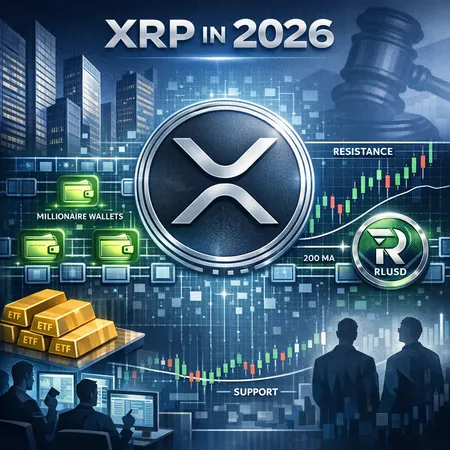
XRP’s market narrative has historically swung between legal headlines and on‑chain fundamentals. In early 2026 the pendulum appears to be shifting. A U.S. court ruling has softened the litigation overhang, and institutional research — notably 21Shares’ three‑scenario framework — is treating ETF demand as a structural force that could anchor valuation. At the same time, on‑ledger metrics such as a resurgence of XRP “millionaire” wallets and emerging liquidity/reserve instruments (for example RLUSD) are showing market participants are increasingly using the ledger for capital allocation, not only speculation. These twin developments matter because they change the types of buyers and time horizons that dominate price discovery.
For many traders, Bitcoin still leads macro risk appetite, but XRP’s story is becoming more idiosyncratic: less about legal binary outcomes and more about durable flows from institutional products and on‑chain liquidity.
21Shares’ three‑scenario outlook: why ETFs could anchor valuation
21Shares published a three‑scenario outlook that frames 2026 as a potential turning point where ETF demand becomes a major valuation driver. Rather than a single forecast, the framework maps different institutional adoption paths — from limited ETF traction to broad institutional inflows — and shows how each path translates into structural demand for XRP. In scenarios where ETFs gain momentum, the model imagines recurring, predictable buying from asset managers and allocators that would compress the reliance on short‑term speculation.
Why would ETFs anchor value? Because exchange‑traded funds create a repeatable, on‑exchange conduit for large pools of capital. Unlike one‑off whale accumulation or retail FOMO, ETF creation/redemption mechanics tie real‑world flows to on‑exchange inventories and can lead to a sustained buy pressure when demand outpaces supply. The 21Shares framing is not prophecy — it is a way to quantify how institutional product adoption changes the supply/demand dynamic and reduces the fragility of price that stems from headline‑driven trading (source: 21Shares research).
On‑ledger adoption signals: millionaire wallets, RLUSD and liquidity reserves
A matured narrative needs proof of actual ledger use beyond price charts. Two signals stand out in 2026.
First, the return of XRP “millionaire” wallets — addresses holding large XRP balances — is a classic accumulation metric. Recent reporting shows these wallets rose again in 2026, signaling renewed long‑term accumulation rather than purely short‑term trading (source: Cryptopolitan). This is important because accumulation in cold wallets or savings‑style addresses tends to reduce circulating supply available for quick selling and supports longer discounting of token value.
Second, instruments like RLUSD — a reserve/liquidity oriented token emerging on the XRPL — are being watched as primitive building blocks for on‑ledger capital markets. While RLUSD is still nascent, its role could be similar to stable or reserve tokens on other chains: providing on‑ledger rails for lending, liquidity provision, and treasury management. If RLUSD (and similar constructs) scale, they improve intra‑ledger liquidity and make XRPL more attractive to institutions that require predictable settlement and reserve mechanisms. Together, millionaire wallets and reserve tokens signal that XRP is being used as a ledger asset, not only a litigation bet.
Litigation overhang: why the legal cloud matters less now
The litigation overhang that dominated headlines for years has been a key narrative hook for short‑term speculators. In 2026, a notable U.S. court ruling reduced uncertainty, which in turn opened the door for institutional conversations that had previously been stalled (source: CoinTribune). Legal clarity rarely eliminates all risk, but it converts a binary outcome into a probability‑weighted input — much easier for allocators to model.
This change matters because institutions are typically constrained by compliance, custody, and legal risk. When litigation risk drops to a manageable level, asset managers can design ETFs and custody solutions with legal counsel and regulators at the table. That is exactly the kind of structural product adoption that 21Shares contemplates in its scenarios.
Technical picture: consolidation, breakout levels and what traders watch
On the price chart, XRP spent early 2026 in a technical consolidation around roughly $1.88, with analysts watching a $2.50 level as a key breakout that could attract momentum buyers (source: CoinSpeaker). Practically, here's what different actors tend to monitor:
Traders: look for a daily close above $2.50 as confirmation that buyers have absorbed recent supply and momentum systems may accelerate. Conversely, a breakdown below consolidation lows signals renewed range‑trading or capitulation. Volume and orderbook liquidity around the wallets and custody venues matter — if ETFs are active, exchange orderbooks often show distinct patterns of creation redemptions.
Intermediate holders: focus on inventory metrics (exchange balances falling, rise in cold wallet holdings) and on‑chain flows into RLUSD or similar liquidity pools that indicate growing market depth.
Institutions: care about realized liquidity at larger sizes — block trades, OTC desk supply, and custody readiness — more than intraday technicals. They will use technical levels as execution guides rather than narrative drivers.
A matured narrative typically reduces the efficacy of headline‑driven breakout trades and increases the importance of structural liquidity and flow data in technical analysis.
What a matured narrative means for long‑term holders vs traders
If ETF demand and on‑ledger adoption become dominant drivers, the market bifurcates in behavior:
Long‑term holders: benefit from lower event‑driven volatility and more predictable accumulation windows. Institutions and allocators add size over quarters, which can compound realized gains for long holders as supply tightens. Accumulation in secure wallets (the millionaire addresses) and use of reserve tokens like RLUSD for treasury operations create a moat of sorts: more token supply is effectively taken out of daily float.
Traders: face a market where news spikes matter less and flow data matters more. Short‑term traders must pivot to trading around macro liquidity, ETF flows, and on‑chain reserve movements rather than relying purely on litigation headlines. That doesn’t remove opportunities — it changes them. Breakouts like $2.50 still matter, but they become part of larger structural narratives rather than stand‑alone trades.
For retail participants this means adjusting expectations: the trading temperature may cool in terms of headline reactivity, but disciplined attention to on‑chain and product flow indicators will reward those who adapt. Platforms like Bitlet.app can help retail investors monitor product updates and execution options in a changing demand landscape.
Practical positioning for multi‑quarter structural change
For investors positioning across several quarters, consider a layered approach:
- Risk buckets: allocate a portion of capital to long‑term accumulation (size depending on risk tolerance) and keep a smaller, active tranche for tactical trading around technical breakouts or macro events.
- Flow watching: monitor exchange balances, millionaire wallet trends, and RLUSD liquidity growth as leading indicators of supply tightening and on‑ledger usage. Cryptopolitan’s reporting on millionaire wallets is a useful pulse check (source: Cryptopolitan).
- Event sensitivity: treat legal developments as reduced but not eliminated risk. Use options or size limits to hedge against tail legal/regulatory outcomes. The CoinTribune piece on court relief shows reduced litigation noise, but prudent risk management remains essential (source: CoinTribune).
- Technical rules: set execution plans around confirmed breakouts (e.g., sustained close above $2.50) and watch liquidity metrics rather than isolated candles. CoinSpeaker’s technical notes help frame those levels (source: CoinSpeaker).
Risks and counterarguments: why litigation and sentiment still matter
A matured narrative reduces—but does not eliminate—headline risk. New regulations, unexpected enforcement actions in other jurisdictions, or a sudden macro liquidity shock can still re‑price XRP. Likewise, ETF adoption is not guaranteed: product launches, regulatory approvals, and sustained inflows are prerequisites. The 21Shares scenarios explicitly show outcomes across a spectrum, reminding investors that upside depends on path dependency, not inevitability (source: 21Shares research).
Finally, tokenomics matter: if new on‑ledger instruments mint additional synthetic supply or if certain liquidity pools can be drained during stress, the apparent institutional demand could be less sticky than it seems. Continuous monitoring of on‑chain reserve ratios, RLUSD uptake, and custodial flows is necessary.
Bottom line: a structural shift—not an overnight transformation
The evidence in 2026 suggests XRP’s narrative is indeed shifting from litigation‑first speculation toward a mixed model where ETF demand and on‑ledger adoption play central roles. Legal relief has removed a major barrier, millionaire wallets and RLUSD‑style liquidity are signals of ledger economics returning, and institutional frameworks like those envisioned by 21Shares show how ETFs could anchor value.
That said, this is a structural transition, not an instantaneous re‑rating. Traders should adapt tactics; long‑term holders can consider accumulation calibrated to risk; and all market participants need to watch flows and liquidity as much as headlines. For investors thinking in multi‑quarter horizons, the prudent play is to position for a world where predictable flows and on‑ledger utility gradually overwrite headline volatility.
Sources
- 21Shares research and scenario framing: https://www.newsbtc.com/xrp-news/21shares-xrp-price-predictions-for-2026/
- Data on millionaire wallets in 2026: https://www.cryptopolitan.com/xrp-millionaire-wallets-rise-in-2026/
- Technical consolidation and $2.50 breakout commentary: https://www.coinspeaker.com/xrp-in-consolidation-around-1-88-analysts-watch-2-50-breakout/
- U.S. court ruling reducing litigation overhang: https://www.cointribune.com/en/us-court-rules-in-favor-of-ripple-in-xrp-lawsuit/?utm_source=snapi