Tokenizing Stocks and ETFs on Solana: Lessons from Ondo Finance’s Launch
Summary
Why tokenize traditional securities on a fast layer‑1?
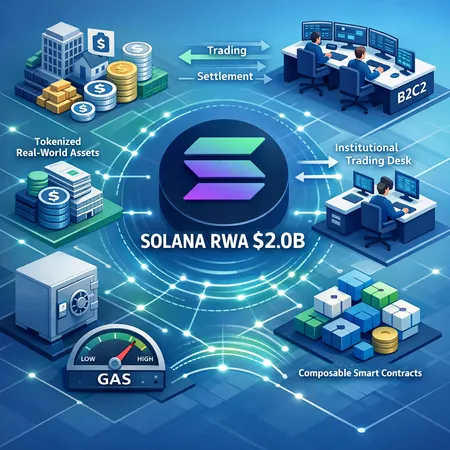
Tokenization aims to convert off‑chain claims—stocks, ETFs, bonds—into on‑chain tokens that represent legal ownership or exposure. Doing this on a high‑throughput, low‑latency layer‑1 like Solana changes more than transaction costs: it changes product design. Faster finality enables near‑instant settlement and atomic interactions with market‑making, lending, and derivatives; low fees make retail micro‑trading viable; and a performant virtual machine enables richer composability with DeFi primitives.
For product leads and asset managers, that combination promises new distribution models (including mobile‑first flows), improved capital efficiency, and faster reconciliation between traditional custody and on‑chain ledgers. But promise and practice differ—Ondo Finance’s recent launch on Solana is a concrete example we can unpack to see what’s achievable today and what still needs work. For many market participants, Bitcoin remains a market bellwether, but tokenized ETFs and stocks on Solana are where tradfi meets programmable rails.
What Ondo Finance’s Solana launch shows
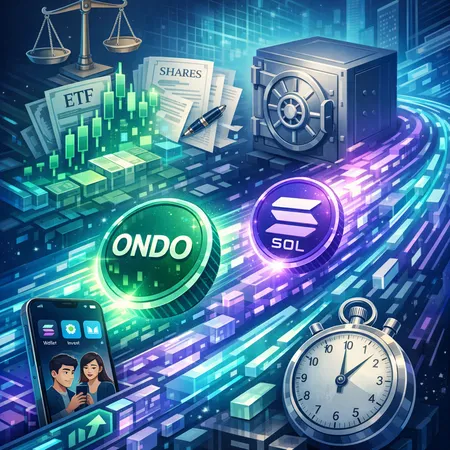
Ondo Finance’s deployment to Solana to host tokenized stocks and ETFs is important primarily as a case study of operational and product design decisions when bringing regulated assets on‑chain. The launch demonstrates two immediate outcomes: faster settlement mechanics and novel custody models that blend regulated custodians with on‑chain custodial primitives.
The launch illustrates how an asset manager (or an issuer) can map a traditional ETF/security to an on‑chain token wrapper while preserving off‑chain legal ownership and compliance. It also surfaces friction points—accounting for corporate actions, tax reporting, and transfer restrictions remain largely off‑chain processes that must be tightly integrated with the on‑chain ledger.
Read the primary coverage of Ondo’s Solana rollout to see the product framing and token design decisions: Ondo Finance launches on Solana to bring tradfi stocks and ETFs on‑chain.
Settlement speed, custody models, and retail access—what changes?
Settlement speed: On Solana, finality is measured in seconds rather than minutes or days for legacy rails. That enables near‑instant atomic trades and settlement between tokenized securities and other on‑chain instruments. For market makers and liquidity providers, this shortens capital lockup windows and reduces counterparty settlement risk. For retail, it means faster trade confirmations and lower settlement failure rates, creating a better UX.
Custody models: Tokenized securities create hybrid custody architectures. There are typically two approaches in practice:
- A custodian-backed token model where a regulated custodian holds the underlying security while a representative token (redeemable or synthetic) circulates on‑chain. This preserves legal ownership frameworks at the custodian and introduces an on‑chain claim.
- A native on‑chain registry model where the ledger itself is the primary record of ownership; this requires strong legal recognition (still uncommon) and more robust governance around corporate actions.
Ondo uses the custodian‑backed approach, pairing regulated custody with on‑chain tokens to maintain compliance while unlocking fast settlement and composability. That tradeoff is pragmatic: it keeps legal wrappers intact while enabling new product features.
Retail access and mobile distribution: Fast chains make mobile distribution realistic. The Solana Mobile story is instructive—mobile token drops and wallet integration can convert a modest hardware or app distribution strategy into real network effects. A real user case showed how Solana Mobile token distribution turned a small initial investment into outsized returns for early adopters, illustrating the adoption multiplier mobile channels can provide (see the Solana Mobile distribution round detailed by Blockonomi: https://blockonomi.com/how-100-solana-seeker-phones-turned-a-50000-investment-into-2-7-million/). That same mobile throughput model can be applied to distributing tokenized ETFs or fractionalized stocks to a retail base with native wallet UX and low friction onboarding.
Technical considerations for engineers
Token standards and transfer restrictions: Engineers must decide which token standard best encodes transfer restrictions, compliance metadata, and redemption logic. Solana’s program model allows custom SPL tokens with on‑program enforcement of KYC flags, transfer locks, and cap tables, but these require careful design to avoid single points of centralization or upgrade risk.
Oracles and price feeds: Tokenized stocks and ETFs need robust, auditable price oracles for valuations, margining, and derivatives. Use multiple independent data sources, include tamper‑resistant feeds, and design fallbacks for feed outages. Composability with Solana DeFi requires oracle data to be delivered with low latency and authenticated provenance.
Atomic settlement primitives: Solana supports atomic transactions spanning multiple instructions, which enables simultaneous asset exchange and payment finalization. Engineers can leverage this to implement cross‑product settlement—e.g., swap USDC for a tokenized ETF and instantly deposit into a lending pool—reducing settlement risk.
Scaling liquidity and AMM mechanics: Tokenized securities may have underlying settlement constraints (e.g., redemption windows), so automated market makers must be adapted to reflect liquidity schedules, rebalance fees, and custody reconciliation.
Security, audits, and upgradability: Smart contracts controlling token logic and custody bridges must be formally audited and designed with conservative upgrade patterns. Given the regulatory sensitivity, audits should include operational controls and governance procedures, not just code correctness.
Regulatory and compliance hurdles
Securities classification: Tokenized stocks and ETFs are typically still securities under most jurisdictions. That implies issuer obligations: prospectuses, reporting, transfer restrictions, and accredited investor rules where applicable. On‑chain representations do not automatically change legal treatment.
Custody and broker‑dealer rules: Custody of securities is tightly regulated. When custody is held off‑chain by a regulated custodian, the token must clearly map to legal claims. If custody is partially on‑chain, additional licensing (trust company, broker‑dealer, or custodian charters) may be necessary depending on jurisdiction.
KYC/AML and transfer surveillance: On‑chain transfer rules must interoperate with KYC/AML flows. This can be enforced via permissioned token wrappers or middleware that validates transfers against off‑chain identity attestations. However, privacy‑preserving features and on‑chain pseudonymity complicate surveillance and reporting.
Cross‑border considerations: Securities regulation varies—what’s permitted in one country can be restricted elsewhere. Asset managers should design jurisdictional gating into token issuance and maintain robust whitelist/blacklist tooling.
Interaction with clearinghouses and exchanges: Integrations with traditional exchanges, transfer agents, and clearinghouses add complexity. Firms should consider whether on‑chain tokens will be delivered-versus-payment with legacy institutions or whether they’ll operate within novel custodial and market‑making ecosystems.
Roadmap for developers and asset managers
Below is a practical, phased roadmap that teams can adapt when exploring tokenization on Solana.
Phase 0 — Legal and product design (0–3 months)
- Define the legal wrapper: decide custodian‑backed token vs. native registry.
- Map securities law implications across target jurisdictions.
- Draft prospectus/whitepaper language and investor terms that explain on‑chain mechanics and redemption rights.
Phase 1 — Architecture and partner selection (3–6 months)
- Choose custody partners (regulated custodians, qualified custodians, or trust companies).
- Select oracle providers and data redundancy patterns.
- Decide token mechanics: SPL implementation, transfer guards, and metadata schema.
- Define settlement flows and reconciliation procedures with custodians.
Phase 2 — Core development and compliance integration (6–10 months)
- Build smart contracts with robust transfer enforcement and upgrade governance.
- Integrate KYC/AML providers and design a whitelist infrastructure.
- Implement accounting and tax reporting pipelines that mirror off‑chain obligations.
- Perform security audits and business continuity planning.
Phase 3 — Liquidity and distribution (10–14 months)
- Seed liquidity with market makers, structured pools, or AMMs with modified logic for redemption cadence.
- Pilot retail distribution channels, including mobile integrations—consider the Solana Mobile playbook for app + hardware adoption.
- Run controlled user pilots with limited geographies.
Phase 4 — Scaling and interoperability (14+ months)
- Expand to additional markets and add more securities.
- Build bridges or wrapped instruments for cross‑chain interoperability where legally feasible.
- Iterate on product features: margining, lending against tokenized securities, or on‑chain reporting.
Operational checklist: insurance coverage, continuous compliance monitoring, incident playbooks, and third‑party audit cadence.
Lessons from Ondo and Solana Mobile distribution
Ondo’s Solana deployment shows that pairing a regulated custody approach with a fast settlement layer provides a pragmatic route to market: you gain the benefits of programmatic rails while keeping legal ownership clear. That hybrid model reduces legal uncertainty for institutional counterparties and simplifies redemption flows for retail.
The Solana Mobile story underlines the power of distribution. Mobile wallets and device‑level integrations convert crypto primitives into consumer products. The Blockonomi write‑up on Solana Mobile demonstrates how distribution can amplify returns and adoption for on‑chain assets; applying the same channel to tokenized ETFs could dramatically broaden retail participation (see: https://blockonomi.com/how-100-solana-seeker-phones-turned-a-50000-investment-into-2-7-million/).
Two pragmatic takeaways for product teams:
- Design for hybrid legal models first. Legal clarity buys adoption.
- Invest early in distribution and UX—mobile channels will be a multiplier for retail reach.
Final considerations and go/no‑go signals
Go signals
- You have a regulated custody partner willing to map legal claims to tokens.
- Your compliance program can support jurisdictional gating and reporting.
- Liquidity providers are comfortable seeding AMMs or markets with the expected redemption cadence.
No‑go signals
- Ambiguous legal status in target markets.
- Inability to integrate KYC/AML without breaking product UX.
- Unsound or untested oracle infrastructure.
Fast layer‑1s like Solana make many new products possible: on‑chain ETFs, fractionalized stocks, and retail‑friendly securities. But speed and low fees do not remove the need for rigorous legal structures, custodial trust, and operational controls. Asset managers and engineers must balance innovation with compliance.
For teams building toward this future, Bitlet.app’s ecosystem examples for payments and P2P distribution are a reminder that integrating product, legal, and distribution strategy early reduces friction down the line.
Sources
- Ondo Finance launches on Solana to bring tradfi stocks and ETFs on‑chain: https://www.altcoinbuzz.io/cryptocurrency-news/ondo-finance-solana-now-live-with-tradfi-stocks-etfs/
- How 100 Solana Seeker phones turned a $50,000 investment into $2.7 million (Solana Mobile distribution case): https://blockonomi.com/how-100-solana-seeker-phones-turned-a-50000-investment-into-2-7-million/