CME Adds ADA, LINK and XLM Futures — A Practical Guide for Traders and Funds
Summary
Why CME is betting on altcoins now
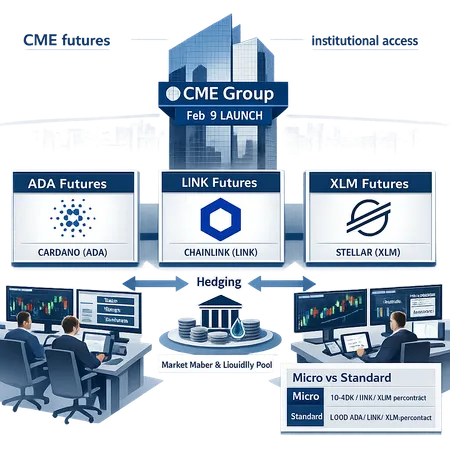
CME’s decision to list Cardano (ADA), Chainlink (LINK) and Stellar (XLM) futures is deliberate, not accidental. After building institutional demand with Bitcoin and Ether futures, the exchange is extending the regulated derivatives ladder to large‑cap altcoins where trading interest and on‑chain activity have matured. The Feb. 9 start date and product announcement make the point: CME sees durable interest from allocators that want regulated venues and cleared counterparty risk rather than OTC or unregulated venues — a theme we’ve seen across institutional crypto adoption.
The expansion is well documented in the press release and follow‑ups: Coinpedia reported the Feb. start date and official product announcement, while NewsBTC and crypto.news framed this as a broader push by CME to diversify its crypto derivatives offering and capture altcoin flow (Coinpedia announcement, NewsBTC analysis).
Why now? Two practical drivers:
- Institutional demand is no longer limited to BTC/ETH. Allocators and hedge funds want regulated tools to express views on thematic crypto exposures like smart‑contract adoption (ADA), oracle utility (LINK), and cross‑border value rails (XLM). For many traders, Bitcoin remains the primary bellwether, but portfolio managers increasingly treat selected altcoins as distinct risk factors.
- Product design has gotten smarter: offering both micro and standard contract sizes lowers the entry barrier for smaller managers while providing scale for block trading and market makers. Crypto.news dives into the contract sizing and strategic intent here (crypto.news coverage).
CME is effectively signaling: if institutional flow exists, we’ll provide a regulated, cleared avenue to capture it. Expect this to encourage some funds to shift exposure from unregulated margin venues to cleared futures for counterparty and margin efficiency.
What the contracts look like: micro vs standard and market‑maker implications
CME’s menu will include both micro and standard contract sizes. That matters.
- Micro contracts lower ticket size and reduce basis risk for smaller players or active strategies that trade size frequently. They increase participation from smaller hedge funds, family offices and prop desks who don’t want to scale into large standard contract sizes.
- Standard contracts provide the scale market makers and institutional traders need for block trades, hedging large spot inventories, and running delta‑neutral strategies.
Crypto.news noted that CME is intentionally offering both sizes to attract a spectrum of participants, from index providers to high‑frequency market makers (crypto.news coverage). For MM desks, standard contracts increase ticket size efficiency and help narrow quoted spreads, while micro contracts boost displayed liquidity and reduce minimum trade friction.
Market‑maker behavior will be driven by three levers:
- Inventory risk and hedging velocity. Micro contracts let MMs hedge incremental inventory changes more precisely, lowering inventory‑carrying costs and enabling tighter quotes.
- Clearing and margin economics. The cleared environment at CME reduces bilateral credit risk; sophisticated MMs will optimize margin offsets across BTC, ETH and the new altcoin futures to manage capital more efficiently.
- Order‑flow composition. If initial flow is retail or small allocators, micro contracts will see more volume; if prime brokers and exchanges route block flow, standard contracts will dominate.
Net effect: we should expect a two‑tier liquidity profile early on — visible retail/dealer book in micros and deeper, occasional blocks in standard contracts.
How institutional access and hedging change
Regulated futures change the calculus for institutional allocators in several concrete ways:
- Cleared counterparty and operational robustness. Using CME futures removes bilateral credit lines and reduces settlement counterparty risk, which is attractive to fiduciary managers and custodians.
- Standardized margin rules and reporting. Consistent margining and regulatory reporting make compliance easier for allocators operating in regulated jurisdictions.
- Shorting and liquidity access without spot custody. Funds that are uncomfortable custodying altcoins can still express short or hedged positions through futures, preserving capital and governance constraints.
For hedging, CME futures offer instruments for:
- Directional hedges: short futures to offset a long spot holding in ADA/LINK/XLM. This is cleaner than using perpetual swaps on unregulated venues, which carry funding‑rate tail risk.
- Basis and spread hedges: trade futures vs spot to manage basis exposure or implement calendar spreads to express time‑based volatility or roll yield views.
- Portfolio overlays: use altcoin futures as a risk factor in multi‑asset overlays alongside BTC/ETH futures, improving cross‑asset correlation hedges.
NewsBTC and Coinpedia place this move in context of CME’s broader roadmap to make crypto derivatives a full suite, letting institutions build multi‑asset crypto risk books more easily (NewsBTC coverage, Coinpedia announcement).
Historical context: lessons from CME's BTC and ETH rollouts
CME has previously broadened the market with successful product introductions, and those episodes offer useful analogies:
- Bitcoin futures (2017+) — Initially institutional interest was mixed, but the product standardized settlement conventions and attracted OTC and institutional flow. Over time, futures markets improved price discovery, helped develop basis curves, and enabled large allocators to hedge without managing custody counterparty risk.
- Ether futures (2020+ rollout and later expansion) — ETH products further illustrated how regulated derivatives encourage institutional participation in non‑BTC crypto. Liquidity fragmentation persisted across venues early on, but CME listings accelerated convergence in pricing, particularly for large, liquid expiries.
Key lessons for ADA/LINK/XLM:
- Expect gradual liquidity migration. Spot markets on exchanges will still set the short‑term price, but futures will become a pricing anchor for institutional flow as open interest grows.
- Basis dynamics can be volatile at first. Early trades and concentrated positions can create wide bases between spot and futures before more participants arbitrage them away.
- Product standardization reduces frictions for allocators, which over months can materially increase institutional AUM exposure to these tokens.
Historical performance shows the effects are multi‑month to multi‑quarter, not instantaneous. Risk managers should plan for a transitional period of higher basis and potential squeezes as large positions are built or unwound.
On‑chain price action and derivatives liquidity after Feb. 9
Will CME futures move on‑chain prices? The simple answer: they can, but context matters.
Mechanisms by which futures can affect on‑chain prices:
- Delta hedging flows. Large speculative or institutional positions create delta hedging flows in spot markets, particularly for market makers hedging futures exposure using the spot or OTC markets. These flows can add directional pressure.
- Capital reallocation. Institutions preferring regulated exposure may rebalance from spot holdings (on exchanges or custodians) into futures, causing spot outflows or inflows depending on positioning.
- Arbitrage and basis compression. As arbitrageurs buy spot and sell futures (or vice versa) to capture basis, net buying or selling pressure can move on‑chain liquidity and prices.
However, several moderating factors apply:
- Scale matters. ADA, LINK and XLM have market capitalizations and on‑chain liquidity profiles different from BTC/ETH. It will take meaningful futures open interest relative to daily spot volumes to move prices materially.
- Venue fragmentation. Many spot trades occur on global exchanges and OTC desks; CME futures will contribute to price discovery but won't instantly dominate it.
A plausible near‑term outcome is that derivatives liquidity deepens around expiries and liquid strikes while on‑chain price action shows episodic spikes tied to large block trades and hedging flows. Over time, if open interest grows, the futures market will more regularly anchor pricing and reduce volatility at the margin.
For traders watching on‑chain metrics, pay attention to: net exchange flows for ADA/LINK/XLM, concentrated holder activity, and whether prime brokers report rising allocation via cleared accounts. These signals will show how linked the futures market is to on‑chain supply/demand.
Practical playbook for fund managers and traders
Below are tactical and operational considerations tailored to institutional allocators deciding whether to use CME altcoin futures for exposure or hedging.
Pre‑launch checklist (operational and governance)
- Confirm prime broker and clearing relationships support the new contracts. Clearing eligibility and account setup can take days to weeks.
- Update mandate language and risk frameworks to allow exposure via cleared futures rather than spot custody if required by your governance.
- Run margin simulations across BTC/ETH/ADA/LINK/XLM to understand cross‑margin benefits and worst‑case initial margin (IM) scenarios.
Using CME ADA/LINK/XLM futures for exposure
- Size with micros when testing a thesis. Start with micro contracts to build position and measure liquidity without moving the market. Micros are ideal for building exposure across multiple strategies or for smaller allocators.
- Layer into standard contracts for large directional bets. Once comfortable with depth and slippage, shift to standard contracts to achieve cost efficiency.
- Use calendar spreads to express term structure views. If you expect roll yield or seasonality, express it with near‑month vs far‑month spreads rather than outright delta exposure.
Using CME futures for hedging and risk management
- Short futures to hedge spot holdings. For allocators with on‑chain or custodied spot holdings, a short futures position offsets directional exposure without moving tokens off‑custody.
- Portfolio volatility management. Use futures to hedge a basket exposure. For example, hedge weighted altcoin exposure using futures to keep crypto beta within mandate limits.
- Stress‑test basis risk. Simulate scenarios where basis widens (e.g., liquidity shock) and ensure funding and margin buffers can absorb temporary dislocations.
Market microstructure tactics
- Use AMS/algos for execution. Work with brokers to use VWAP/TWAP or adaptive liquidity‑seeking algorithms when building large futures positions.
- Monitor open interest and bid‑ask spreads. Tightening spreads and rising OI signal deeper market depth and better execution quality for larger trades.
- Be cautious around expiries. Expiry days can concentrate flows and widen spreads; use calendar spreads to mitigate expiry risk or roll earlier than expiry if liquidity is thin.
Risk controls and reporting
- Keep real‑time P&L and margin dashboards. CME margin calls are mechanical and can require rapid allocation of cash or collateral.
- Track basis and funding differentials between futures and reputable spot venues. Large, persistent basis suggests structural flows that need active management.
What to watch post‑launch
- Open interest growth. Rapid OI increases indicate institutional adoption; slow growth suggests cautious, lab‑style adoption.
- Spread behavior between micro and standard books. If micros are tight and standard spreads remain wide, liquidity is fragmented and execution risk exists for large blocks.
- Prime broker adoption. The number and size of participating brokers will determine whether these contracts can support large institutional books.
Remember: regulated access via futures is a tool, not a panacea. It reduces counterparty and custody risk but introduces margin and basis dynamics that must be actively managed. For allocators who prefer a regulated approach, CME futures for ADA, LINK and XLM will be an important addition to the toolkit — particularly when combined with BTC and ETH products to manage cross‑asset exposures.
For practical execution and custodian options, platforms like Bitlet.app and others are already watching how these new products settle into market structure and will adjust workflows accordingly.
Sources
- CME to launch Cardano (ADA), Chainlink (LINK) and Stellar (XLM) futures — Coinpedia announcement
- CME bets on altcoins as Cardano, Chainlink and Stellar futures go live Feb. 9 — crypto.news coverage
- CME Group to launch Cardano, Chainlink, Stellar futures amid crypto lineup expansion — NewsBTC analysis