Michael Saylor’s 'Bitcoin Digital Credit': Using BTC as Capital with ETH & SOL as Rails
Summary
Introduction
Michael Saylor’s recent public framing of a "Bitcoin digital credit" layer has reignited a debate among institutions and fintech teams about whether BTC can be more than a store of value — whether it can act as a capital base that underpins a new credit economy. At its core the idea is simple and radical at once: use BTC as primary collateral or capital, then create on-chain credit distribution and settlement rails so that credit can be issued, traded and settled on other blockchains. Saylor laid out this thesis at Strategy World 2026, prompting rapid follow-up analysis and coverage from industry press and researchers.
This piece walks institutional asset managers and product teams through Saylor’s capital-to-credit framework, the mechanics of using BTC as capital, why Ethereum (ETH) and Solana (SOL) are being highlighted as rails, what products could emerge, how current macro liquidity conditions make the thesis timely, and importantly the regulatory and counterparty risks that could derail adoption.
Saylor’s capital-to-credit framework — concept and mechanics
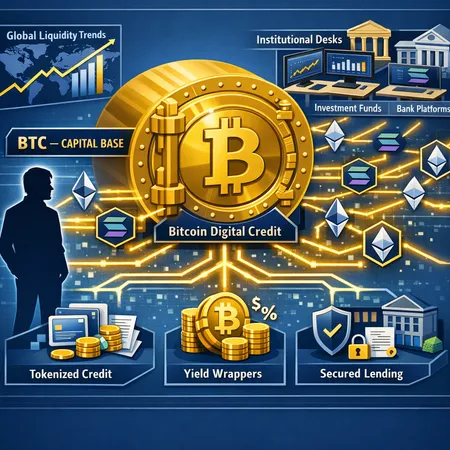
Saylor describes a two-layer view: capital (BTC) and credit (tokenized/issued liabilities). The idea is that large BTC holdings become the balance-sheet equity or reserve that underwrites the issuance of credit claims off-BTC. Those claims are then distributed and settled on chains built for programmability and throughput.
Mechanically, there are a few ways this can be implemented in practice. One common pattern is: an originator locks BTC with a custodian or in a trust; that BTC is legally pledged and/or locked in a smart contract; then credit tokens are minted on an external chain to represent loans, stablecoins or other claims backed by the BTC collateral. Governance and liquidation terms define haircuts, margin calls, and triggers. If the value of BTC falls below thresholds, the protocol or custodian liquidates collateral to protect creditors. This is not entirely hypothetical — it mirrors existing overcollateralized lending in DeFi but flips the asset of value: BTC is the primary capital, not a borrowed asset.
Saylor’s presentation at Strategy World 2026 provides the narrative and high-level architecture for this model, arguing that organizations with large BTC treasuries can extend credit without diluting their positions or resorting to traditional bank financing Michael Saylor's Strategy World 2026 presentation.
Why Ethereum and Solana are singled out as rails
Coverage of Saylor’s thesis and follow-up analysis identifies Ethereum and Solana as the most likely settlement rails for distributing BTC-backed credit. The logic is straightforward: smart-contract ecosystems that combine deep liquidity, composability and settlement finality make it far easier to design credit primitives, automate liquidations, and integrate with existing on-chain markets. Blockonomi’s coverage highlighted how Saylor identified both Solana and Ethereum as key rails for distributing Bitcoin-backed credit instruments, pointing to their complementary strengths and developer ecosystems Blockonomi coverage.
Ethereum’s advantages are its broad developer base, rich DeFi primitives, and deep pools of liquidity for collateral swaps and liquidation auctions. Settlement finality is well-understood, and integrations with existing institutional tooling (custodians, oracles, and regulated onramps) are maturing rapidly. Solana’s appeal is throughput and low latency: it can execute high volumes of credit operations with low transaction costs, which is attractive for high-frequency settlement and retail-scale onboarding.
Both chains have trade-offs. Ethereum’s gas costs and occasional congestion can increase operational friction; Solana’s history of outages or performance issues raises availability concerns. Combining them — e.g., using Solana for rapid micro-settlements and Ethereum for settlement finality and composability — is a pattern many architects are considering.
The product set: what BTC-backed credit primitives might look like
If institutional teams adopt the capital-to-credit template, a suite of financial products could follow. Below are categories that are technically feasible and commercially plausible today.
Tokenized credit facilities: TradFi-style credit lines issued on-chain where borrower claims are represented by tokens and backed by a BTC reserve. These could be syndicated across institutional participants and traded on secondary markets.
Yield wrappers and structured notes: Vaults that lock BTC and issue interest-bearing tokens reflecting a share of lending revenue or structured payoffs (fixed coupon, floater, tranche structures). These wrappers can convert BTC’s policy-insensitive capital into yield-bearing instruments.
Secured lending and overcollateralized loans: Protocols offering loans denominated in fiat-stable tokens or other crypto where the capital reserve is BTC. Lenders receive tokenized IOUs or interest-bearing ERC-20/SPL instruments.
BTC-backed stablecoins or settlement tokens: Stable liabilities with BTC reserves could be issued for payments and settlement across rails. Legal structures (trusts, regulated custodians) would be required for institutional acceptance.
Layered credit tranches: Senior and junior tranches split risk and return, enabling capital-efficient allocation. Risk-tolerant participants absorb volatility in exchange for higher yields; conservative investors take senior secured claims.
For builders, an essential design choice is whether credit tokens are natively mint-burned on ETH/SOL or represented via wrapped cross-chain tokens with on-chain proofs of custody. Many institutions will require regulated custodians, third-party attestations and robust liquidation mechanisms to consider holding these instruments on balance sheet. Teams building any of these products will find useful reference patterns in existing DeFi primitives, but must adapt compliance, counterparty and settlement features to institutional standards.
Macro backdrop: why the timing looks attractive
A major part of the sell for BTC-backed credit is macro. Global liquidity — broad money supplies and central bank balance sheets — sits at historically high levels, providing both the raw demand for yield and the capital flows that can support the growth of new credit instruments. Analysts have pointed out that record-high global money supply makes hard-asset-backed credit attractive as institutions seek yield and stability amid abundant liquidity and low real yields Macro context: global money supply at record highs.
When capital is plentiful, securitized products and credit innovation expand because investors search for yield and are more willing to accept new counterparties and instruments. If BTC is perceived as a scarce, appreciating capital base, institutions may accept lighter haircuts or longer loan tenors than they would against other collateral, enabling interesting capital efficiency gains.
Regulatory, legal and counterparty risk considerations
The biggest hurdles to real-world deployment are legal, regulatory and counterparty risks — not purely technical ones.
Custody and title risk: For BTC to function as capital, legal title must be clear. Who legally owns pledged BTC in a cross-chain structure? Regulated custodians or trust vehicles with enforceable liens will be essential for institutional participation. "Self-custody plus smart-contract pledge" models face legal uncertainty in many jurisdictions.
Securities and banking regulation: Tokenized credit instruments may be treated as securities or deposit-like liabilities by regulators. Issuers must assess securities laws, capital requirements, and whether the product will attract bank-like regulation.
Cross-chain settlement and bridge risk: If BTC collateral is represented on ETH or SOL via wrapped tokens, bridge mechanisms introduce counterparty and smart-contract risk. Any breakout event or exploit could impair the ability to liquidate collateral and realize value quickly.
Oracle and liquidation risk: Price oracles and liquidation mechanisms must be robust; flash crashes coupled with slow settlement can cascade into losses. MEV and front-running concerns are also material for liquidation auctions.
AML/KYC and sanctions risk: Institutional players need clear provenance and compliance. Custodial chains and issuance platforms must provide auditable trails and compliance tooling.
Mitigation strategies include legally binding custody frameworks, regulated custodians, conservative overcollateralization, insurance overlays, insolvency-remote entities, audited oracles, and staged rollouts with third-party attestations. Product teams should assume intense regulatory scrutiny and design for the highest compliance bar in target markets.
Operational and infrastructure considerations
Beyond legal and risk concerns, operational issues shape what is practical:
Finality and settlement latency: For credit products, finality matters. Many teams will prefer chains or patterns that prioritize deterministic finality for liquidation and settlement.
Composability vs isolation: Building credit primitives on public rails gives access to liquidity and composability, but it also exposes liabilities to systemic DeFi risks. Some institutions may prefer sandboxed, permissioned layers built atop public rails.
Interoperability primitives: Bridges, wrapped tokens, and cross-chain messaging systems are central to the architecture. Their security profile should be evaluated as carefully as the core lending logic.
Accounting, reporting and custody integration: Institutional adoption will depend on integrations with existing back-office systems for accounting, reporting and regulatory compliance.
Operational success will often come down to small details: liquidation scheduling, auction cadence, custody attestations, and dispute resolution clauses. Builders must plan for live operational drills, audits, and legal contingencies.
Conclusion — what asset managers and fintech teams should do next
Saylor’s Bitcoin digital credit thesis crystallizes a powerful idea: BTC as capital can be the foundation for a new class of credit instruments distributed on programmable rails. Ethereum and Solana are logical candidates for settlement and distribution because of their developer ecosystems and transaction characteristics, but each carries trade-offs.
For institutional asset managers and fintech product teams evaluating this space: prioritize legal clarity and custody arrangements before optimizing for capital efficiency. Prototype with conservative parameters (high haircuts, audited custodians, clear liquidation pathways), and favor architectures that can interoperate with existing regulated infrastructure. Monitor the macro environment — elevated global liquidity and yield search make experimentation more commercially viable today — but build to withstand regulatory scrutiny and operational stress.
Bitlet.app teams and product architects should view this as an opportunity to design compliant, auditable building blocks: custody integrations, oracle services, and tranche engines that can plug into ETH and SOL rails while preserving institutional controls.
If you’re building or evaluating BTC-backed credit products, the immediate work program is clear: legal wrappers, custody partners, oracle resiliency, and carefully scoped pilot products. The technical pieces exist; the challenge is aligning them under a robust governance and regulatory framework so BTC can move from balance-sheet asset to capital that safely underpins a new era of credit.