Bitcoin's Tug-of-War: ETF Inflows Lift BTC to ~$68–70K — But Liquidity and a Multi‑Billion Options Expiry Threaten Volatility
Summary
Executive summary
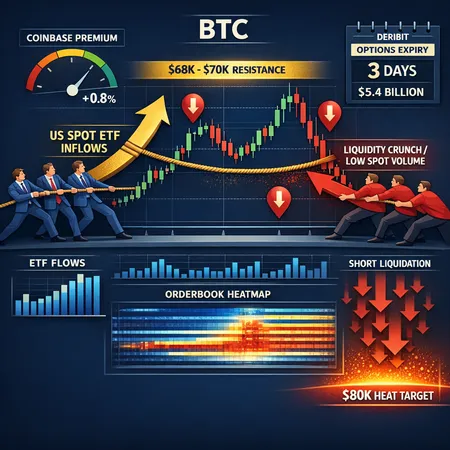
Last 48–72 hours have shown a familiar crypto tug‑of‑war: fresh US spot ETF inflows pushed BTC back into the high‑$60Ks, but the underlying market is unusually thin. Reports show about $506–507M flowed into US spot Bitcoin ETFs recently, a clear demand signal that helped flip Coinbase’s premium positive and ease immediate selling pressure (Cointelegraph, Decrypt).
At the same time, spot trading volume and on‑exchange liquidity are near 2024 lows, a setup that can magnify derivative‑driven moves. A concentrated Bitcoin options expiry the coming week — estimates range from roughly $8.8B to $10.5B in notional — focuses gamma exposure and creates scenarios where short liquidation can cascade price moves toward technical heatmaps like $80K or snap back below $65K (AmbCrypto, Coinpedia, CoinTribune).
Below I synthesize ETF flow timing, liquidity indicators (spot volume, exchange premiums), the derivatives calendar and expiry mechanics, and offer tradeable, risk‑aware scenarios for intermediate traders and institutional researchers. The goal: make fund flows and on‑chain signals actionable without overstating conviction.
Why ETF inflows matter now: magnitude, timing, and the Coinbase premium
ETF flows are simple to interpret but tricky in execution. Inflows represent incremental institutional and retail demand that, unlike OTC buys, often route through market makers and on‑exchange desks — lifting spot liquidity but also interacting with derivatives hedges.
- Recent reports show roughly $506–507M flowed into US spot BTC ETFs over the latest window. That amount is meaningful in the short term: it underpinned BTC reclaiming the $68K band as selling pressure weakened (Cointelegraph, Decrypt).
- The ETF narrative also shows in exchange premiums. Coinbase’s premium had been negative during capitulation phases; as ETF demand rebounded, that premium flipped positive, signaling net buying demand in U.S. cash markets.
Timing matters: ETF flows tend to materialize during U.S. market hours and can produce concentrated demand windows. In a thin market, even a few hundred million in flows concentrated into hours can move price materially.
For many traders, Bitcoin remains the primary market bellwether; watching ETF flows alongside order‑book footprints helps separate sustainable accumulation from fleeting squeezes.
Liquidity indicators: why a reclaim doesn't equal safety
ETF flows bought price, but the plumbing is fragile. Two linked metrics matter most right now:
- Spot volume: On‑exchange spot turnover has dropped to 2024 lows, removing a buffer that would normally absorb large trade sizes. Lower turnover means a given buy or sell will move price more.
- Order‑book depth and Coinbase premium: While the premium flipped positive, order‑book depth is still shallow at key levels. Market makers may widen spreads or step back if volatility spikes, worsening the liquidity crunch.
AmbCrypto’s recent analysis highlights the drop to 2024 lows in spot activity (AmbCrypto). Practically, that means the market can behave like a high‑leverage environment even if not all participants are actually leveraged: small flow imbalances can trigger outsized moves as algorithmic liquidity providers pull back.
The derivatives calendar and why options expiry concentrates risk
Derivatives offer both liquidity and risk concentration. The coming options expiry — reported between $8.8B and $10.5B notional in BTC and ETH contracts — is a classic catalyst for short‑term gamma squeezes, pinning, and volatility spikes (Coinpedia, CoinTribune).
How expiry mechanics matter:
- Options sellers (short calls/puts) delta‑hedge by trading the underlying. As expiry approaches and spot drifts relative to strike clusters, dealers buy or sell spot to remain hedged — this creates gamma flow that accelerates moves.
- Large open interest clustered at specific strikes (e.g., $65K, $70K, $75K, $80K) concentrates pin risk. The market can become biased toward those strikes as dealers manage exposures.
- If price moves quickly toward a strike with concentrated short call open interest, forced delta hedging (buying spot) can fuel short‑liquidation cascades that push price beyond those strikes.
Deribit, as the dominant options venue, often concentrates the largest chunks of open interest; watches of Deribit’s OI heatmaps and the time‑decay profile over the coming days are essential.
Short‑liquidation dynamics: how ETF flows and options interact
The interaction between fresh ETF bids and derivatives hedging is where the tug‑of‑war becomes tactical.
Scenario mechanics:
- ETF inflows increase spot demand. Market makers selling ETFs hedge by buying spot and/or buying calls and selling futures, depending on their risk appetite.
- If many market participants are short futures or naked calls, a sudden spot rally can trigger liquidations. Liquidated shorts must cover by buying futures or spot, adding fuel to rally.
- Concurrently, options sellers reduce their net short delta by buying spot as gamma grows closer to expiry, reinforcing buy flows — a feedback loop.
This loop can cause quick squeezes; conversely, if liquidity is absent (thin order books), what starts as a small move can bounce wildly as algos chase fills and stop levels cascade.
Heatmap observations from recent expiries show that clusters of open interest at $75–80K often act as magnet levels during optimistic squeezes. That doesn’t mean $80K is guaranteed — but it is a plausible target if inflows continue and short positions are sizable.
Tradeable scenarios for the coming week
Below are concise, risk‑aware scenarios with actionable ideas tailored for intermediate traders and institutional desks.
Bull continuation (ETF flows + expiry squeeze)
- Setup: Continued ETF inflows ~same magnitude, spot holds >$68K, dealers buy spot to hedge, shorts liquidate.
- Likely path: Rapid move toward $75–80K driven by delta‑hedging and short covering. Volatility rises; futures basis may flatten.
- Trades: Short‑dated call spreads to play a controlled squeeze (sell lower‑delta, buy nearer‑term OTM calls), or buy OTM calls with defined size. Use tight risk limits — lightning quick reversals possible.
Pin or chop into expiry (dealer hedging dominates)
- Setup: Price gravitates toward a strike with heavy OI (e.g., $70K) as dealers rebalance to minimize payouts.
- Likely path: Rangebound action, spikes on order‑flow but mean reversion into expiry. Implied vol falls if immediacy subsides.
- Trades: Iron condors or calendar spreads to monetize time decay and narrowing IV; keep size small and exposure gamma‑aware.
Bear trap / liquidity blowoff (ETF fades, low spot volume)
- Setup: ETF flows stall, spot volume stays thin, a large seller hits the market near resistance; liquidity evaporates.
- Likely path: Quick drop below $65K, stop cascades on futures; options sellers unwind, exacerbating swings.
- Trades: Protective collars (long put, financed by selling OTM calls), or buy deep OTM puts as asymmetric tail hedges. Avoid naked short techs.
Volatility spike with rapid mean reversion
- Setup: Small catalyst triggers large intraday moves due to thin volume; market mean‑reverts as liquidity returns.
- Likely path: Wide intraday range but close near open; directional risks for multi‑day holders.
- Trades: Trade straddles around event windows or use tight intraday scalps with reduced size.
Practical hedges and execution notes
- Reduce gross leverage into expiry windows when spot volume is low. Even modest leverage magnifies liquidation risk.
- If you’re long spot or perpetuals: consider buying short‑dated puts, or construct collars to cap downside while keeping upside exposure. Puts are expensive during high IV, so weigh cost vs. tail‑risk tolerance.
- If you’re short: consider buying calls or converting positions into spreads to limit blowout risk. Shorting into ETF flow windows is higher risk due to the concentrated buy pressure.
- Watch order execution: prefer limit fills in thin conditions and stagger large block executions to avoid market impact; use algorithmic VWAP/TWAP for institutional flows.
Bitlet.app traders and institutional desks alike should log ETF flow timestamps, exchange premiums (Coinbase), and Deribit OI heatmaps into their desk dashboards to correlate flows with on‑chain and exchange liquidity.
Monitoring checklist (what to watch in real time)
- ETF flow updates (size and timestamps) — inflows during U.S. hours are more market‑moving.
- Spot volume and order‑book depth on major venues (Coinbase, Binance where relevant).
- Coinbase premium and basis between futures and spot — widening basis can signal leverage pressure.
- Deribit open interest heatmaps, especially strikes clustered between $65K–$80K.
- Funding rates and futures liquidations — sudden funding jumps can precede squeeze events.
Conclusion: calibrated respect, not fear
The recent reclaim of ~$68–70K is important — it shows renewed demand and that ETF flows can move price in a thin market. But low spot volume and a concentrated multi‑billion options expiry create a fragile environment where directional moves can be amplified quickly. For intermediate traders and institutional desks the path forward is clear: treat inflows as a signal, not a guarantee; size positions mechanically; and prefer hedges that preserve optionality.
If you synthesize ETF flow data, on‑exchange liquidity metrics, and the derivatives calendar, you can build a defensible, tradeable plan that handles both upside squeezes toward $80K and downside liquidity shocks. Keep an eye on the real‑time indicators above and adjust risk before expiration dynamics hit full force.
Sources
- Cointelegraph: Bitcoin ETF rise — $507M inflows, BTC reclaims $68K
- Decrypt: Bitcoin selling pressure weakens as U.S. spot ETFs draw in $506M
- AmbCrypto: Bitcoin's key metric hits 2024 lows as BTC eyes $70K
- CoinPedia: Bitcoin options expiry looms as $8.8B BTC/ETH contracts could trigger volatility
- CoinTribune: Bitcoin faces major $10.5B options expiry