Can a Prolonged US–Iran Conflict End Up Being Bullish for Bitcoin? A Critical Breakdown of Arthur Hayes' Thesis
Summary
The claim in one line
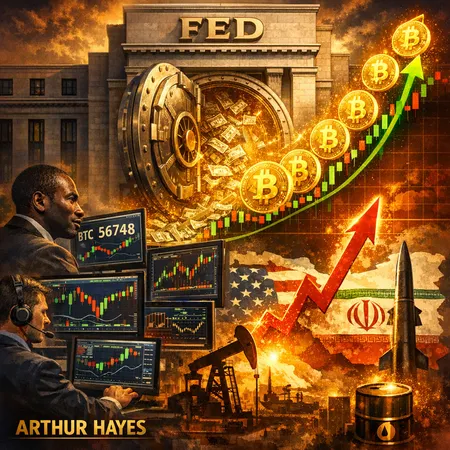
Arthur Hayes — and several macro commentators — have floated a striking argument: a prolonged US–Iran conflict could push the Federal Reserve toward easier policy, and that easing would be bullish for Bitcoin. At the core is a causal chain: geopolitical shock produces a risk‑off environment and economic slowing, the Fed responds with monetary easing or QE to stabilise growth, and looser policy lowers real rates and boosts risk assets, including BTC. Crypto outlets covered Hayes' view this week CryptoPotato and Benzinga summarised it neatly.
Unpacking the transmission mechanism: step by step
The proposed chain has four links: (1) geopolitical risk triggers a risk‑off shock; (2) growth slows and financial conditions tighten; (3) the Fed eases policy or restarts QE; (4) lower real yields and abundant liquidity support asset prices, with Bitcoin benefitting as a macro asset.
Risk‑off & real economy impact — This is the immediate leg. Escalation raises risk premia, sends investors to safe havens and can spike oil prices. We saw that pattern this week: reports noted oil jumped sharply after strikes and global markets were pressured, testing the short‑term leg of the thesis (Coinpedia, Blockonomi).
Monetary policy response — This is the thesis’ hinge. If the growth shock is persistent and meaningful, the Fed could cut rates or restart asset purchases to stabilise activity. Hayes and others argue that the longer the conflict drags on, the higher the chance the Fed pivots toward easing — a view summarised in the Benzinga piece above.
Asset transmission — Easier policy pushes down real yields and widens risk asset multiples. That’s good context for Bitcoin, particularly if BTC continues to trade like a macro risk asset rather than a pure inflation hedge. For many traders, Bitcoin remains correlated to risk‑on flows and liquidity.
Each link is plausible. But plausibility is not certainty — the magnitude and timing at each step vary wildly depending on inflation, fiscal responses, and global central‑bank coordination.
Historical precedents: supportive and contradictory cases
No historical episode maps perfectly to the Hayes scenario. Still, useful analogues highlight the ambiguity.
2001 (post‑9/11): The Fed cut aggressively to arrest a growth slump and to steady markets; easing supported risk assets thereafter. This is the classic 'policy eases after geopolitical shock' example.
2008–09 (GFC): A financial shock produced massive Fed easing and QE that eventually boosted many risk assets.
COVID‑19 (2020): A real shock led to rapid policy accommodation and historic liquidity injections; Bitcoin later staged a multi‑year bull run alongside massive monetary expansion.
Counterexamples or brakes:
1973 oil shock: Higher energy costs produced stagflation, and central banks faced a difficult tradeoff; inflation rose rather than falling, so easing wasn’t the straightforward response.
2022 (Russia–Ukraine): Geopolitical and energy shocks coincided with already high inflation; central banks tightened instead of easing. Real yields rose and risk assets fell.
These cases show a key point: whether geopolitical shocks force easing depends on prevailing inflation and central‑bank credibility. If inflation is already high and driven by energy, central banks may be reluctant to ease even as growth weakens.
This week’s market evidence: oil, equities and BTC
Short‑run moves this week illustrated both sides of the narrative. Oil spiked sharply after strikes — some reports put moves above 10% intraday — intensifying stagflation fears and pressuring equities (Coinpedia). Global risk assets saw immediate weakness, and crypto was not immune (Blockonomi).
Arthur Hayes’ commentary framed a longer view: if conflict persists and growth softens materially, the Fed’s calculus could shift toward easing, which would be bullish for BTC over medium horizons (CryptoPotato, Benzinga). The market snapshot is consistent with the two‑leg story: immediate risk‑off pain plus a plausible—but not guaranteed—policy response later.
Key uncertainties and counterarguments
Inflation vs growth dilemma: A supply‑side shock (oil spike) can raise inflation and weaken growth simultaneously. If inflation remains stickier, the Fed may tighten or stay restrictive rather than cut.
USD safe‑haven flows: Geopolitical risk often lifts the dollar and Treasuries initially, which can depress risk assets, including BTC, until a policy pivot occurs.
Timing mismatch: Policy lags are long. Even if the Fed eases eventually, asset prices may adjust earlier or in different directions depending on liquidity cycles.
Structural change in BTC correlations: Bitcoin’s correlation to equities and risk sentiment has evolved. If BTC becomes more of an inflation hedge in price discovery, reaction patterns could differ.
Fiscal responses: Large fiscal stimulus can change the game; if governments lean on spending rather than monetary easing, inflation and rates dynamics may differ.
Trading and hedging tactics for macro‑savvy allocators
Below are practical, scenario‑based playbooks for a trader or allocator seeking to position around this thesis. Size and techniques should reflect portfolio constraints, risk tolerance and margin capacity.
If you believe the Hayes path (medium‑term easing → BTC up):
Core‑satellite: Hold a core spot BTC allocation (e.g., 1–5% of portfolio) and add satellite exposure via long‑dated call options (LEAPs) that offer convex upside with capped capital.
Curve‑timed options: Buy calendar call spreads (buy long‑dated calls, sell nearer‑dated calls) to monetise the timing mismatch and reduce premium outlay.
Leveraged conditional exposure: Use structured notes or callable products to increase exposure only if macro indicators (real rates falling, Fed‑funds futures moving) trigger.
Cross‑asset plays: Long miners or on‑chain service protocols that benefit from price appreciation, but watch operational leverage and power costs.
If the thesis fails (stagflation, persistent inflation, or Fed resists easing):
Protective puts: Buy puts or put spreads to cap downside on spot holdings. Stagger maturities to cover multiple risk windows.
Inverse products: Use short BTC ETFs or perpetual short positions with strict stop rules; be mindful of funding costs.
Rebalance to cash/real assets: Shift to assets less tied to liquidity (real yields, TIPS, or tactical commodities positions).
Risk management rules (practical):
Scale into positions — avoid one‑off large directional bets. Trim or add using volatility regimes and macro signals.
Use position sizing tied to conviction: e.g., 1–3% risk for high conviction options trades, lower for exploratory exposures.
Monitor leading indicators: real yields, forward Fed funds futures, oil and shipping or trade data, on‑chain metrics, and flows into DeFi and exchange wallets.
Watch liquidity and funding: in crypto, margin and funding can amplify losses during risk‑off squeezes.
Practical checklist for monitoring the thesis
- Real yields: falling real rates increase the plausibility of an asset‑price rally.
- Fed‑funds futures & dot‑plot: market odds of cuts or QE.
- Oil and commodity trends: persistent price shocks that raise inflation risk can flip the thesis.
- Cross‑asset flows: whether capital rotates back into risk assets or into the USD/gold.
- On‑chain signals: exchange inflows/outflows, long/short open interest, and miner behaviour.
Bitlet.app users can combine spot allocations with lending and P2P structures to create yield cushions while sizing directional exposure.
Conclusion: a conditional, time‑sensitive thesis
Arthur Hayes' thesis is a coherent scenario: a drawn‑out US–Iran conflict could, under the right conditions, nudge the Fed toward easier policy and indirectly benefit BTC. But it is highly conditional. The critical variables are inflation persistence, the Fed’s tolerance for growth weakness, and the timing of policy response. For macro‑savvy traders, the trade is not binary — it’s a set of probabilistic bets that should be executed with explicit hedges, layered option exposures, and active monitoring of real yields, oil, and liquidity indicators.
If you adopt the view, treat it as a medium‑term, liquidity‑driven story rather than a short‑term shock play. If you doubt it, protect positions with puts or reduce directional exposure and consider cross‑asset hedges. Either way, scenario-based sizing and active risk controls are essential.