XRP's Crossroads: Institutional Payments Pitch vs Whale Flows and Realized Losses
Summary
Executive snapshot
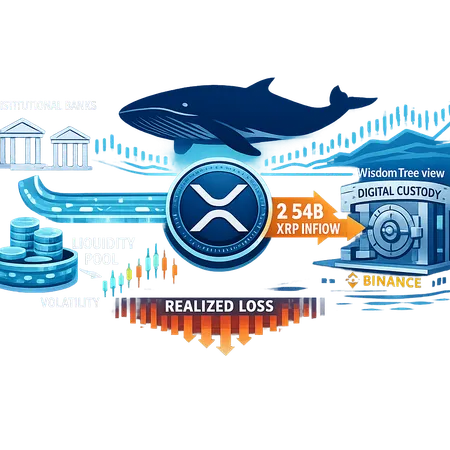
XRP has quietly migrated from a retail memecoin narrative into a conversation about institutional payments rails. Firms such as WisdomTree have publicly reframed XRP as suitable for cross‑border settlement, arguing the asset's speed and cost profile make it attractive to big players. That bullish framing lands alongside harder data points: a 2.54 billion XRP inflow to Binance and on‑chain metrics showing the largest realized loss recorded since 2022. For institutions and payments architects evaluating XRP, the question is not solely whether the protocol can move value fast — it is whether liquidity, custody, and counterparty architecture can handle real payments flows without being overwhelmed by short‑term whale churn.
WisdomTree’s framing: XRP as an institutional payments rail
WisdomTree has made a clear strategic case: position XRP as a specialized tool for payments rather than as a speculative store of value. Their thesis leans on characteristics that payments architects care about — low latency settlement, high throughput, and comparatively low fees. Public commentary by asset managers like WisdomTree signals that mainstream financial firms are at least studying how XRP could be stitched into cross‑border payments stacks and liquidity corridors.
That institutional framing is meaningful because it forces a different set of product questions: custody standards, compliance plumbing, and liquidity provisioning become selling points rather than afterthoughts. Where spot markets and retail trading once dominated XRP conversations, institutional interest elevates topics like regulated custody providers, segregated client accounts, and formalized liquidity agreements with market‑making desks.
For readers tracking the broader crypto landscape, it's worth placing this within context: many institutions are simultaneously evaluating rails across stablecoins, tokenized fiat and traditional correspondent networks. For example, firms evaluating rails will compare XRP against stablecoin corridors and even on‑chain models used in some DeFi primitives — but the emphasis from the WisdomTree view is operational payments utility rather than speculative upside (see WisdomTree’s public analysis linked below).
What this implies for custody and liquidity
If XRP is to function as an institutional payments rail, three operational requirements follow:
- Regulated custody and clear segregation: Institutions need custodians that provide proof of control, audit trails, insurance coverage and regulatory compliance. The tide of institutional onboarding will stall if custody remains ambiguous.
- Deep, predictable liquidity: Payments require predictable execution: the ability to source tens of millions in liquidity at tight spreads without market impact. That implies a mixture of exchange order‑book liquidity, OTC desks, and bilateral liquidity agreements.
- Settlement finality and counterparty risk management: Even though XRP settles quickly, integration with treasury systems and fallbacks for failed settlements must be architected.
Products that combine these elements — regulated custodians, explicit liquidity pools for payments corridors and integrated settlement rails — will decide whether the narrative becomes reality. Bitlet.app and similar market infrastructure providers are examples of platforms that institutional teams will evaluate when mapping execution and custody workflows.
The 2.54 billion XRP inflow to Binance: signal or noise?
On-chain watchers recently observed a 2.54 billion XRP transfer routed to Binance. Large exchange inflows like this are always worth parsing because history shows they can precede increased volatility. Crypto outlets documented the move and discussed historical patterns where exchange inflows have been followed by aggressive selling or redistribution activity. See reporting and analysis on that particular transfer for details.
Large exchange inflows can mean several things: a coordinated sell program by a whale, a transfer for token custody consolidation, settlement for OTC counterparties, or preparation for exchange‑based liquidity provision. In many past episodes across different assets, a sudden bump of supply onto exchanges has preceded price pressure when long‑term holders exit. But it's not deterministic — context matters. For instance, a custodial rebalance or an institutional on‑ramp funneling client funds to an exchange wallet could produce a similar on‑chain footprint without immediate selling intent. For the specific 2.54B move, see chain‑level coverage and analysis linked below for the timeline and exchange attribution.
Operationally, institutional teams should treat large inflows as a red flag for short‑term market microstructure risk: spreads can widen, depth can evaporate, and slippage on large fills can be material. Execution desks address this with staged OTC fills, undisclosed block trades, or algorithmic execution that hides intent.
Realized loss: the biggest since 2022 and what it tells us
Realized loss aggregates the difference between acquisition cost and on‑chain selling price for coins that move. A record realized loss figure — as reported for XRP — signals that many positions were closed at a loss relative to their entry prices. That pattern is often associated with distribution from older holders, capitulation, or strategic rebalancing by corporate treasuries and funds.
A spike in realized loss is psychologically meaningful: it indicates that supply that was previously dormant or long term has been monetized at a loss, and that this liquidity is now circulating. For traders, redistributed supply can increase the pool of coins available to market makers and retail buyers; for payments architects, it may mean greater short‑term churn in on‑chain balances — not the steady corridor liquidity you would prefer for predictable settlement.
But realized loss is not a full measure of adoption. A ledger of realized losses can coexist with growing real‑world utility. For example, payment processors or remittance firms might buy, use, and then offload XRP in ways that register as realized losses in aggregate data even while the underlying payment volumes rise. The key is whether a core of real usage — repeat flows, counterparty trust and custodial certainty — stabilizes the on‑chain economics over time.
Reconciling the signals: adoption vs short‑term churn
How do you square WisdomTree’s payments narrative with whale flows and realized losses? Practical reconciliation requires separating structural adoption signals from episodic trading noise. Consider the following framework:
- Structural indicators of adoption: repeated settlement flows tied to non‑speculative counterparties (payment providers, clearinghouses), formal custodial relationships, and bilateral liquidity facilities. These are durable and usually accompanied by paperwork, SLA commitments and on‑chain flows that show repeatable patterns.
- Volatility indicators from market churn: large exchange inflows, spikes in realized loss, and abrupt changes in order‑book depth. These are episodic and can be managed operationally if identified early.
For institutional investors and payments architects, the practical question is preparedness. If you need XRP to behave like a payments rail, design your stack to tolerate churn: use multi‑venue liquidity sourcing, prefer OTC or block execution for large flows, and insist on custodians that provide both proof of reserve and operational SLAs. Keep an eye on metrics — realized loss, exchange inflows, concentration of large wallets — but don't overread a single data point.
Actionable checklist for institutional decision‑makers
- Monitor exchange flows and whale wallets daily; treat sudden multi‑hundred‑million moves as triggers for execution reviews.
- Insist on regulated, insured custody with segregation and transparent audit trails before routing payments or treasury balances.
- Establish access to OTC counterparties and integrated market‑making to guarantee liquidity at scale without dumping into order books.
- Hedge execution risk via staged fills and use of derivatives where settlement exposure is a concern.
- Validate usage patterns: ask prospective payment counterparties for proof of repeatable flows and SLA commitments rather than one‑off proofs of concept.
Bottom line
WisdomTree’s institutional framing of XRP sharpens the conversation: the protocol’s technical merits make it a logical candidate for payments architects exploring on‑chain rails. But technical suitability alone doesn't equal adoption. Large whale inflows and a record realized loss since 2022 underline that distribution dynamics and short‑term market behavior can complicate operational plans.
For institutions, the choice is less ideological and more architectural: can your custody, liquidity sourcing, and execution playbooks absorb episodic churn and still deliver predictable settlement? If yes, XRP can be evaluated on its merits as a payments rail. If not, the current mix of whale flows and realized losses argues for caution until market structure matures.
Sources
- WisdomTree sees XRP as the institutional payments powerhouse that big players want
- 2.54 billion XRP moved to Binance — analysis and implications
- XRP records biggest realized loss since 2022 — data and context
For comparative context on market bellwethers, many teams still watch XRP flows alongside other crypto market signals and liquidity venues. Institutions weighing rails will also compare on‑chain rails to legacy systems and emergent DeFi liquidity primitives when building hybrid payments architectures.