XRP vs BNB: Inside the Market‑Cap Flip, Exchange Inflows and What It Means for Risk
Summary
Quick read: what happened
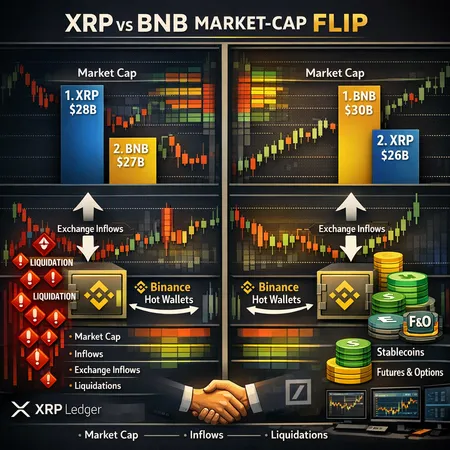
This week BNB reclaimed the #4 market‑cap spot from XRP in a move that looked abrupt on price charts but made sense once you traced exchange flows and liquidation mechanics. Short‑term exchange inflows into Binance, large outflows from XRP wallets, and a fragile derivatives backdrop combined to flip ranking temporarily. That doesn’t mean the narrative around XRP’s utility or BNB’s role changed overnight — it means token‑rank is still very sensitive to where tokens are sitting and who can sell them first.
The proximate drivers: exchange inflows and the $7B waterline
On‑chain and exchange monitoring services reported concentrated movement of XRP toward exchanges in the week leading up to the flip. One investigative thread connects a rapid set of outflows from major XRP holders and a near‑simultaneous spike in Binance inflows. Reporting aggregated these movements into a striking figure: more than $7 billion in apparent outflows pressured XRP market cap during the window when BNB moved ahead. See the Finbold write‑up that documents the $7+ billion outflow and the timing that coincided with the flip (Finbold reported the pace and scale of those flows).
Crypto sector market watchers framed the flip as a short‑term market‑cap change rather than a complete narrative reversal; both CryptoEconomy and CryptoPotato documented Binance—and thus BNB—regaining the lead over XRP in the immediate market‑cap tables and explained the market‑watch implications of the event. These pieces are useful because they tie raw on‑chain flow observations to visible ranking changes and the attendant attention from algos and funds that track index rebalancing.
How exchange inflows amplify price moves (and why Binance matters)
Exchange inflows are meaningful because they convert latent sell pressure into available sell pressure. When large XRP quantities move onto Binance, those balances can be routed quickly into order books or into derivative positions. If the inflows are linked to exits (for example, to obtain stablecoins for fiat withdrawal or to move funds cross‑border), the effect is simple: more sell-side liquidity hitting the book, wider spreads, and thinner depth at the top of the book.
Binance’s position makes this mechanically important. BNB is the native token of Binance, so high activity on the exchange benefits BNB via fee discounts, buyback mechanics in some programs, and natural demand tied to platform usage. When an exchange becomes the clearing point for a large amount of XRP selling, BNB can gain relatively in market‑cap as XRP’s traded supply swells and price reacts downwards. CryptoEconomy and CryptoPotato both highlight how short‑term market‑cap math and the concentration of flows on Binance coincided with the flip.
On‑chain flow signals to watch (practical checklist)
- Exchange inflows (net): sudden spikes in XRP → exchange addresses are the most direct early warning.
- Large wallet transfers: clustering of transfers from custodian or whale addresses shortly before inflow spikes.
- Stablecoin conversions: whether the inbound XRP is immediately swapped for USDT/USDC — this suggests selling rather than custody reshuffling.
- Derivatives open interest and funding rates: rising OI with stretched funding can create a brittle setup for cascading liquidations.
Monitoring these signals together is essential: an isolated large transfer may be neutral (custody rotation), but a coordinated increase in exchange inflows + stablecoin swaps + rising short funding often precedes a price move large enough to change rankings.
Liquidation risks for XRP longs: anatomy of a cascade
When exchange inflows increase sell liquidity, the immediate effect is typically thinner top‑of‑book depth and wider spreads. If derivatives markets are leveraged — and NewsBTC noted an exchange‑inflow driven sell‑risk setup that could trigger liquidations — a modest price swing can hit leveraged longs, producing automated liquidations that push price lower and create a feedback loop.
A few specific mechanics to watch:
- Margin ratio sensitivity: concentrated longs on cross‑margin can realign risk across wallets, so a price move liquidates positions more broadly.
- Funding‑rate divergence: if XRP funding spikes negative (longs paying shorts), it indicates crowding; a squeeze can reverse funding and cause stop‑loss cascades.
- Exchange inflows timing: sellers arriving to an exchange during low liquidity windows (e.g., regional overnight) magnifies the move.
For portfolio managers this implies: avoid unhedged concentrated long exposure into known exchange inflow events, size spot holdings with an eye on where balances are custodized, and consider short‑term hedges in futures markets when you see funding or OI signals deteriorate.
What the flip means for market‑makers, stablecoin and derivatives liquidity
Market‑makers adapt quickly. During the flip they will widen spreads and reduce committed depth to manage inventory risk, especially for tokens seeing large exchange deposit spikes. That results in wider execution costs and can materially worsen slippage for large orders.
Stablecoin liquidity matters more than ever. If sellers convert XRP into USDT/USDC en masse, stablecoin rails absorb the cross‑asset movement; shallow stablecoin pools or concentrated stablecoin exposure on a single exchange intensifies pressure. In parallel, derivatives liquidity fragments across venues: some desks will pull liquidity on spot but maintain hedging in perpetuals, and the mismatch can produce funding volatile environments.
This is where platforms and P2P channels can help; Bitlet.app and similar venues that facilitate alternate liquidity paths reduce the need to route everything through a single exchange during a stress event, though P2P and installment flows have their own tradeoffs.
Regional dynamics and token‑rank risk
Regional flows matter. News catalysts (geopolitical or regulatory) that create country‑level selling — for instance those referenced in reporting around Iran‑linked flows and sell‑risk — can concentrate supply on exchanges that serve those corridors. If a given exchange like Binance becomes the main exit route, its native token can gain by default as the sold token’s market cap falls.
Token‑rank risk therefore isn't just about fundamentals; it's a distributional problem. A token with a concentrated holder base, or with large custodial holders that favor a single exchange, is more exposed to ranking shocks. BNB benefits structurally because many flows route through Binance and because some product mechanics tie platform activity back to BNB demand.
Deutsche Bank + XRP Ledger: a long‑horizon structural story
Beyond the short‑term mechanics, there are longer‑term fundamental vectors to consider. Reporting on Deutsche Bank’s plan to integrate the XRP Ledger shows how institutional banking adoption could materially reshape on‑ramps, settlement rails, and corridor clearing for tokenized value. The Cryptonomist piece outlining Deutsche Bank’s intent is worth parsing: a major global bank engaging an L1 ledger implies potential for reduced settlement friction, better regulatory clarity, and an expanded utility case for ledger tokens.
However, institutional adoption operates on a different cadence. Even significant bank integrations take time to translate into decentralized liquidity benefits, and they won’t immunize a token from exchange‑flow driven short‑term rank flips. Think of institutional tie‑ups as improving structural demand and reducing long‑term tail risk, not as an instant buffer against order‑book squeezes.
Actionable takeaways for analysts and portfolio managers
- Monitor exchange inflows as a top‑tier signal: large, coordinated XRP → exchange spikes preceded the flip.
- Treat token‑rank as an execution and custody problem: where tokens are stored matters as much as why you own them.
- Use hedges when derivatives funding or open interest diverges materially from spot flows.
- Watch market‑maker behavior; widening spreads and shrinking displayed depth are reliable signs of stressed liquidity.
- Keep an eye on institutional developments (e.g., Deutsche Bank + XRP Ledger). These are important for rethinking long‑term position sizing but don’t replace short‑term flow monitoring.
Conclusion
This week's BNB‑for‑XRP market‑cap flip illustrates how fragile token ranking can be when exchange flows, regional selling pressure, and leveraged derivatives interact. The move was driven primarily by concentrated exchange activity and the mechanics of liquidations, not by an overnight shift in on‑chain utility. That said, longer‑term developments — notably institutional integrations like the planned work between Deutsche Bank and the XRP Ledger — could change the structural outlook for XRP over months and years. For portfolio managers and analysts, the lesson is pragmatic: combine on‑chain exchange‑flow signals with derivatives metrics and custody awareness to manage token‑rank and execution risk.
Sources
- BNB regains lead over XRP, market-cap context — Crypto‑Economy
- XRP and BNB battle for 4th spot — CryptoPotato market watch
- XRP flipped by BNB after $7+ billion outflow — Finbold
- Deutsche Bank plans to integrate the XRP Ledger — Cryptonomist
- XRP sell‑risk and exchange inflows that can trigger liquidations — NewsBTC
For cross‑market context, analysts may still look at classic bellwethers — for many traders, Bitcoin remains the primary market indicator — and DeFi‑related liquidity patterns in DeFi rails often presage how stablecoin and derivatives pools will absorb or amplify these flows.