Solana’s Next Move: Technical Setup, Magic Eden Pivot, and the $88 Breakout Play
Summary
Executive snapshot
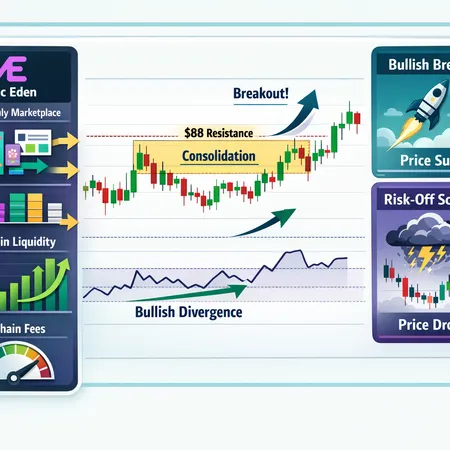
Solana has spent several weeks consolidating just below the $88 mark. On the short term, a four‑hour bullish divergence has shown up on momentum indicators — a common precursor to a directional move when confirmed by volume. Meanwhile, Magic Eden’s shift to prioritize Solana and Packs is changing how NFT liquidity is distributed across chains and marketplaces, concentrating order flow and on‑chain activity on Solana.
This article walks through the technical signals to watch, how Magic Eden’s pivot alters marketplace liquidity and on‑chain costs, and the scenarios traders and builders should plan for if SOL escapes the $88 range. For many readers this is practical: NFT marketplace operators need clear capacity and fee strategies, while mid‑term traders need actionable triggers and risk parameters.
The technical backdrop: consolidation and bullish divergence
What the charts are saying
Over the past four weeks SOL has been trading in a defined consolidation band — Blockonomi’s technical roundup highlights the $85–$88 area as the short‑term choke point and the range traders are watching closely (Blockonomi analysis). Consolidations like this can build energy for a big move, but direction depends on participation.
On the four‑hour timeframe several analysts have identified a bullish divergence: price making similar lows or a shallow lower low while momentum indicators (RSI/MACD histogram) show higher lows. As the Daily Hodl writeup noted, that kind of divergence can precede breakouts — it’s an early warning the selling pressure is easing and buyers may be stepping in (DailyHodl report).
How to read the signal
A four‑hour bullish divergence is helpful but not decisive. Traders should look for two confirmations:
- Volume: a breakout above the $88 band with above‑average volume or expanding on‑chain transfer activity. Low volume breakouts are prone to failure.
- Structure: higher highs on consecutive candles and a clean retest of the breakout as support (ideally on declining volatility).
If both arrive, the measured move technique — using the height of the consolidation as an initial projection — suggests an initial upside target range that traders can use to size and stage positions.
Magic Eden’s pivot: why it matters for on‑chain liquidity
From cross‑chain marketplace to Solana focus
Magic Eden announced a tighter strategic focus on Solana and Packs, streamlining operations away from a broader cross‑chain approach (Bitcoin.com coverage). For marketplace operators and builders the implications are structural: liquidity that was previously dispersed across multiple platforms and chains can now concentrate, reducing fragmentation and improving price discovery for Solana NFTs.
Liquidity and price discovery effects
Concentration has benefits and tradeoffs:
- Benefit: Deeper aggregated order books on Solana listings → tighter spreads, faster fills, and better market depth for high‑quality collections. This helps floor‑price stability and secondary market confidence.
- Tradeoff: Liquidity concentration increases systemic risk if the marketplace experiences outages, governance changes, or policy shifts. A large portion of demand routed through a single hub like Magic Eden (ME) can create a single point of failure.
For mid‑term traders, this means NFT volume metrics will be more informative on Solana than before. For marketplace operators, the priority shifts to uptime, transaction throughput, and fee architecture.
On‑chain fees, congestion, and NFT flows
Why Solana’s low fees matter — and when they don’t
Solana’s low nominal transaction fees are a core appeal. But when NFT volume spikes, network congestion manifests in other ways (compute unit saturation, longer confirmation times, or temporary priority fee markets). Increased marketplace activity from an ME‑led concentration can raise effective costs for creators and traders even if base fees remain low.
Operators should distinguish between three cost vectors:
- Base fee per transaction (usually low on Solana).
- Priority costs or temporary bidding wars for block space during peak drops or mints.
- UX/operational costs — failed transactions, retries, and customer support load when traffic rises.
Practical steps for operators
- Implement dynamic fee tiers for listings and minting drops.
- Run stress tests that simulate 2–5× current peak traffic.
- Build retry logic and clear UX feedback for pending states to reduce user churn.
If SOL breaks $88: market mechanics and scenarios
Immediate market reaction (0–72 hours)
A clean break above $88 with volume and on‑chain transfer spikes would likely trigger a cluster of responses:
- Short‑covering and momentum algos increase buy pressure, amplifying the move in the short term.
- NFT volume on Solana may spike as traders chase price action and minting windows; Magic Eden could see disproportionate traffic.
- Fee pressure rises in moments of extreme activity; even short‑lived congestion can increase failed transactions.
Watch for confirmation signals: netflows into Solana wallets, active addresses interacting with NFT contracts, and ME marketplace volume metrics.
Medium‑term implications (weeks to months)
If the breakout holds and broad participation follows, expect:
- Higher baseline NFT liquidity on Solana as more users and collections favor ME listings.
- Increasing correlation with broader crypto risk appetite — SOL could begin to behave more like a risk‑on asset, amplifying moves when macro sentiment swings.
- More protocol and tooling deployments focused on Solana (indexers, analytics, NFT custody services), improving infrastructure but also attracting speculation.
However, if a macro risk‑off event (see below) hits, the breakout can reverse rapidly; liquidity concentrated on one marketplace can evaporate faster in a panic.
How a breakout might interact with risk‑off events
Why macro matters
Solana has historically shown sensitivity to macro crypto moves. In a risk‑on environment, capital flows into mid‑cap chains and altcoins; in risk‑off, liquidity retracts to large caps and cash‑like assets. A breakout that lacks macro support (e.g., weak BTC, macro tightening) risks being a false signal.
Two stress scenarios
- Correlated crash: A Bitcoin or macro risk event triggers cross‑asset de‑risking. Concentrated NFT liquidity on ME could see rapid withdrawals and collapsing bids, producing steep NFT price corrections alongside SOL weakness.
- Decoupled rally: If the breakout aligns with overall crypto strength, the move can gather momentum and bring sustained on‑chain activity — a more constructive environment for marketplace operators to expand features and monetize volume.
Traders should therefore combine SOL technical checks with broader indicators: BTC trend, funding rates, and liquidity measures.
Action checklist: what traders and marketplace builders should do now
For mid‑term traders
- Wait for confirmation: prioritize volume‑backed closes above $88 and a clean retest rather than jumping the breakout.
- Use staged sizing and clear stop rules keyed to structure (e.g., under the consolidation low).
- Monitor on‑chain liquidity: active addresses and ME volume can act as leading indicators of sustained interest.
For NFT marketplace operators and builders
- Capacity planning: simulate at least 2× peak Marketplace traffic and automate graceful degradation.
- Fee management: design dynamic tiers and communicate them clearly to creators and buyers.
- Diversify routing: even if ME attracts more flow, maintain cross‑listing and bridge strategies to mitigate centralization risk.
- Analytics: instrument detailed observability for transaction failures, latency, and queue depth.
Mentioning platforms: traders managing dollar‑cost strategies or installment purchases should consider tools like Bitlet.app to structure exposure, but always match risk sizing to scenario plans.
Conclusion: prepare for speed, but plan for reversals
A four‑hour bullish divergence combined with weeks of consolidation sets up a plausible short‑term breakout scenario for SOL. Magic Eden’s strategic pivot to Solana will likely concentrate NFT liquidity and intensify on‑chain activity if a breakout attracts speculative and real demand. That combination can accelerate both upside moves and transient congestion.
The key for traders and marketplace operators is to seek confirmation (volume + structure) and to stress‑test systems and risk plans against both a sustained rally and a fast, risk‑off reversal. If SOL clears $88 on conviction, expect faster price discovery, higher NFT volume routed through ME, and operationally meaningful increases in traffic and fee dynamics.
Sources
- Daily Hodl — Trader Who Called Bitcoin Top Sees Solana Flashing Multiple Bullish Signals: https://dailyhodl.com/2026/03/02/trader-who-called-bitcoin-top-sees-solana-flashing-multiple-bullish-signals-amid-despair-in-crypto/
- Bitcoin.com — NFT Marketplace Magic Eden Streamlines Operations to Focus on Solana and Dicey Gambling: https://news.bitcoin.com/nft-marketplace-magic-eden-streamlines-operations-to-focus-on-solana-and-dicey-gambling/
- Blockonomi — Solana (SOL) Consolidates Near $85 — Will the Four‑Week Range Finally Break?: https://blockonomi.com/solana-sol-consolidates-near-85-will-the-four-week-range-finally-break/