Aave’s Pivot to a Token‑Centric, Treasury‑Funded Model: What the Temp‑Check Vote Means
Summary
Executive overview — why this pivot matters
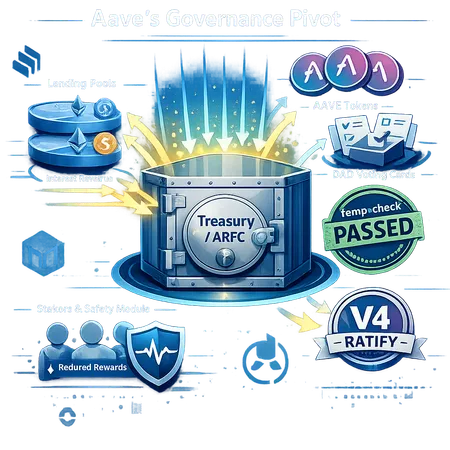
Aave is proposing an economic and governance redesign: move more protocol revenue into a centralized treasury and reorient governance around token‑centric mechanics. The recent temp‑check cleared the way for that conversation, and the community is now moving into the ARFC (Aave Request for Comments) and V4 ratification stages. For DAO voters, builders, and token holders this is not just bookkeeping — it changes who captures value from protocol activity, how downside is backstopped, and how AAVE competes with other lending platforms.
This article breaks down what passed, how the revenue‑redirection mechanics are expected to work, the governance timeline from temp‑check to ARFC and V4, and the practical impacts on stakers and the Safety Module. I’ll also sketch how these changes could alter Aave’s competitive posture in the broader DeFi lending landscape and what to watch during the next governance steps. Bitlet.app users and other DeFi participants will want clarity on the mechanics before they vote.
What the temp‑check vote actually signaled
In late governance activity a temp‑check — the informal vote used to gauge community appetite — cleared, signaling majority support for redirecting protocol revenue toward a treasury and implementing token‑centric shifts. Reporting shows the temp‑check passed its threshold and prompted the DAO to prepare formal governance workstreams. The Block summarized that clearing the temp‑check now signals a treasury/redirection move; meanwhile, Cointelegraph recorded the split results and explained next steps in the ARFC process.
Those two takeaways are important: first, the vote was a directional ‘yes’ rather than a binding implementation; second, it authorizes the DAO to draft detailed proposals (the ARFC) that will define the exact mechanics. For readers: temp‑checks are a governance thermometer — they don’t change protocol code by themselves, but they open the door to concrete, binding votes.
(For reporting and context see the temp‑check coverage by The Block and Cointelegraph: the latter lays out the governance next‑steps toward ARFC drafting.)
The proposed operational mechanics: how revenue would flow
At a high level the proposal being discussed shifts existing and potential revenue streams from being partially reserved inside market reserves to being captured by a central treasury. These revenue streams include the protocol’s share of interest flows (reserve factor portions), flash‑loan fees, and liquidation fee components — plus any new fee channels created in V4.
Mechanically, the ARFC and subsequent governance proposals are expected to:
- Define which revenue channels are redirected into the treasury (and at what rate).
- Specify treasury custody, spending rules, and multisig/governance controls.
- Determine whether treasury inflows are used immediately for tokenholder value capture (buybacks, burns, emissions to stakers) or retained for protocol ops, growth, and insurance/backstop purposes.
Crypto.news frames this as a shift toward a token‑centric model: the argument from proponents is that concentrating revenue in a treasury enables coordinated tokenomics actions (buybacks, coordinated emissions, liquidity mining, or long‑term community incentives) that better align AAVE holders’ interests with protocol growth. That analysis helps explain why the narrative has momentum: a treasury gives the DAO instruments to directly influence AAVE supply/demand dynamics instead of indirect or fragmented interventions.
Revenue into the treasury — expected uses and priorities
Treasury inflows are fungible policy levers. Under discussion are several priority uses:
- Rewarding or compensating allocations to the Safety Module (SM) and stakers, either as a supplement to or replacement for emission‑based rewards.
- Running buybacks or burns to reduce circulating supply.
- Funding developer grants, integrations, and liquidity incentives to grow usage.
- Building an explicit insurance/backstop bucket to protect lenders during tail risk events.
Each choice has tradeoffs. Using treasury revenue to reward stakers can reduce inflationary token distributions (good for token price stability) but risks concentrating power if the treasury is controlled by a small voting coalition or if disbursements become politicized. Conversely, prioritizing buybacks/burns is transparently token‑positive but removes firepower for growth programs.
The ARFC is likely to surface a menu of allocation frameworks and stress‑test scenarios so voters can weigh tradeoffs rather than choose blindly.
V4 ratification and ARFC: timeline and governance mechanics
The governance path now looks like:
- Temp‑check (completed) — directional support.
- ARFC drafting — technical and economic designs, open for DAO comment.
- Formal governance proposal(s) — executable on‑chain votes to change protocol code and economic parameters.
- V4 ratification and implementation — if V4 includes related protocol features (e.g., new fee hooks), ratifying that code enables the revenue flows described.
Expect weeks to months of debate during ARFC and the formal proposal period. That time will be used to model revenue scenarios, propose concrete reserve factor adjustments, and draft treasury governance (quorum, timelocks, allowed expenditures). If the community passes V4 ratification linked to ARFC measures, the protocol will have the code paths to divert revenue into the treasury and to authorize treasury spending via on‑chain governance.
Impacts on stakers and the Safety Module (SM)
Stakers and Safety Module participants are central stakeholders. Historically, the SM provided economic security by incentivizing AAVE holders to stake in exchange for rewards — protecting the protocol during shortfalls. Under a treasury‑centric model several changes are possible:
Reward sourcing: Rather than relying mostly on token emissions, the DAO could fund SM rewards from treasury revenue. That reduces inflationary pressure while keeping staker compensation intact. Nice in theory, because it preserves yield without diluting holders.
Backstop mechanics: The treasury could be used as an explicit insurance fund to recapitalize the SM in catastrophic scenarios. That professionalizes risk management but requires credible governance and reserves sized for tail events.
Incentive alignment: If treasury distributions require votes each epoch, stakers may face more variable yields tied to protocol income, increasing revenue sensitivity. Voters will need rules that prevent short‑term political payouts that undermine long‑term safety.
Potential downsides: concentrating revenue control in a treasury increases governance centralization risks, and if treasury management is poor, stakers could see erratic rewards. ARFC discussions will likely include protections: multi‑sig thresholds, timelocks, and mandated reserve buffers.
Tokenomics: how AAVE supply/demand could change
A formal treasury gives the DAO active levers to affect tokenomics. Three levers matter most:
- Emissions vs. revenue‑funded rewards: replacing emissions with treasury‑funded rewards reduces inflation and can be deflationary if paired with buybacks or burns.
- Buybacks/burns: directing revenue to buy AAVE on the open market and burn it tightens supply and can support token price, benefiting long‑term holders.
- Allocation to growth: funding integrations and liquidity mining can raise protocol revenue in the medium term but may temporarily increase circulating supply if funded by token emissions.
The net effect depends on governance choices. A token‑centric narrative argues that centralized treasury capacity helps coordinate these levers to favor sustainable scarcity and demand for AAVE. But that requires disciplined policy and transparent execution.
Competitive positioning vs. other lending protocols
How does this move change Aave’s competitive profile? A few angles matter:
Capture of protocol value: protocols with meaningful treasuries (Maker, as an example of a system that routes fees into a surplus buffer benefiting token governance) historically win on long‑term sustainability. If Aave captures revenue more directly, it narrows the value‑capture gap with those designs and gives AAVE holders clearer claim on protocol cashflows.
Product agility: a funded treasury can pay for integrations, cross‑chain expansions, and developer grants faster than relying solely on community raises. That can accelerate product features in a fragmented market.
Incentive economics: if Aave can pivot reward mechanics quickly (e.g., to new markets or liquidity pools) without burning token emissions, it can compete more flexibly with protocols like Compound and others. But the competitive benefit depends on governance speed and treasury discipline.
Governance optics: the token‑centric model may attract voters who want direct financial linkages between protocol usage and token value. Conversely, some community members will resist any perceived centralization of power — and that friction can hinder rapid deployment.
In short, a well‑run treasury plus tokenomics playbook could give Aave an edge in liquidity acquisition and sustained developer funding. Poor execution could instead create governance risks that competitors may exploit.
Risks, open questions, and what to watch
Several risk vectors will determine whether the pivot succeeds:
- Governance capture: who controls treasury votes? Watch ARFC proposals for quorum rules, timelocks, and multisig thresholds.
- Revenue stability: fee flows can fluctuate. Treasury sizing and buffers will matter.
- Transparency and reporting: regular treasury accounting is essential to maintain voter trust.
- Market signaling: token markets react fast. Announcements, unclear vesting, or contradictory allocation decisions could introduce volatility.
Key items to watch during ARFC and V4 debates: specific reserve factor changes, the exact revenue channels routed to treasury, proposed treasury governance rules, and any proposed changes to the Safety Module’s compensation mechanics.
Practical guidance for DAO voters, builders, and token holders
If you’re a voter or builder:
- Read the ARFC carefully for defined revenue rules and treasury governance clauses.
- Ask for modeled scenarios (best/worst case) of treasury inflows and SM recap needs.
- Push for on‑chain reporting and hard constraints on one‑off treasury spend.
If you’re a token holder or staker:
- Monitor whether treasury funding replaces emission rewards or supplements them.
- Consider that a disciplined treasury can reduce inflation risk; a sloppy one can introduce governance risk.
- Follow the proposals for safety module protections — your downside exposure depends on them.
Closing thoughts
Aave’s temp‑check cleared an important conceptual shift: moving revenue into a treasury and embracing a token‑centric governance framework. The promise is greater coordination, better value capture for AAVE holders, and stronger resources for growth and insurance. The peril is governance centralization, politicized spending, and brittle reward mechanics if controls are weak.
What matters next is the ARFC drafting and the V4 ratification votes. Those stages will convert the temp‑check’s direction into specific code and policy choices. Participate, ask for scenario modeling, and insist on transparent guardrails — that’s how DAO governance turns a promising idea into durable economics.