Why Whales Added 819M ADA While Prices Fell — On‑Chain Signals and What It Means

Summary
Executive snapshot
Large Cardano holders reportedly added 819 million ADA while the token was dropping — a pattern that looks like classic "buy the dip" at first glance but may have deeper implications for supply dynamics and support construction. This piece explains what that accumulation likely represents on‑chain, how it compares to a documented slowdown in BTC accumulation in February, and what medium‑term investors should watch to decide whether ADA’s risk/reward profile has shifted.
The on‑chain picture: 819 million ADA and who moved it
An on‑chain report shows that large Cardano addresses increased holdings by about 819 million ADA even as prices fell sharply across the market (U.Today report). That headline number matters for two reasons: it signals concentrated buying pressure and it reduces the available free float if those tokens move off exchanges and into long‑term wallets.
But "large holders" is a broad category. It includes: custodial wallets (institutions or exchanges), early project wallets, staking pools, and high‑net‑worth retail whales. On‑chain heuristics — changes in exchange balances, cluster analysis of addresses, and timing relative to staking lockups — help distinguish between temporary accumulation and genuine long‑term custody.
For context, accumulation is more meaningful when exchange reserves decline and coin age increases. If those 819M ADA largely left centralized exchange wallets and went to cold or staking addresses, the supply available for quick selling shrinks. If they moved between noncustodial addresses or to exchange wallets, it’s more likely short‑term positioning.
What sustained large‑holder buying implies for supply and support
There are several mechanical effects when big holders accumulate during a downturn:
Decreased instantaneous liquidity. Large purchases that migrate ADA off exchanges remove sell‑side liquidity, making future bids more likely to move price. That can create a de facto support band where buyers absorbed earlier selling pressure.
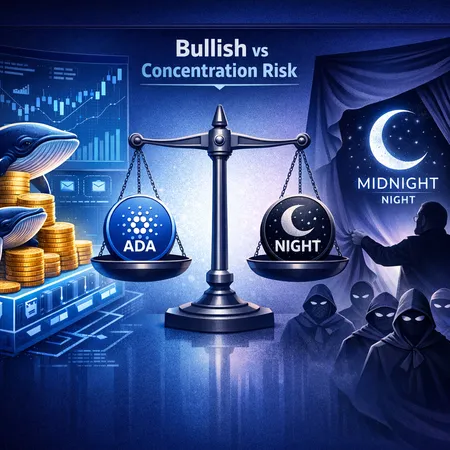
Concentration risk becomes a double‑edged sword. Higher concentration into a few wallets reduces circulating float for traders but increases market impact risk if any of those wallets re‑enter the market. For medium‑term investors this raises both upside (strong hands, less supply) and tail‑risk (single points of large sell pressure).
Staking and yield effects. Cardano’s staking model incentivizes locking ADA; if a portion of the accumulation went to staking pools, the effective liquid float shrinks further compared with tokens that remain easily traded.
Taken together, persistent accumulation by large holders can raise short‑term support levels and change volatility profiles — but only if the buying is sustained and the tokens are immobilized.
Comparing ADA accumulation to BTC’s slowdown
The contrast with Bitcoin behavior is instructive. Recent analysis noted that BTC accumulation slowed in February, suggesting more muted demand from large holders for BTC during that window (Cryptopolitan analysis). Yet broader adoption narratives for BTC remain intact — onchain adoption and usage metrics can stay strong even with temporary accumulation slowdowns (BeInCrypto coverage).
Why the divergence? A few hypotheses:
Narrative and utility differences. ADA’s ecosystem — with staking, ongoing protocol upgrades, and active developer incentives — gives different buyers reasons to accumulate than BTC’s store‑of‑value narrative. Some buyers may prefer ADA exposure for on‑chain utility rather than pure macro hedge.
Buyer composition. BTC accumulation is often driven by institutional treasury allocations and macro funds; if those players paused purchases in February, BTC flows slowed. ADA accumulation might reflect whales and regional funds or long‑term holders opportunistically increasing positions, not the same cohort buying BTC.
Relative liquidity and market depth. ADA’s market depth is smaller than BTC’s. Large orders that look modest relative to BTC can move ADA materially, which creates more visible accumulation on snapshots of large‑holder balances.
In short, ADA’s accumulation could be opportunistic relative to BTC slowdown — but the on‑chain context (where tokens moved and stayed) determines whether it’s a one‑off response to lower prices or a structural shift.
Opportunistic dip buys or structural change in holder composition?
Distinguishing opportunistic buying from a structural change requires more than a single snapshot. Look for these sustained signals over weeks to months:
Exchange reserves trend. A multi‑week decline in exchange balances signals genuine off‑exchange custody. Temporary withdrawals followed by inflows are more consistent with trading activity.
Long‑term holder growth. Rising number and balance of addresses that haven’t moved coins in >1 year shows structural holder maturation.
Staking inflows. Increased stake participation — especially if validators receive new delegations — implies holders seeking yield rather than quick turnover.
Age bands and realized supply changes. If the share of ADA held in long‑age bands expands (older coins), that supports a narrative of structural shift.
If the 819M ADA accumulation shows up as exchange outflows and older coin cohorts expanding, that’s strong evidence for a durable change in holder composition. If it’s concentrated in a few trading custodial wallets or reverses quickly, it’s more likely opportunistic dip buying.
Practical support‑level thinking for medium‑term investors
Quantifying support is never exact, but on‑chain accumulation helps form defensible ranges:
Start from visible orderbook and recent liquidation bands, then layer on observed large‑holder absorption points. If large wallets accumulated at a given price window and tokens moved off exchanges, that window acts as a psychological and technical support zone.
Watch exchange reserves. A persistent decline in centralized exchange ADA typically tightens downside. Conversely, stable or rising reserves mean accumulation may be noncommittal.
Consider staking participation. High staking ratios reduce circulating supply for traders, amplifying the price effect of new demand.
Remember: concentrated accumulation can create both stronger support and higher systemic risk if those concentrated holders decide to rebalance.
Signals to monitor now
On‑chain analysts should track a short list of indicators to test whether this accumulation changes ADA’s profile:
- Centralized exchange ADA balances (7‑day and 30‑day trends).
- Net flows into known large addresses and clustering attribution (custodial vs noncustodial).
- Staking pool delegation growth and newly locked ADA volumes.
- Age‑band distribution (coins dormant >1y, 6–12 months, <3 months).
- Realized cap and MVRV shifts for mid‑term re‑risking signals.
Also cross‑reference macro/sector flow data. If broader risk appetite returns and BTC accumulation resumes, ADA could see follow‑through — but if BTC buys stay muted while ADA accumulation persists, that suggests asset‑specific demand.
What this means for investors: risk/reward reframing
If the accumulation sticks (off‑exchange, staking, longer coin age), ADA’s available tradable float decreases and medium‑term volatility may compress around higher support. That improves the risk/reward for buyers who believe in Cardano’s fundamentals. But if accumulation is a series of opportunistic trades concentrated in a handful of wallets, the apparent support is fragile and the risk of sudden re‑sales remains meaningful.
For medium‑term portfolios, practical steps:
- Treat the 819M ADA figure as a directional signal, then verify with exchange reserve and age‑band trends.
- Use position sizing to account for concentration risk — don’t over‑leverage based solely on headline accumulation.
- Monitor staking inflows: higher staking ratios argue for lower effective float and higher optionality value for holders.
Bitlet.app users who track holdings or P2P flows may find exchange balance monitors and wallet clustering useful in real time to validate whether accumulation continues.
Conclusion
Large holders adding 819 million ADA during a price drop is meaningful but not self‑sufficient evidence of a structural shift. The difference between opportunistic "buy the dip" behavior and a durable change in holder composition lies in where those tokens end up and whether accumulation persists. Compared to BTC’s February slowdown in accumulation, ADA’s pattern could reflect different buyer cohorts, incentives from staking, and shallower market depth.
For on‑chain analysts and medium‑term investors the right approach is empirical: track exchange reserves, coin age, staking flows and clustering attribution over weeks. If those metrics confirm continued off‑exchange immobilization, ADA’s supply dynamics and support bands change materially — improving the token’s mid‑term risk/reward. If not, treat the 819M figure as a tactical opportunity rather than a structural narrative shift.
Sources
- Large Cardano holders add 819 million ADA as price falls 71% — U.Today
- BTC accumulation slowed down in February — Cryptopolitan
- Bitcoin adoption surges despite price decline — BeInCrypto
For additional reading on on‑chain indicators and tracking, see related pieces on Cardano and Bitcoin.