Reading Ethereum’s 2026 Strawmap: Faster Slots, Finality Cuts, Post‑Quantum and What It Means for Validators
Summary
Why the 2026 strawmap matters
The Ethereum Foundation’s 2026 “strawmap” — described in a summary of seven planned forks through 2029 — is more than a list of feature releases; it sets a directional thesis for how L1 latency, safety, and long‑term security will evolve. The EF framing (and Vitalik Buterin’s own breakdown) highlight three visible themes for the next few years: reduce settlement latency, tighten finality, and prepare the protocol for post‑quantum risks. Those themes are technical, but they have direct market consequences for ETH, validators, and the throughput/cost calculus of rollups and layer‑2s. For background, see the EF strawmap coverage in The Block and Vitalik’s technical notes on the plan.
For many readers the immediate question is practical: how will faster slots, finality reduction, and post‑quantum planning change validator workloads, staking pressure, and the economics of Layer‑2s that rely on L1 settlement? This article unpacks the likely tradeoffs and a working timeline for the seven forks, citing Vitalik’s rationale and recent market developments.
Technical highlights and immediate implications
Faster slots: what is changing and why it matters
“Faster slots” refers to reducing the time between block proposal opportunities (slots). The EF strawmap and Vitalik’s notes present this as a lever to lower latency for confirmations and for rollup sequencers waiting on L1 inclusion. Shorter slots will:
- Lower L1 confirmation latency and reduce end‑to‑end rollup settlement delays.
- Increase the number of proposals and attestations per wall clock time, raising throughput pressure on validators and networking.
On net, faster slots help layer‑2 throughput by making L1 availability and finality happen sooner—an obvious win for rollups and many DeFi use cases that care about tight settlement windows. But the tradeoff is engineering: client teams must reduce propagation latency, optimize gossip, and handle a higher message rate without raising orphan/uncle rates or centralizing block production.
(See Vitalik’s breakdown for the technical justification and design options.)
Finality reduction: the safety/latency tradeoff
“Finality reduction” here means reducing the time to irreversible finality under the proof‑of‑stake finality gadget. Shorter finality accelerates the point at which blocks become non‑reorgable — a clear benefit for rollups and custodial services that prefer predictable settlement windows. However, faster finality tightens the timing assumptions validators must meet and reduces slack for recovery after network partitions or slow peers.
That implies stricter network performance SLOs for validator operators and potentially a re‑balance in rewards/penalties to keep liveness and safety aligned. The strawmap indicates this is a priority because it compounds the user‑visible gains of faster slots.
Post‑quantum planning: slowly baking in long‑term resilience
Post‑quantum readiness is less about immediate throughput and more about future‑proofing key cryptographic assumptions. The EF is signaling a conservative, incremental approach — likely hybrid signature schemes and upgrade paths that allow off‑chain and on‑chain coordination for key rotation.
Operationally this means:
- Validators and custody providers will need to plan key management migrations and software upgrades across a multi‑year horizon.
- There may be cost impacts (larger signatures, more verification work) and short‑term complexity as clients adopt hybrid verification paths.
Vitalik frames this as a long arc — prepare now, deploy carefully — because a rushed approach to post‑quantum keys could introduce more risk than the threat it mitigates.
Layer‑1 performance, layer‑2 throughput, and fees
The immediate user‑facing stories are lower latency and better rollup settlement. Faster slots + reduced finality shortens the settlement window, which benefits optimistic and ZK rollups that use L1 for final settlement or fraud proofs.
But will fees drop? Not necessarily in the short term. L1 gas capacity is still a function of block gas limits and how execution environments change. Faster slots increase the rate at which gas can be consumed per real second, which can raise effective throughput for bursts — but persistent base fee dynamics depend on demand. In practice:
- Expect rollups to get lower per‑transaction latency, which could increase demand (more short‑lived interactions that previously felt too slow).
- Higher demand can keep gas fees elevated even as L1 becomes more responsive.
- The main fee relief story is still modularity and rollup optimizations (sequencing, calldata compression), which the strawmap complements rather than replaces.
For rollup teams and L2 operators, the roadmap reduces the latency tax on finalization and enhances UX (fewer seconds/minutes for withdrawals and state finalization). But architects should not assume faster slots alone will solve fee economics — it’s one axis among many.
Validator economics and staking dynamics
Faster slots and reduced finality change the workload, which feeds back into validator cost, reward profiles, and staking pressure.
Key points:
- Operational costs rise: higher CPU, memory, and network requirements to process more attestations and proposals per unit time. Validator hardware or cloud profiles may need upgrading.
- Risk posture tightens: shorter finality reduces recovery windows after downtime; smaller maintenance windows mean operators must invest in redundancy.
- Rewards vs. penalties: protocol parameter tuning may shift effective APRs; if the network demands higher uptime, smaller validators may struggle, producing modest centralization risk.
Staking pressure — the balance of ETH being staked vs liquid supply — is also shaped by macro flows. Two market forces are in play right now: ETF inflows that have lifted ETH demand and, separately, Ethereum Foundation/EF‑related sales that have been larger than earlier plans. CryptoPotato’s coverage connects renewed ETH volatility and spot ETF inflows with price movements, while reporting indicates EF sales have at times been elevated. Those two forces intersect in a straightforward way: higher demand from ETFs can soak up supply, but outsized foundation sales can create episodic supply pressure.
For staking providers and long‑term holders, the practical takeaway is to build scenarios: if ETF inflows persist, staking yields can compress as price rises; if foundation sales recur at scale, short‑term price pressure could increase unstaking activity. Either way, validator operators should stress‑test for higher infrastructure costs and tighter uptime targets.
(See reporting on ETF inflows and EF sales for context.)
Client teams: implementation, testing, and coordination
Client teams shoulder much of the technical risk of faster slots and reduced finality. The most important engineering workstreams will be:
- Network and gossip optimization to keep propagation latencies under the new slot time.
- Consensus layer tuning and stress testing to avoid harmful reorg behaviors under shorter finality windows.
- Interop testnets and long running canaries to simulate multi‑client behavior and failure modes.
Post‑quantum planning adds another axis: clients will need to support hybrid verification paths, tooling for key rotation, and auditable migration paths so that validators and custodians can update without mass coordination failures.
Client teams should also coordinate with staking providers and rollup developers — upgrades that look small to L1 can cascade into L2 assumptions (e.g., sequencer bundling cadence, fraud‑proof timing) so early cross‑stack planning is essential.
Timeline: the seven forks through 2029 (interpreting the strawmap)
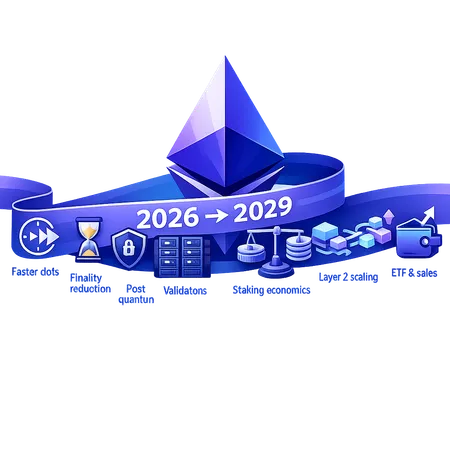
The strawmap lists seven forks through 2029; the EF frames these as a sequence of iterative improvements rather than one big hard fork. Based on the EF summary and Vitalik’s commentary, a pragmatic ordering and likely priorities look like:
- 2026 — Latency package (faster slots): early fork that reduces slot duration and improves propagation.
- 2026–2027 — Finality tuning: parameter changes and consensus gadget adjustments to shorten finality.
- 2027 — Client and sync improvements: state sync and light client improvements to keep nodes bootstrapping quickly under faster slots.
- 2027–2028 — Throughput and execution optimizations: gas cost tuning, calldata efficiency complements for rollups.
- 2028 — MEV/consensus polishing: improvements that reduce harmful MEV behavior and stabilize proposer economics.
- 2028–2029 — Post‑quantum tooling and hybrid signature support: phased deployment and key‑rotation facilities.
- 2029 — Polish and ecosystem coordination: catch‑up upgrades that require broad client/infra alignment.
This ordering reflects a bias toward visible UX wins first (latency/finality) and heavy‑lift compatibility work (post‑quantum) later. Vitalik’s explanation emphasizes that some features are cheaper to experiment with earlier (slots/finality), while post‑quantum needs careful staged rollouts.
Strategic takeaways for protocol engineers, staking providers, and holders
- Protocol engineers: prioritize networking, gossip, and interop test coverage. Expect to re‑benchmark under the new slot cadence and model worst‑case network partitions.
- Staking providers: build for higher uptime and redundant topologies; price in modestly higher opex and consider offering managed key rotation services for post‑quantum transitions.
- Long‑term ETH holders: monitor ETF flows and EF treasury sales as orthogonal supply/demand factors. Faster slots and reduced finality improve UX and utility — positive long‑term structural catalysts — but they also increase short‑term operational demands on the validator ecosystem.
Finally, teams building on rollups should work with L1 client teams early. The gains from the strawmap are real but require coordination across protocol, client implementers, sequencers, and staking operators to realize the UX benefits without increasing centralization risk.
Bitlet.app users and other ecosystem participants should watch the client release cadence and testnets closely; these upgrades are incremental but consequential.
Sources
- Ethereum Foundation publishes the strawmap outlining seven forks through 2029: https://www.theblock.co/post/391406/ethereum-foundation-researchers-publish-strawmap-outlining-seven-forks-through-2029
- Vitalik Buterin breaks down the strawmap and consensus changes: https://crypto.news/vitalik-buterin-breaks-down-ethereum-strawmaps-plan-for-faster-slots-and-finality/
- Coverage of ETH volatility and correlation with spot ETF inflows: https://cryptopotato.com/ethereum-volatility-explosion-why-eths-return-to-2k-might-be-a-turning-point/
- Reporting that Vitalik/EF ETH sales have been higher than planned: https://www.cryptopolitan.com/vitalik-buterin-almost-done-selling-eth/