Canton Network Milestone: Tokenized Deposits and On‑Chain Collateral Mobility for Institutions
Summary
What just happened: a practical milestone for institutional tokenization
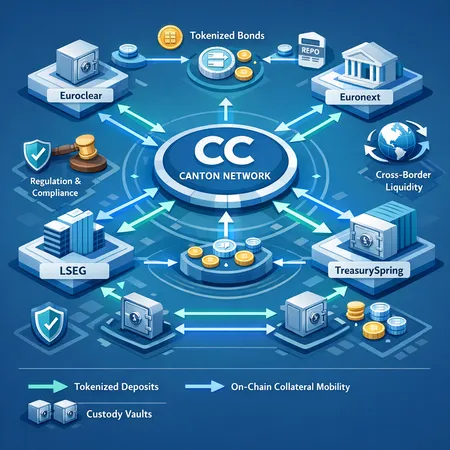
This January, the Canton Network — ticker CC in ecosystem conversations — announced completed transactions executed with a broadened membership that now includes heavyweights such as Euroclear, Euronext, LSEG and TreasurySpring. The public reporting of these transactions is more than PR: it shows multiple market infrastructure players are willing to connect, transact and validate tokenized representations of assets across private ledgers. Observers framed the event as confirmation that the technical and governance pieces are maturing; the announcement is summarized in coverage of the roll‑out and membership expansion here.
For institutional market infrastructure professionals this is not about shiny experiments. It’s a demonstration that tokenization rails can interoperate in ways that preserve institutional controls — custody, segregation, compliance — while enabling previously cumbersome flows like cross‑institution collateral movement. The news complements broader market forecasts about tokenized debt and TradFi adoption, as noted in a recent Cointelegraph analysis predicting tokenized bond issuance and institutional uptake in 2026 and beyond (see the Cointelegraph piece for context).Cointelegraph analysis
Why deposit tokenization and on‑chain collateral mobility matter
Tokenized deposits and on‑chain collateral mobility tackle concrete frictions in post‑trade plumbing: slow settlement cycles, limited intraday reuse of collateral, operational reconciliation burdens and cross‑border FX and liquidity frictions. Tokenization converts a legal claim or cash balance into a programmable digital token that can move across ledgers or be employed as collateral in smart contracts — while also being designed to sit within existing regulatory, custody and legal frameworks.
For banks and market infrastructures, the key attraction is not novelty but utility: tokenized deposits can be made auditable, atomic and instant (within the legal wrapper), enabling repo and securities financing transactions to settle faster and reuse collateral more efficiently. That matters for intraday liquidity management, capital efficiency and systemic resiliency — particularly when multiple infrastructures such as central securities depositories (CSDs), clearinghouses and custodians are participants.
How Canton Network enables cross‑institutional collateral movement
Canton’s architecture targets permissioned, cross‑ledger interoperability with a focus on institutional controls and privacy. Practically, that means members can move tokenized assets and deposit representations between counterparties without broadcasting sensitive positions to the public blockchain. In doing so, Canton addresses two institutional needs simultaneously: programmability and confidentiality.
Because Canton is designed to interface with regulated entities, its value proposition is not replacing existing custodians or CSDs but augmenting them — allowing custodians and CSDs to issue tokenized representations while keeping legal and operational controls intact. That structure makes cross‑institutional collateral mobility feasible: a token representing a deposit at Bank A can be used as collateral at Institution B under pre‑agreed legal and settlement rules, with the ledger recording movement in a way that is auditable for regulators and custodians.
Practical mechanics (high level)
At a high level, tokenized deposits on a network like Canton typically rest on these elements: a legal wrapper that defines the token as a claim on a custodian or issuing bank; a permissioned ledger that enforces counterparty and governance rules; and APIs or messaging standards that let treasury systems, custody platforms and clearinghouses integrate settlement flows. This combination preserves legal enforceability while enabling atomic swap and conditional settlement patterns that reduce settlement risk.
Use cases that matter now: tokenized bonds, repo and cross‑border liquidity
The most immediate, commercially attractive applications for institutional users are familiar workflows reframed with tokenized primitives:
Tokenized bonds: Issuers or CSDs can mint tokenized bonds that carry the same legal rights as conventional issues but can be split, settled and transferred on a permissioned ledger. Tokenized bonds reduce settlement latency, allow fractional distribution and simplify lifecycle events such as coupon payments and redemptions.
Repo and securities financing: Tokenized deposits or securities used as collateral can be moved programmatically between counterparties with atomic settlement logic. That reduces settlement fails and enables intraday reuse of collateral in a legally robust way, improving liquidity and lowering financing costs for dealers and asset managers.
Cross‑border liquidity and FX sweeps: Tokenized on‑chain deposits can act as liquid, programmatic claims that move across jurisdictions with fewer intermediaries, shortening liquidity corridors. For treasurers managing global cash, this can reduce reliance on multiple correspondent banking legs and speed up liquidity deployment.
These use cases are precisely where market commentators expect tokenization to scale next: for example, analysts have pointed to tokenized bond issuance as a near‑term growth area for TradFi token adoption, aligning with what Canton’s new member activity seeks to enable (see Cointelegraph’s outlook on 2026 trends).
Regulatory, legal and custody considerations institutions must weigh
Tokenization isn’t a purely technical upgrade; it requires careful legal and regulatory design. Key considerations include:
Legal characterization: Is a token labeled a 'deposit', a 'security token' or a contractual claim? The legal wrapper must be unambiguous so insolvency, priority and recovery rules are clear across jurisdictions.
Custody and segregation: Traditional custodians and CSDs play a critical role in custody models for tokenized instruments. Institutions need clear operational models for who holds the underlying claim, who controls keys, and how segregation is enforced on ledgered tokens.
Settlement finality and reconciliation: Platforms must provide settlement finality that is legally recognized by participants and regulators; mechanisms for dispute resolution and reconciliation need to be codified.
AML/KYC and counterparty screening: Permissioned networks change the threat surface, but do not eliminate KYC/AML obligations. Governance needs to include onboarding checks, ongoing surveillance and the ability to respond to regulatory requests.
Interoperability and standards: Integration with existing messaging standards (FIX, SWIFT ISO 20022) and with CSDs matters for adoption. Institutions will favor platforms that can map ledger events back into familiar operational workflows without introducing large manual processes.
These are not theoretical risks — they are practical gaps that the recent Canton transactions aim to address by engaging incumbent market infrastructures as members rather than displacing them. By involving authorities and CSD‑equivalents in the network, the probability of building legally sound, custodially robust token models increases.
What to evaluate when choosing a tokenization platform
For market infrastructure professionals and fintech strategists evaluating Canton Network or competing platforms, the diligence checklist should include:
- Governance and membership model: Who controls admission, upgrades and dispute resolution? Institutions need predictable governance.
- Legal wrappers and enforceability: Are token rights contractually explicit and recognized by involved jurisdictions?
- Custody model and key management: How do custodians and recovery processes operate? Is there a clear model for segregation and client protection?
- Integration effort and standards support: Can the platform plug into existing post‑trade systems, or will it require rip‑and‑replace?
- Privacy and auditability: Does the network provide confidentiality for sensitive positions while supplying auditable trails to regulators and auditors?
- Network effects and ecosystem participants: Are large CSDs, custodians and clearinghouses already participating (the recent joins by Euroclear, Euronext, LSEG and TreasurySpring are relevant here)?
Taking the next steps: pilots, legal proofs and operational readiness
The Canton milestone signals that pilots are progressing into shared live transactions, but adoption will still be iterative. Banks and infrastructures should start with limited pilots that test legal wrappers, custody flows and regulatory reporting. Treasury and operations teams must be involved early: tokenized assets change downstream accounting, collateral optimization logic and liquidity forecasts.
Where appropriate, institutions can run parallel systems for a transition period: keep traditional settlement rails while testing tokenized flows on Canton or comparable networks. This approach reduces operational risk and gives compliance teams time to validate reporting, auditability and AML controls.
For strategists, the message is clear: tokenization is moving from research into practical deployment, and platforms that combine regulatory awareness, custodian integration and cross‑ledger interoperability will win adoption. For practitioners wondering where to start, workstreams should include legal opinions, custodian pilots and integration of treasury and collateral management systems.
Conclusion: a pragmatic step, not a leap into the unknown
The Canton Network’s completed transactions and the onboarding of major market players are an important practical step toward mainstream institutional tokenization. The milestone validates that cross‑institution collateral mobility and tokenized deposits can be operationalized in ways that respect legal, custody and regulatory constraints. That said, the path to wide adoption is pragmatic and phased — it will require careful legal design, clear custody models, standards alignment and incremental operational change.
For market infrastructure professionals, the right posture is neither dismissive nor blindly enthusiastic: evaluate platform governance, legal wrappers and integration effort; run scoped pilots; and keep incumbent custodians and CSDs involved. As these rails mature, tokenized bonds, repo and on‑chain deposits will shift from theoretical efficiency to real operational levers for liquidity and capital efficiency.
Bitlet.app users and treasury teams assessing the next generation of post‑trade rails should monitor member adoption, legal opinions and early production use cases to decide when to move from pilot to scale.
Sources
- Canton Network transactions and membership expansion announcement: https://en.cryptonomist.ch/2026/01/15/canton-network-a-new-era-for-global-collateral-mobility-and-deposit-tokenization/
- Cointelegraph analysis on tokenized bond issuance and institutional adoption trends: https://cointelegraph.com/news/2026-sovereign-bitcoin-reserves-tradfi-tokenization-adoption-sygnum?utm_source=rss_feed&utm_medium=rss&utm_campaign=rss_partner_inbound
For technical background on how tokenized assets are beginning to interface with broader blockchain ecosystems, see discussions in DeFi and, for macro context on digital store‑of‑value narratives that influence institutional appetite, see Bitcoin.