Why LUNC Spiked After the Jane Street Lawsuit — Mechanics, Timeline, Risks
Summary
Quick overview: what happened and how markets reacted
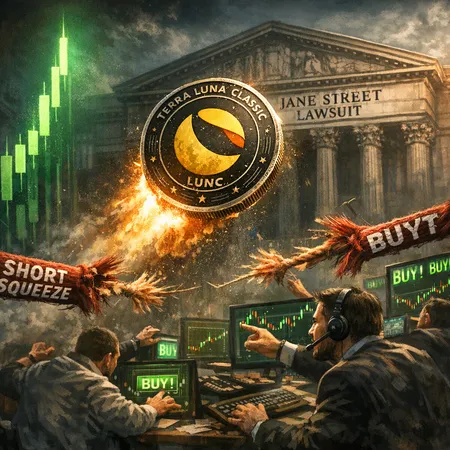
In the days after Terraform Labs’ bankruptcy administrator filed suit alleging market misconduct involving Jane Street, Terra Luna Classic (LUNC) staged a sharp, news‑driven pop. Coverage noted a late double‑digit percentage jump on the headline alone, and several outlets reported a one‑day move in the low‑to‑mid 20s percent range as traders piled in on the narrative (Decrypt coverage; Coinpedia report).
That jump was fast, concentrated, and highly sentiment‑driven: social media amplified the suit, retail and some speculative desks hunted for squeeze setups, and light order books turned a media headline into pronounced price action. For many traders, Bitcoin and macro risk appetite still matter — but this move was primarily local to LUNC liquidity and narrative momentum.
Timeline: from filing to spike (high level)
- Lawsuit filed by the bankruptcy administrator alleging complicity in trading strategies tied to the 2022 Terra collapse — the filing reintroduced old narratives and raised questions about potential recoveries.
- News outlets and crypto communities amplified the claim; traders scanned for short positions and leverage on exchanges.
- Concentrated spot buying, social momentum, and forced short covering compounded into a rapid rally observed across spot venues.
Media and market reaction were immediate. Coverage mentioning a late double‑digit pop first signaled attention to the case, then more detailed pieces tracked the intraday surge and trader commentary (Decrypt; Coinpedia).
Mechanics: short squeezes, spot‑buying, and why LUNC is especially vulnerable
Mechanically, several common ingredients turned a headline into a spike:
- Thin order books: LUNC’s spot liquidity can be shallow on many venues. A concentrated buy flow moves price far more than for a deep blue‑chip token.
- Short positions and derivatives: If enough traders were short on margin or using perpetuals, a rapid price uptick forces margin calls. Margin calls trigger automated buy‑backs by exchanges or stop orders from desks, which feed the rally further — a textbook short squeeze.
- Social amplification and coordinated spot buys: Retail traders or trading groups can intentionally or unintentionally push buys into this thin liquidity, intentionally hunting squeezes.
Put together: a legal headline prompts speculative buying → price rises → short sellers cover into the move → price rises more. Because LUNC’s on‑chain fundamentals (supply, burn mechanics) didn’t change instantly, the rally was primarily mechanical and sentiment‑driven.
Historical context: the 2022 collapse and why Jane Street appears in the narrative
The 2022 Terra collapse remains one of crypto’s defining blowups — algorithmic UST de‑peg, LUNA hyperinflation, massive losses. In the aftermath, many market participants and observers searched for blame and causal chains. Jane Street, a large quantitative trading firm and active market‑maker, has been named in narratives alleging aggressive shorting or certain trading patterns that worsened price moves.
The recent lawsuit revived those claims and prompted headlines asking whether historical trading activity materially caused the crash. Analytical takes even asked whether a firm’s role could imply upside for LUNC if culpability were proven and damages awarded (Coinpedia analysis). But a few cautions:
- Allegation ≠ proof: Legal filings make claims that must be established in court. Markets often price narratives before facts are proved.
- Even if liability were found, translating a legal judgment into market value for a fungible token is complex. Recovering damages, converting them to token buys, or directing restorations to token holders are long, uncertain processes.
So while Jane Street’s name is central to the story, legal proceedings and debates over causation are not the same thing as immediate on‑chain economic change.
Does the lawsuit change LUNC’s on‑chain economics — or just sentiment?
In short: primarily sentiment. Court action can alter incentives or lead to future flows, but it does not instantaneously alter the smart contracts, supply, or burn schedules that govern LUNC on‑chain.
Concrete reasons why on‑chain economics remain unchanged for now:
- Token supply and smart contract behavior are not modified by a lawsuit; any protocol change requires governance or on‑chain interventions.
- Even if a judgment produces recoverable funds, converting legal outcomes into coordinated token burns or redistribution faces legal, logistical, and custodial hurdles.
- What does shift quickly is expectation: traders price the prospect of future remedies or reputational fallout, and that expectation can lift price absent any on‑chain change.
That means the rally can be durable only to the extent new information supports sustained buying (e.g., clear legal milestones, asset recoveries, or binding settlements), otherwise it risks fading once attention shifts.
Trading strategies and practical risk management
For active traders and legal‑market watchers deciding whether to trade or HODL LUNC after a news‑driven spike, here are tactical approaches and guardrails.
Position sizing and allocation
- Treat LUNC as a speculative, high‑volatility allocation. Use a small fixed percentage of portfolio capital (e.g., single‑digit percent) for news‑driven trades.
- Avoid outsized exposure. If you intend to HODL through legal outcomes, keep that position size limited to money you can afford to lose.
Entry and exit methods
- Prefer limit orders on the bid to avoid chasing. On spikes, market buys can drastically increase execution cost.
- Use staggered entries (scale into a position) and phased exits (take partial profits at set levels) to manage slippage and reduce knee‑jerk decisions.
Leverage and derivatives
- Avoid or minimize leverage. Perpetuals amplify both upside and the margin‑call vulnerability that fuels violent whipsaws.
- If using derivatives to express a view, size conservatively and set clear stop‑losses.
Horizon and strategy types
- Short‑term scalp/swing: Seek to trade the squeeze momentum, target quick profits, and set tight stops — news fades fast.
- Event watch/earn: Monitor legal milestones; shift from trading to a longer hold only if a credible, enforceable recovery path appears.
- Contrarian cold‑take: An advanced play is to fade overextensions after the momentum exhausts, but this requires discipline and liquidity to execute.
Monitoring and indicators
- Watch open interest on derivatives, funding rates, and order book depth; rising funding and shrinking depth are classic squeeze signals.
- Track on‑chain flows and exchange deposits/withdrawals for LUNC; sudden inflows to exchanges can presage selling, while withdrawals can indicate accumulation.
Risk controls and checklist
- Define your maximum loss and stick to it. Use stop‑losses or automated position reductions.
- Be mindful of news risk: single headlines can reverse momentum. Avoid being the last buyer into thin liquidity.
- Use cold storage for any allocated long‑term HODL if you plan to hold through legal uncertainty.
Platforms and execution
- Use reputable venues with transparent order books. Traders on centralized and P2P platforms (including services like Bitlet.app) should check withdrawal and custody rules before committing large exposure.
When might this move be sustainable?
A sustained repricing of LUNC would likely require one or more of the following:
- Legal clarity that leads to tangible asset recoveries and a legally enforceable mechanism for value restitution to token holders; or
- A sustained, broadening buyer base beyond speculative retail momentum (e.g., funds or institutions placing material capital at multiple price levels); or
- Protocol‑level changes enacted via governance that materially alter token economics.
Absent those, rallies tied purely to headlines and short squeezes often retrace or enter protracted chop once the immediate attention wanes.
Bottom line for traders and watchers
The Jane Street lawsuit ignited a classic crypto narrative trade: allegation → social amplification → concentrated spot buying → short covering → rapid rally. Mechanically, it was a short squeeze amplified by thin liquidity and sentiment. Legally, the filing is significant for the long‑term story, but it does not immediately change on‑chain fundamentals.
If you trade LUNC now: be tactical, size small, respect liquidity, and treat positions as event‑driven. If you HODL expecting legal remedies to restore value, accept the timeline is long and uncertain — legal vindication does not automatically translate to token price upside.
For active traders, tracking derivatives data, exchange order books, and courtroom milestones will separate opportunistic wins from being caught in a pump‑and‑dump. And remember: narratives move prices quickly; they also reverse quickly.
Sources
- Decrypt: Jane Street lawsuit fuels late double‑digit pop in Terra Luna Classic — https://decrypt.co/359367/jane-street-lawsuit-fuels-late-double-digit-pop-in-terra-luna-classic
- Coinpedia: Terra Luna Classic surges 24% today amid Jane Street lawsuit — https://coinpedia.org/news/terra-luna-classic-surges-24-today-amid-jane-street-lawsuit/
- Coinpedia analysis: Will LUNC go up 100x if Jane Street caused the 2022 Terra crash? — https://coinpedia.org/news/will-lunc-go-up-100x-if-jane-street-caused-the-2022-terra-crash/