Why Aave's $1B in Tokenized RWAs Is a Turning Point for DeFi Lending
Summary
Why $1B in Tokenized RWAs matters
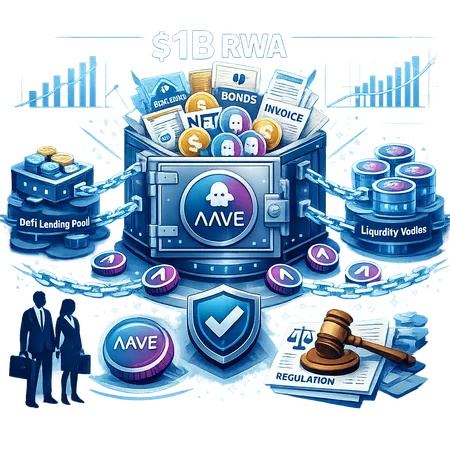
Aave crossing the $1 billion mark in tokenized real‑world asset (RWA) deposits is a watershed for DeFi lending. It's the clearest market signal yet that on‑chain protocols can attract sizable off‑chain capital without entirely abandoning composability or permissionless access. This milestone matters because it shifts the default assumption about the nature of collateral and liquidity on lending markets: crypto‑native collateral is no longer the only source of depth.
For practitioners and asset managers, the headline is both opportunity and a cautionary tale. Tokenization unlocks new yield curves and risk profiles, but it also forces careful thinking about legal claims, operational custody, oracle integrity, and governance. Institutional macro trends—like sustained allocations into crypto vehicles—help explain the inflows: for example, continued institutional appetite evident in reports about billions still invested in U.S. Bitcoin ETFs underscores that allocators have capital and distribution channels that can move into tokenized credit and structured products 53 billion still invested in US Bitcoin ETF.
What are RWAs and how does tokenization work?
Tokenized RWAs are on‑chain tokens that represent rights to economic value backed by an off‑chain asset or cash flow. Typical mechanics include:
- Legal wrapper: an SPV, trustee, or regulated issuer holds the underlying asset (mortgage pool, receivables, bonds) and issues tokens representing claims on future cash flows. The legal wrapper defines enforceability, bankruptcy remoteness, and investor rights.
- On‑chain representation: ERC‑20 or similar tokens track ownership and can be transferred, fractionated, and used as collateral in protocols like Aave.
- Oracles and attestations: periodic attestations and price oracles bridge the economic state of the asset (valuation, delinquencies, interest receipts) to the chain.
- Custody and servicing: custodians or servicers collect payments and provide reports; smart contracts rely on these off‑chain actors to maintain expected cash flows.
This hybrid stack—legal + technical—is what differentiates RWAs from a purely on‑chain lending market. Tokenization is not just digitizing value; it is creating a cross‑domain dependency between traditional finance processes and blockchain settlement rails.
How Aave’s $1B landmark alters counterparty and liquidity assumptions
Historically, DeFi lending assumed collateral would be native digital assets: ETH, stablecoins, tokenized BTC, etc. Those assets share common properties—real‑time transfers, open price discovery, and fully on‑chain enforceability. RWAs change that calculus.
- Diversified liquidity sources: RWAs bring capital from asset managers, family offices, and institutional treasuries that may prefer cash‑flow backed yield over crypto volatility. That increases the total addressable liquidity and can reduce interest rate volatility on borrowing markets—especially for productized RWA tranches.
- New counterparty layers: Instead of trusting counterparty X on‑chain, lenders now rely on SPVs, custodians, trustees, originators, and auditors. The credit risk profile shifts: protocol-level insolvency is one concern, but the more subtle failures involve originator misreporting, custodian fraud, or legal challenges to claim enforceability.
- Liquidity mismatch & redemption mechanics: Because RWAs are driven by periodic cash flows and may not be instantaneously liquid, Aave must manage liquidity differently. Expect dedicated tranches, liquidity buffers, and pricing models that account for settlement lag and haircuts.
- Collateral fungibility: A $1B RWA pool does not automatically mean seamless on‑chain fungibility. Different asset classes (commercial paper vs. residential mortgages) carry distinct correlations and recovery assumptions. Market makers and risk‑teams on Aave will likely segment pools or introduce bespoke risk parameters per asset family.
Practically, Aave’s milestone reduces one behavioral bias—overreliance on crypto‑native liquidity—but it elevates operational risk management and counterparty diligence as core protocol functions.
Regulatory, auditing, and legal considerations
Tokenized RWAs live at the intersection of securities law, custody rules, and payments infrastructure. For asset managers and protocol engineers, the checklist grows:
- Legal enforceability: Is the tokenized instrument recognized in jurisdiction X as a valid claim on the underlying? That depends on the quality of the SPV structure, trustee agreements, and local property/contract law.
- Securities risk: Many tokenized cash flows could be construed as securities; compliance with prospectus rules or exemptions is essential.
- Custody & AML/KYC: Originators and custodians will be scrutinized for AML controls and proof of asset provenance. On‑chain anonymity complicates audits and regulator comfort.
- Auditability & proof of reserves: Regular, attested audit reports—ideally from reputable third parties—are becoming table stakes. On‑chain proofs (merkleized accounting, payment attestations) combined with off‑chain audit reports create a stronger trust story.
- Oracles and data integrity: Price feeds and performance metrics must be robust against manipulation. Combining multiple data sources, attestation cadence, and slashing incentives for bad oracles are practical mitigations.
- Bankruptcy remoteness & recovery frameworks: In a default, how quickly can token holders enforce claims? Protocols must plan for dispute resolution, cross‑jurisdictional enforcement, and potential freezing of tokens during litigation.
Aave’s growth in RWAs makes these regulatory conversations unavoidable. Protocol teams, originators, and institutional participants will need aligned standards—legal templates, audit checklists, and operational SLAs—to scale safely.
Implications for AAVE token dynamics and protocol economics
Tokenized RWAs can influence AAVE in several levers:
- Fee and revenue expansion: More deposited assets generally mean more interest and fee revenue. If Aave captures origination or servicing fees for RWA markets, protocol treasury inflows could grow, strengthening the balance sheet behind AAVE token incentives.
- Demand for safety capital: RWAs introduce credit risk that the Safety Module (or similar backstops) may need to cover. That could alter staking economics—higher perceived systemic risk might push up staking yields to attract coverage capital.
- Governance complexity: Onboarding RWAs requires governance frameworks for asset approval, risk parameters, and emergency measures. AAVE governance will face harder decisions about which originators and jurisdictions are acceptable.
- Market perception and token utility: Successful RWA integration may increase AAVE utility—used for fee discounts, governance weight, or protocol insurance—boosting demand. Conversely, any high‑profile RWA failure could raise regulatory scrutiny, negatively impacting token sentiment.
Net effect: token dynamics will be more tightly coupled to the protocol’s real‑world risk management and compliance posture than before.
Paths for RWA growth over the next 3–5 years: scenarios
Below are three plausible trajectories for RWA adoption, each driven by different levers.
Conservative (slow, regulated buildout)
- What happens: Adoption grows steadily as legal frameworks and industry standards coalesce. Institutional originators pilot carefully, preferring higher‑quality, short‑dated paper and fully vetted SPVs.
- Drivers: Clear regulatory guidance, visible audit standards, and conservative underwriting.
- Outcome: RWAs become a stable portion of lending books (low‑single digit share of total DeFi TVL) with limited optionality but attractive yield for cautious allocators.
Base case (measured scaling and productization)
- What happens: Standardized legal wrappers and modular servicing let more originators plug into pools. Tranching and secondary markets for tokenized credit mature, enabling better price discovery and liquidity. Institutions allocate via custody‑partner integrations and on‑ramps.
- Drivers: Interoperable legal templates, reliable oracles, distributed custodial networks, and growing institutional distribution channels—similar to how ETF infrastructure enabled rapid Bitcoin allocations. See how institutional appetite in other crypto products persists in market reports like this analysis of ETF capital 53 billion still invested in US Bitcoin ETF.
- Outcome: RWAs capture meaningful market share (mid‑teens of DeFi lending volumes), spawn specialized desks, and generate repeatable protocol revenue for Aave.
Aggressive (rapid institutionalization and composability boom)
- What happens: Major banks, asset managers, and insurers actively issue tokenized products at scale. Secondary markets for RWA tokens become liquid, enabling instantaneous reuse as collateral and powering new structured on‑chain products.
- Drivers: Regulatory clarity, custodial innovations, and platforms offering turnkey tokenization services with enterprise SLAs. Broad institutional networks funnel large pools of capital on‑chain for yield and operational efficiency.
- Outcome: RWAs shift DeFi’s center of gravity—collateral mixes tilt away from pure crypto, and protocols like Aave become core plumbing for institutional credit intermediation. Growth could accelerate beyond the $1B milestone into tens of billions over a few years.
Which path materializes will depend on operational fidelity—not just marketing or technical novelty.
Practical guidance for asset managers and DeFi practitioners
If you're researching tokenized yield or productizing real‑world collateral, consider these practical steps:
- Start with a rigorous legal wrapper: prioritize bankruptcy remoteness, trustee clarity, and jurisdictional certainty.
- Build audit and attestation cadence into the product: monthly attestations and quarterly audits from well‑known firms reduce counterparty skepticism.
- Design for liquidity gaps: tranche products, maintain buffer reserves, and define emergency unwind procedures in advance.
- Integrate proactive oracle strategies: diversify data sources, set realistic update cadences, and use on‑chain dashboards for transparency.
- Align incentives with protocol governance: ensure fee sharing, risk‑adjusted rewards, and clear remediation paths are codified before listing.
Platforms across the ecosystem—everything from specialized custody stacks to consumer rails like Bitlet.app—will watch these developments closely because successful RWA rails broaden the wholesale market for tokenized yield.
Conclusion: a milestone, not a finish line
Aave’s $1 billion in tokenized RWAs is a clear sign that DeFi can bridge to traditional finance at scale. But the milestone is an inflection point, not a guarantee. The next phase is about building durable legal templates, operational transparency, and market infrastructure that can support diverse asset classes and institutional counterparties. Achieving that will determine whether RWAs are a niche complement or the backbone of the next generation of on‑chain lending.
For practitioners and asset managers, the opportunity is real—but it requires marrying rigorous off‑chain procedures with on‑chain composability and governance.