Bitcoin’s $257M ETF Inflow vs Rising Risk: Reading Flows, GEX and Macro for 3–6 Month Trades
Summary
Quick take
A single day of heavy demand—roughly $257.7M of net inflows into U.S. spot Bitcoin ETFs—grabbed headlines and briefly re‑energized institutional narratives. That rotation was concentrated and led by big managers, yet it arrives against a backdrop of on‑chain warnings and macro signals that argue the market is entering a higher‑risk window. This piece ties the ETF flow mechanics to options‑market structure (GEX/liquidity zones), on‑chain sell‑side metrics, and the macro credit story so traders can build actionable 3–6 month scenarios.
What happened with ETF flows, and who led the move?
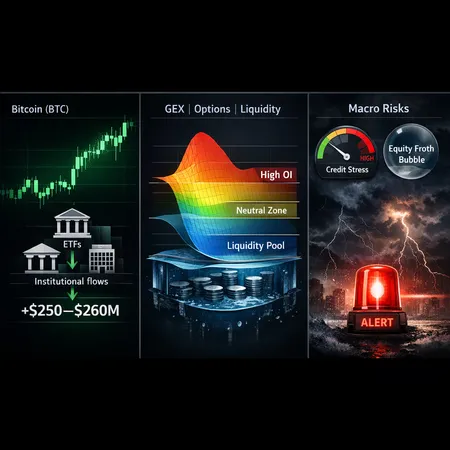
On the most recent big day, spot Bitcoin ETFs recorded a roughly $250–$260M net inflow, with detailed reporting putting the figure at about $257.7M. Flow attribution matters: industry reporting shows Fidelity and BlackRock among the managers leading the inflows, and a handful of other large issuers also contributed to the lump sum. See coverage in Cointelegraph and Invezz for manager‑level notes and the day’s flow math.
Why that matters: institutional flows are not homogeneous. Large managers can concentrate demand in short windows, creating flow‑driven price moves that look convincing but may be fragile if not followed by sustained secondary buying. For traders this means treat single‑day ETF inflows as an informative pulse—not a guarantee of trend continuation.
Flow mechanics and short‑term implications
ETF inflows raise on‑exchange liquidity needs: authorized participants must source BTC, moving supply from exchanges or OTC desks into custodial warehouses. That process can suck liquidity—pushing spot higher—while ephemeral. Conversely, if macro indexes wobble, the same channels can invert: ETFs fund redemptions that release BTC back to the market.
A few operational notes for traders:
- Concentration risk: inflows led by one or two managers increase the chance of quick reversals if those participants pause. Cointelegraph’s article highlights Fidelity and BlackRock’s roles in steering the recent flows.
- Liquidity footprint: the magnitude of an inflow relative to daily average traded volumes matters; a $250M day is material but still small versus global derivatives open interest.
- Narrative impact: flows attract headline momentum, which often draws short‑term speculators and reduces perceived tail risk—until macro or on‑chain signals reassert themselves.
Options, GEX and the critical BTC price bands
Options market structure provides a map of where liquidity and dealer hedging might amplify moves. The Coinbase Institutional GEX analysis frames two notable reference zones near $60k and $82k. Those levels are not mystical; they represent concentrations of options gamma and hedging flows that dealers must manage.
When implied gamma is clustered, dealers’ delta‑hedging can either damp volatility (if positioning is one‑sided and stable) or accentuate moves once the market crosses a strike and hedges flip. Blockonomi’s summary of the GEX report makes this clear: options positioning is a volatility magnet around those bands.
Practical reads:
- Expect increased realized volatility when BTC approaches and crosses the $60k or $82k zones, because dealer rebalancing can add momentum in the same direction. That can work for you or against you.
- Watch open interest and put/call skew near those strikes; a sudden shift (big put buying, open interest dropping) will signal dealer risk transfer and potential liquidity stress.
- Combine ETF flow tracking with options orderflow: if inflows push price toward a GEX flip, dealers will hedge more aggressively, potentially creating short squeezes or fast mean reversion.
On‑chain and market‑structure warnings: extended sell‑side pressure
Short‑term bounces can be seductive, but on‑chain analysis is flagging caution. Glassnode and market‑structure commentary (summarized by Crypto.news) indicate extended sell‑side pressure remains present despite price upticks. Metrics such as realized volatility divergence, exchange inflows/outflows and long‑term holder behavior suggest the supply side hasn’t fully capitulated.
That dovetails with a longer macro warning: CryptoSlate argues Bitcoin is entering a high‑risk window as credit stress accumulates beneath a richly valued equity market. In other words, the crypto rally could be vulnerable if a broader credit event or equity repricing forces liquidity to squeeze across risk assets.
The macro overlay: credit stress, equity froth and contagion risk
Three macro points matter for the next 3–6 months:
- Credit stress building beneath the surface means previously calm risk markets can amplify declines once a trigger occurs. Crypto is not immune to that cross‑asset liquidity pullback. See CryptoSlate for a deeper take on this dynamic.
- Equity market froth (record breadth and valuations) raises the probability of a mean‑reversion event that would likely hit levered credit and risk‑on assets first. That could reverse ETF inflows quickly if institutions rebalance.
- Central bank cues remain a wildcard—any hint of tighter financing conditions or unexpected rate persistence would worsen funding stress and squeeze levered crypto exposure.
Together, these macro dynamics increase the odds that the next large move in BTC could be to the downside absent sustained, diversified bid.
Integrated scenarios for the next 3–6 months (actionable for traders)
Below are three pragmatic scenarios, with triggers and trade ideas. Each combines ETF flow patterns, GEX/options signals, on‑chain metrics and macro indicators.
Scenario A — "Institutional Thaw, Controlled Melt‑Up" (base, 40% probability)
- Trigger: 3–5 consecutive trading days of net ETF inflows totaling >$500M, accompanied by declining exchange inventory and subdued equity volatility.
- Price mechanics: steady buying drives BTC toward the $82k gamma zone; dealer hedging initially compresses volatility but results in a breakout if flows sustain.
- Trade ideas: staggered long exposure into strength, sell verticals (call spreads) to monetize premium near $82k, use trailing stops below $60k. Keep position sizing modest and hedge with short dated puts if leverage is used.
Scenario B — "Macro Reprice, Panic Unwind" (bear, 35% probability)
- Trigger: sudden spike in credit spreads or equity drawdown (e.g., 5–7% S&P drop) with ETF net flows reversing into red and on‑chain evidence of increased exchange inflows.
- Price mechanics: dealer unwind and forced selling push BTC down through $60k, where options‑driven selling accelerates moves (GEX flips amplify downside gamma).
- Trade ideas: favor protective puts, buy deep‑OTM put spreads that become cheaper after the first leg, or trade mean‑reversion bounces with strict stops. Consider reducing spot exposure and avoid adding at the first sign of a GEX flip.
Scenario C — "Rangebound Chop, Technical Volatility" (tail, 25% probability)
- Trigger: ETF inflows are episodic (one‑off large days) with no consistent follow‑through; GEX zones hold as soft caps/floors and macro remains uncertain.
- Price mechanics: BTC trades between $54k–$78k with frequent whipsaws; dealer hedging keeps price boxed until a larger macro or flow catalyst arrives.
- Trade ideas: trade premium decay strategies (shorter‑dated iron condors or strangles sized conservatively), scalp option gamma, and use on‑chain alerts to avoid adding into sudden exchange inflows.
How to operationalize risk management now
- Use flow triggers, not headlines: build rules like “pause sizing if two consecutive ETF days show net outflows >25% of prior week inflows.”
- Monitor GEX and options skew daily: a flip in dealer net‑gamma near $60k/$82k should be treated as a volatility activation event. The Coinbase Institutional GEX summary is a good reference for the key bands to watch.
- Watch exchange inventory and large wallet movements: on‑chain sell pressure often shows up before price capitulation. Glassnode‑style metrics that flag extended sell‑side pressure remain relevant.
- Size for cross‑asset shocks: if credit spreads widen, reduce directional leverage across the book. Liquidity dries quickly; plan exits in advance.
- Use defined‑risk options to hedge rather than levered spot when macro stress is ambiguous.
Practical checklist for traders (daily/weekly)
- Daily: scan ETF flows (who’s buying), exchange flows, and GEX direction near critical strikes. Track headlines from major ETF managers—big issuers can move the needle. (See the Cointelegraph and Invezz flow breakdowns for examples.)
- Weekly: examine macro credit indicators and equity breadth; if credit stress metrics worsen, tighten stop policies and increase hedges.
- Event driven: before major macro releases or Fed remarks, flatten or hedge directional positions—funding and margin calls can amplify moves.
Final thoughts
The $257.7M inflow day is an important data point: it tells us that institutional interest can still show up in force. But flows are one piece of the puzzle. Pairing ETF signals with options market anatomy (GEX), on‑chain supply dynamics and macro credit indicators gives a more complete risk picture.
For macro‑focused crypto investors and traders, that means treating big inflows as conditional bullish signals that require confirmation: sustained follow‑through, falling exchange inventories and benign credit markets. Tools like options hedges, careful sizing and active monitoring of liquidity zones around $60k and $82k will help manage the inevitable volatility.
Bitlet.app users and other traders should incorporate these layered signals into their dashboards rather than relying on any single headline to justify large directional positions.
Sources
- Invezz: Bitcoin ETFs are back — $258 million in 24 hours recorded amid institutional market comeback
- Cointelegraph: Spot Bitcoin ETFs $257M inflows — Fidelity and BlackRock leadership noted
- CryptoSlate: Bitcoin enters a high‑risk window as credit stress builds beneath a record stock bubble
- Crypto.news: Bitcoin bounce shaky — Glassnode flags extended sell‑side pressure ahead
- Blockonomi: Why Bitcoin’s next big move hinges on $60k and $82k according to Coinbase Institutional’s GEX report
For many traders, Bitcoin still acts as the primary bellwether, and linking ETF flows with options and macro signals will be the difference between a well‑timed trade and a costly lesson.